Tag Archives: Jesus

Thoughts on Singing and Evolution

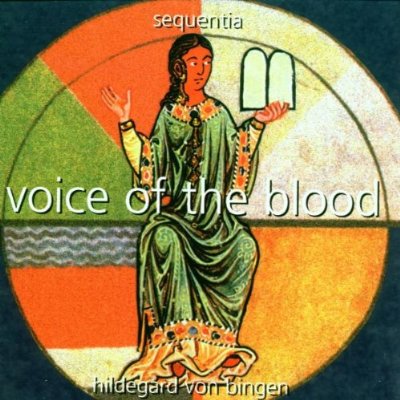
Cover from the “Voice of the Blood” cd, Hildegard of Bingen (from Amazon.com).

In church last weekend the thought came to me that the beauty of human singing is an example of a God given gift or virtue.  How can singing, beautiful singing, be considered a trait that evolved?  Our voices are so varied to begin with that it’s hard to think that somehow that variety evolved, but then there is also singing.  Can you imagine a chimp or ape singing?  The thought is laughable.

The theory of evolution is based on the survival of the fittest.  Surely that works at a basic level in any environment with any species.  But there are many problems with the time frame for species to actually diverge and develop (despite what basic level text books say . . . they make it sound like all is fact when it is not); and it can easily be shown that there has not been enough time for humans to have developed to their present state from their nearest assumed ancestor (for more on this, see “Science and Human Origins” Informational Review).

So besides all the other differences between us and the very small and very ape-like ancestor of ours, singing had to develop somehow, right?  As already mentioned, environment plays a factor in who lives and who does not.  But a biggy that evolutionists use is sexual selection.  I’m not writing a scientific discourse here, but am going by my past studies (I have a degree in anthropology with an emphasis on human evolution and archaeology).

Here’s an example.  Why are human female breasts so big (usually, and compared to other primates)?  Well, you can imagine the answer:  males had more sex with females with bigger breasts, producing more big-breasted females.  And you might reflect on how that answer just doesn’t seem valid based on human sexuality, that while many men find large breasts attractive, most men wouldn’t care about that when it came to the chance for sex.  And if you imagine it from a purely scientific, non-Christian viewpoint, “evolving” men probably cared even less and raped more.  At any rate, scientists may try to argue that human singing is a result of not survival of the fittest in the environment, but survival of the most reproduced based on attraction, just like the breast example.

Do you think that could be so, really?   A good singer (or any other charismatic person, for that matter), may have more sex partners – which in the past would result in more offspring.  But, considering how beautiful good singing is, wouldn’t we all be great singers by now?  Or, wouldn’t some populations have a very high per cent of great singers by now, and some have mostly lousy singers?  And, of course, this type of argument can’t account for the amazing nuances/differences of the human voice itself.

No, we were created with these traits.  Singing is often, if not always, associated with the spiritual.  I don’t mean that singing is always spiritual, but that is has always been used in spiritual contexts as far as I’m aware.  Singing is emotional, it’s often spiritual, it can induce or promote thoughts of love.   We as humans think musically and mathematically, with thoughts of the music of the spheres and the singing of angels.  This all coming from the survival of the fittest?  I don’t think so.  When we see human aggression and greed, the survival of the fittest makes sense, but when it comes to beauty like human singing, it does not.

[Edited on December 23, 2014]

Female Hajj Pilgrims to Saudi Arabia Sent Back Home

This is from a very short article in Bloomberg online, and there are other articles to be found by googling:

Nigeria has protested to Saudi Arabia’s authorities over the detention of more than 1,000 female pilgrims who arrived in the kingdom for the annual Hajj pilgrimage without male guardians, state-run Radio Nigeria said. . . . Saudi Arabia enforces restrictions that are interpreted from the Wahhabi version of Sunni Islam. Women can’t travel or get an education without male approval or mix with unrelated men in public places.

As a Christian, I am at a loss as to why anyone would voluntarily become a Muslim in the first place, but when I see stuff like this, I am out-and-out flummoxed.  So, women must be controlled and herded like lesser beings, AND, they can’t even be in public with other men because . . . why???  Oh, men can’t control themselves.  They’ll just start doing some Mardi Gras moves in the street.  Really??  Belong to a religion that is so controlling, that seems to acknowledge and even promote the idea that human males are as good as randy rabbits, and that seems to not control its tyrannical and extremely violent members no matter what it does?  (And I won’t even get into all the persecution that goes on in the world against Christians at the hands of Muslims.)

Wow.  Sorry, but there is simply no comparison between Christianity and Islam.  And don’t go whining (atheists) about ancient pockets of “Christian” history (a lot of actual Christians died in trying to get false and violent actions to stop).  Sure, there have been wolves in sheep clothing that have done bad things in the name of Christianity.  It happens everyday in every area of life – I mean, charlatans seeking power and all of that, using whatever thing people have positive feelings about.   What you do is look at the founder of the faith.  Is s/he like that (false, after power, money, etc.)?  I won’t get into Muhammad here and the history of Islam, but I think it worth looking at Christ and the history of those who actually follow Him and his teachings.

Christ was sin-free and was not married; he didn’t go after multiple wives or even minor wives; he didn’t leave any heirs for everyone to argue about or over.  He lifted women UP from their low status at the time He visited us here on earth.  Women could follow Him and learn from Him.  In fact, He said it was better for a woman to learn from Him, to take the time and do that – as it was more important – than to serve Him or other men!!!  Wow!!  Why would any woman NOT want to follow Jesus?  If you want to know more and discover some pretty cool information that you just don’t hear about all that often, see New Testament Views of Women.   You may want to read about the woman at the well whom Christ talked with too.

In the future, I’ll try and post an article about the good in the history of Christ’s true followers, like those who founded hospitals (hospitals that were free) and universities.  People seem to have forgotten the parts of Christian history, too, when Christians died in order to stop those who did violence in Christ’s name.   In the meantime, if any Muslims come here, don’t go hatin’ on me.  Actions are actions, and the action reported on in the press was done and promoted by a whole country, and a whole section of Islam.  It’s no secret.  If you want to explain how your own sect of Islam is not like that in the comments, go ahead, but know that WordPress comments are always moderated.

Christian Poems VIII: Nicholson, Aquinas, Priest

Graveyard crosses (by saavem, http://www.sxc.hu/photo/1397939).

The Burning Bush

by Norman Nicholson

When Moses, musing in the desert, found
The thorn bush spiking up from the hot ground,
And saw the branches on a sudden bear
The crackling yellow barberries of fire,

He searched his learning and imagination
For any logical, neat explanation,
And turned to go, but turned again and stayed
And faced the fire and knew it for his God.

I too have seen the briar alight like coal,
The love that burns, the flesh that’s ever whole,
And many times have turned and left it there,
Saying:  “It’s prophecy–but metaphor.”

But stinging tongues like John the Baptist shout:
“That this is metaphor is no way out.
It’s dogma too, or you make God a liar;
The bush is still a bush, and fire is a fire.”

In The Earth is the Lord’s: Poems of the Spirit, H. PLotz, ed. (Thomas Y. Crowell Co. 1965), 57.

_______________

“Adoro te supplex, lateens deitas”
(beginning stanzas)

by Thomas Aquinas

Godhead here in hiding, whom I do adore
Masked by these bare shadows, shape and nothing more,
See, Lord, at thy service low lies here a heart
Lost, all lost in wonder at the God thou art.

Seeing, touching, tasting are in thee deceived;
How says trusty hearing? that shall be believed;
What God’s Son has told me, take for true I do;
Truth himself speaks truly or there’s nothing true.

On the cross thy godhead made no sign to men;
Here thy very manhood steals from human ken:
Both are my confession, both are my belief,
And I pray the prayer of the dying thief.

In The Poems of Gerard Manley Hopkins, W.H. Gardner and N.H. MacKenzie, ed.s (Oxford Univ. Press 1967); Hopkins had translated this Aquinas poem.

__________________

You Wait

by Victoria Priest

God abounds, is all around;
      His love for me endures.
But I, up in the air then on the ground;
      Smitten now, but later all demurs;
      Oh love!  How foul am I!
Your love abounds, is all around;
      You yet wait for my return.

Christian Poems VII: Donne, Herbert

Heart aflame (Vicki Priest).

HOLY SONNETS (vi)

By John Donne (1572 – 1631)

Batter my heart, three-person’d God; for, you
As yet but knock, breathe, shine, and seek to mend;
That I may rise, and stand, o’erthrow me, and bend
Your force, to break, blow, burn and make me new.
I, like an usurped town, to another due,
Labour to admit you, but O, to no end.
Reason, your viceroy to me, me should defend,
But is captiv’d, and proves weak or untrue.
Yet dearly I love you, and would be loved fain,
But am beroth’d unto your enemy:
Divorce me, untie, or break that knot again,
Take me to you, imprison me, for I
Except you enthrall me, never shall be free,
Nor ever chaste, except you ravish me.

In The Oxford Book of Christian Verse.  D. Cecil, ed. (Clarendon Press 1940), p 87.

___________

LOVE II

By George Herbert (1593 – 1633)

Immortal Heat, O let they greater flame
Attract the lesser to it:  Let those fires,
Which shall consume the world, first make it tame,
And kindle in our hearts such true desires,

As may consume our lusts, and make thee way.
Then shall our hearts pant [for] thee; then shall our brain
All her inventions on thine Altar lay,
And there in hymns send back thy fire again.

Our eyes shall see thee, which before saw dust;
Dust blown by wit, till that they both were blind:
Thou shalt recover all they goods in kind,
Who wert disseized by usurping lust:

All knees shall bow to thee, all wits shall rise,
And praise him who did make and mend our eyes.

In The One Year Book of Poetry.  P. Comfort and D Partner, ed.s (Tyndale House Pub.s 1999), Feb. 14.

__________

“BUT ART THOU COME, DEAR SAVIOR?”

By Anonymous

But art Thou come, dear Saviour? hath Thy love
Thus made Thee stoop, and leave Thy throne above

Thy lofty heavens, and thus Thyself to dress
In dust to visit mortals?  Could no less

A condescension serve? and after all
The mean reception of a cratch and stall?

Dear Lord, I’ll fetch Thee thence!  I have a room
(‘Tis poor, but ’tis my best) if Thou wilt come

Within so small a cell, where I would fain
Mine and the world’s Redeemer entertain,

I mean, my heart:  ’tis sluttish, I confess,
And will not mend Thy lodging, Lord, unless

Thou send before Thy harbinger, I mean
Thy pure and purging Grace, to make it clean

And sweep its nasty corners; then I’ll try
to wash it also with a weeping eye.

And when ’tis swept and wash’d, I then will go
And, with Thy leave, I’ll fetch some flowers that grow

In Thine own garden, Faith and Love, to Thee;
With these I’ll dress it up, and these shall be

My rosemary and bays.  Yet when my best
Is done, the room’s not fit for such a guest.

But here’s the cure; Thy presence, Lord, alone
Will make a stall a court, a cratch a throne.

In The Oxford Book of Christian Verse.  D. Cecil, ed. (Clarendon Press 1940), pp 260-261.

“The Way My Ideas Think Me:” An Explanation

The Way My Ideas Think Me (Jose Garcia Villa) is a playful and familiar (as opposed to formal in a religious sense) poem that may mask the seriousness of the subject matter.  The first stanza presents a difficulty, a problem, the tension.  The second stanza is fun, as if the author is in a playland; the third stanza flows from it – though something is getting serious enough for the author to become angry.  The fourth stanza presents action to relieve the earlier presented—and the building—tension.   Some specifics are below each stanza (these are my current and concise thoughts on the poem, without influence from other literary critics).

The way my ideas think me

Is the way I unthink God.

As in the name of heaven I make hell

That is the way the Lord says me.

This stanza, and poem, would be easier if the author seemed to be saying that he makes his own life hell, but he says he makes hell “in the name of heaven.”  How would you be making your own life hell “in the name of heaven”?  When we do something in someone else’s name, it’s outward – in witness, in action with someone or something else.  The author, then, seems to be saying that his ideas are contrary to God – he “unthinks” God with his incorrect notions of God and His will – and he witnesses or puts into action those incorrect notions.  These actions can push people toward hell more than toward God; they can make life worse for everyone involved instead of better.  The author hears from God, however, letting him know of his false and detrimental ways.

And all is adventure and danger

And I roll Him off cliffs and mountains

But fast as I am to push Him off

Fast am I to reach Him below.

But now we have this fun stuff.  Well, is making hell in the name of heaven serious, or not?  The life of the Christian can certainly seem like a dangerous adventure, and I think the author is simply stating this in attractive terms so that we’ll pay attention.  He isn’t talking missions trips, however.  Maybe the author thinks it’s challenging and maybe a bit fun to see how far he can go with God – how much “on the edge” activities he can do (sinning or border-line behavior)—without losing Him.  After all, he pushes God away.  The author is “on top” or up high, and he pushes God down.  However, he doesn’t actually want to get rid of God, but quickly reaches back to Him.

And it may be then His turn to push me off,

I wait breathless for that terrible second:

And if He push me not, I turn around in anger:

“O art thou the God I would have!”

The author recognizes his behavior and wants acknowledgment from God – that He’s around and that He’s going to give guidance – also that He has the righteous authority to do so.  If He isn’t such a God, what’s the point?  What is the point of life without a God who is good, moral, has authority in these matters, and has the ultimate capacity to teach, guide and judge?  If you keep on going down the wrong road, would you rather God left you alone, or that He intervened – as a loving parent would?  The author recognizes that there should be consequences to our actions – he waits for God to push him off the mountain.

Then he pushes me and I plunge down, down!

And when He comes to help me up

I put my arms around Him, saying, “Brother,

Brother.” . . . This is the way we are.

God is there for the author–he’s not alone.  God pushes him off the high place (perhaps that he made for himself), but afterwards God also extends His hand and gets the author back up on his feet.  He is so glad to have such a friend, such a God.  With all his foibles and human delusions (like thinking we can do stuff on our own and be our own king of the mountain) he can still depend on his Lord, and even delight in him as “brother.”  And who is our “brother” but the Lord Jesus Christ, who died for us to be adopted into God’s family?  We can sin and make mistakes, but Jesus will never leave us if we continue to seek Him.

Christian Poems VI: Carson, Schnackenberg

Jupiter image (jelega at stock.xchng, http://www.sxc.hu/photo/1155282)

[I WONDER]

By D.A. Carson

I understand that matter can be changed
To energy; that maths can integrate
The complex quantum jumps that must relate
The fusion of the stars to history’s page.
I understand that God in every age
Is Lord of all; that matter can’t dictate;
That stars and quarks and all things intricate
Perform his word—including fool and sage.

But knowing God is not to know like God;
And science is a quest in infancy.
Still more:  transcendence took on flesh and blood—
I do not understand how this can be.

The more my mind assesses what it can,
The more it learns the finitude of man.

In The Poetic Bible, C Duriez, ed. (Scribner Poetry 1997), 180.

__________

SUPERNATURAL LOVE

By Gjertrud Schnackenberg

My father at the dictionary-stand
Touches the page to fully understand
The lamplit answer, tilting in his hand

His slowly scanning magnifying lens
A blurry, glistening circle he suspends
Above the word “Carnation.”  Then he bends

So near his eyes are magnified and blurred,
One finger on the miniature word,
As if he touched a single key and heard

A distant, plucked, infinitesimal string,
“The obligation due to every thing
That’s smaller than the universe.”  I bring

My sewing needle close enough that I
Can watch my father through the needle’s eye,
As through a lens ground for a butterfly

Who peers down flower-hallways toward a room
Shadowed and fathomed as this study’s gloom
Where, as a scholar bends above a tomb

To read what’s buried there, he bends to pore
Over the Latin blossom.  I am four,
I spill my pins and needles on the floor

Trying to stitch “Beloved” X by X.
My dangerous, bright needle’s point connects
Myself illiterate to this perfect text

I cannot read.  My father puzzles why
It is my habit to identify
Carnations as “Christ’s flowers,” knowing I

Can give no explanation but “Because.”
Word-roots blossom in speechless messages
The way the thread behind my sampler does

Where following each X I awkward move
My needle through the word whose root is love.
He reads, “A pink variety of Clove,

Carnatio, the Latin, meaning flesh.”
As if the bud’s essential oils brush
Christ’s fragrance through the room, the iron-fresh

Odor carnations have floats up to me,
A drifted, secret, bitter ecstasy,
The stems squeak in my scissors, Child, it’s me,

He turns the page to “Clove” and reads aloud:
“The clove, a spice, dried from a flower-bud.”
Then twice, as if he hasn’t understood,

He reads, “From French, for clou, meaning a nail.”
He gazes, motionless.  “Meaning a nail.”
The incarnation blossoms, flesh and nail,

I twist my threads like stems into a knot
And smooth “Beloved,” but my needle caught
Within the threads, Thy blood so dearly bought,

The needle strikes my finger to the bone.
I lift my hand, it is myself I’ve sewn,
The flesh laid bare, the threads of blood my own,

I lift my hand in startled agony
And call upon his name, “Daddy daddy”—
My father’s hand touches the injury

As lightly as he touched the page before,
Where incarnation bloomed from roots that bore
The flowers I called Christ’s when I was four.

In The Vintage Book of Contemporary American Poetry, JD McClatchy ed. (Vintage Books 1990), 535-537.

Secular girl activist meets Christian girl activist: love and necromancy, OR, An Encounter with Simone Weil: A film review

This film is not yet out for general release.  See this FB page  or the website for more info.

Normally a review would recommend an audience for the book or movie or whatever it is that is being reviewed, but this film makes it difficult to say who exactly would prefer it or get the most out of it.  I love the late Simone and seriously looked forward to “An Encounter with Simone Weil,” but I was in for a surprise with this pseudo-documentary.  This film (the Director’s Cut), by Julia Haslett, is like a personal travel diary only instead of the destination being a place, it’s a person.  And the road there is strewn with corpses.

Ok, so let’s make a stab at the audience, or in this offering, audiences.  The filmmaker comes from the liberal anti-American, anti-Christian segment of America, as is made apparent in the film, so that same audience is probably the intended one (since a quote from Michael Moore is on the front dvd cover, this is not a risky guess); the secondary audience would be those who otherwise like Weil or want to know more about her, most likely having heard of her in Christian or philosophy circles.

Simone Weil (1909-1943) was one of those rare of the rarest of human beings, a person with extreme intellectual prowess fused with extreme empathy and charity.  She was an intellectual who taught philosophy (and taught it all in the original languages), gave up her teaching job to labor with factory workers, had conversations with the likes of Trotsky . . . but scratch the record . . . she was also a Christian mystic.  This film touches on her academic career, but focuses on Simone’s social activism (“political” activism in the film) and her unfortunate and apparently irrational taking up with God (film’s view, not the reviewer’s).   It also has much interesting archival footage.

Haslett makes this film, does this research, due to her sadness and feeling of regret after her father’s suicide.  Could I have done something to stop it?, she asks, and Can I do more to help others who suffer?  She is inspired by something Weil wrote, “Attention is the rarest and purest form of generosity.”  Indeed, surprisingly true and knowledge worth acting upon.  How did Simone give attention, how did she alleviate suffering (or at least how did she try), and how does Haslett emulate Simone in this regard?

Without going into too much detail (a short bio of Simone can be found here, there is an excellent biography at the beginning of the book, Waiting for God, and there are numerous other sources about Simone as well), Simone didn’t just research social problems and make suggestions to the government.  She knew that the only way to understand someone’s suffering, at least to some degree, was to become them.  Thus the factory work episode mentioned earlier.   She also, from a very early age, paid attention to the sufferings of soldiers and workers and ate the small amounts they ate, or didn’t pay for heat if her fellow workers could not afford it.  She gave up on pacifism when she saw that war was inevitable and that providing help to the better side was a good; she fought in Spain for a short time (in 1936) with those against the fascists, and she volunteered to be a front-line nurse early in the Second World War.  She didn’t just talk, she walked the walk.

This is all well-known material regarding Simone Weil.  So what did Haslett do?  She does what she can to suffer alongside her brother who is in and out of depression, and she is involved with causes that are meant to alleviate suffering and bring about justice.  The problem with these causes is that they are very political and Haslett can’t seem to get herself to look at all the sides of the issues (she shows that there is voter fraud in Florida, on the side of the Republicans, but she ignores the voter fraud perpetuated by the Democrats).   Simone was very good at (and purposefully so) looking at opposing information.  Haslett’s inability to look at the other side, of humbling herself for that (or simply not villainizing the “other side”), shows up in another important way in this film.

Haslett is so enamored with Weil, and so mystified by some things about her, that she wants to meet her.  Since she can’t actually bring her back from the dead, she hires an actress (obviously a sharp one) to read and absorb Simone’s writings, and work in a factory like Simone did (sort-of), in order to “become Simone” so that Haslett can ask her questions.   [I’ll pause while you take that in.]   My first thought was, Why doesn’t she just try and understand Simone herself?   Haslett perhaps realized that she was incapable of doing so, but then, what use would there be in talking to and getting annoyed with an actress when you can basically do the same thing with a book?  It does indeed come to the inevitable head when the actress (bless her) says that “I” -meaning Simone – did not kill myself and by being  a slave of God’s I could get beyond my pain (Simone had very bad and long-lasting migraines) and try and do what I was called to do.

“Simone” insisted that she did not kill herself.  This is in reaction to many people’s claim that she passively ended her own life by not eating enough (while trying to get over tuberculosis); something the doctor who filled out her death certificate claimed.  Knowing Simone’s lifelong habit of only eating so much based on someone’s suffering–in this case, it was the amount allotted to her occupied countrymen in France–many question the doctor’s judgment.   But Haslett seemed to be trying to make the case that Simone killed herself, and had earlier submitted to Christ, out of desperation–desperation over not being able to stop the suffering of so many, and knowing that suffering would never come to an end.  It is presented that Simone had to have turned to religion only as a last resort – after all reason and rational thought were used up.  Reading Simone’s writings, one would be very hard pressed to come up with a justification of this opinion of Haslett and others.

For one thing, Simone insisted that “she had not needed to be converted; she had always been implicitly, in ‘secret’ even from her lower self, a Christian” (Fiedler 1951, 23).  Regarding suffering, she came to view her own, from the migraines, as a gift.  Of course, suffering caused by man should be worked against.  Regarding reason and rational thought, consider her claim:  “Christ likes us to prefer truth to him because, before being Christ, he is truth.  If one turns aside from him to go toward the truth, one will not go far before falling into his arms” (Weil 1951, 69).  Very unlike Haslett, Simone knew that humans needed salvation.  In all the history now known there has never been a period in which souls have been in such peril as they are today in every part of the globe.  The bronze serpent must be lifted up again so that whoever raises his eyes to it may be saved” (Weil 1951, 76; see Numbers 21:5-8 and John 3:13-15 for biblical references).

All this is significant since Haslett is against it . . . yet she can’t seem to dismiss it.  At the end of the film we find that the brother she includes in the film, who suffered depression after his father’s suicide, committed suicide himself.  Haslett equates his suicide with Weil’s, though this seems very far from the mark (especially if you are of the opinion that Weil did not commit suicide).  She says that, since the world is doomed, the only choice is whether to commit suicide or not.  Wow.  I do hope that if any suicidal persons see this film that they aren’t encouraged negatively by it.  In any case, there actually seems to be hope in the end.

Amazingly, Haslett, for the first time, gives a nod to the supernatural; she says that to give attention is a “miracle.”  As she kisses a wall, she ends the film with this Weil quote:  “Two prisoners whose cells adjoin communicate with each other by knocking on the wall.  The wall is what separates them but it is also their means of communication.  It is the same with us and God, every separation is a link.”  Perhaps the best audience for this film are all those who desire Haslett (and others like her) to look toward God longer, until she desires Him instead of the vessel in which He worked so brightly (Simone).
.

Fiedler, Leslie A.  “Introduction,” in Waiting for God.  Simone Weil (New York: Harper Colophon 1973)

Weil, Simone.  Waiting for God (New York: Harper Colophon 1973; reprint of G.P. Putnam’s Sons 1951)

What does God say about employer obligations, worker rights?

Hall-Scott Factory workers, undated (late 1800s to early 1900s; http://theoldmotor.com/?p=18973).

In the Old Testament, Micah tells Israel, “He has showed you, O man, what is good.  And what does the Lord require of you?  To act justly and to love mercy and to walk humbly with your God” (Micah 6:8).  Indeed, chapter six of Micah concerns the Lord’s decision to punish Israel because of its practices that opposed God’s laws and intentions:  Israel was full of those who used dishonest scales, who lied, and who were violent.

Many of God’s OT regulations were meant to protect those in weaker social and economic situations. Psalm 146 is a praise to God who, unlike mortal men, “upholds the cause of the oppressed and gives food to the hungry.  The Lord sets prisoners free, the Lord gives sight to the blind, the Lord lifts up those who are bowed down, the Lord loves the righteous.  The Lord watches over the alien and sustains the fatherless and the widow, but he frustrates the ways of the wicked” (7-9).

These ideals are certainly carried through into the New Testament, where it is emphasized that all are to be treated with respect and as one would like to be treated themselves, and that all persons are equal in God’s sight (Matthew 7:12; Galatians 3:28; 1 Peter 3:8). So what did God command concerning the rights of workers?  What was expected of the employer (or master)?  For one, all persons, including hired people and servants/slaves, were to have the Sabbath day for rest (Deuteronomy 5:14).  Second, workers were to be paid at the end of the day (Leviticus 19:13b; Matthew 20:1-16).  Third, employees are to be treated with gratitude, respect, and good will, as this verse from Ruth 2:4 exemplifies:  “And behold, Boaz came from Bethlehem. And he said to the reapers, ‘The LORD be with you!’ And they answered, ‘The LORD bless you.’”

Verses that continue with this idea, but also provide the reason – that all humans are equal – include Job 31:13-15, Colossians 4:1, and Ephesians 6:9.  For example:  “Masters, do the same to them, and stop your threatening, knowing that he who is both their Master and yours is in heaven, and that there is no partiality with him” (Ephesians 6:9).

God also gave warnings to those who would disobey His will and laws in the employer-employee relationship.  In Malachi He says, “Then I will draw near to you for judgment.  I will be a swift witness against . . . those who swear falsely, against those who oppress the hired worker in his wages, the widow and the fatherless, against those who thrust aside the sojourner, and do not fear me” (3:5).  There’s more in Jeremiah:   “Woe to him who builds his house by unrighteousness, and his upper rooms by injustice, who makes his neighbor serve him for nothing and does not give him his wages . . .” (22:13). James did not pull any punches when he wrote:

Now listen, you rich people, weep and wail because of the misery that is coming upon you.  Your wealth has rotted, and moths have eaten your clothes.  Your gold and silver are corroded. Their corrosion will testify against you and eat your flesh like fire. You have hoarded wealth in the last days.  Look! The wages you failed to pay the workmen who mowed your fields are crying out against you.  The cries of the harvesters have reached the ears of the Lord Almighty.  You have lived on earth in luxury and self-indulgence. You have fattened yourselves in the day of slaughter.   You have condemned and murdered innocent men, who were not opposing you (5:1-6).

Another thing to consider about God’s laws and regulations is that they were more advanced and humane than those of the ancient near eastern societies that surrounded Israel.   Some slaves in Israel were the poor who became too indebted.  Instead of becoming homeless and/or being on various forms of welfare, “Someone would agree to pay their debt for six years (or fewer) of labor. After the time was over, the owner-employer sent them on their way, with funds and good.”

One law made it illegal to return runaway slaves to their masters!  “If a slave has taken refuge with you, do not hand him over to his master.  Let him live among you wherever he likes and in whatever town he chooses. Do not oppress him” (Deuteronomy 23:15-16). Laws such as these (and there are more) provided a big incentive for masters to treat all in their household fairly.   In contrast, there is hint about how poor persons were treated elsewhere.

In the story of the Prodigal Son (Luke 15), the son receives his inheritance from his still-living father and then moves to a far-off country.  He soon finds himself without any money left, “So he went and hired himself out to one of the citizens of that country, who sent him into his fields to feed pigs.   And he was longing to be fed with the pods that the pigs ate, and no one gave him anything” (15-16).  If the prodigal were paid every evening, would he be without food?  If he had been even a slave in Israel, would he be without food and shelter? I am not advocating slavery (!) but am pointing out a result of our practice and attitude toward the less successful in our country (the United States): the slaves of Israel were better off than the jobless/homeless in America.

(c) Vicki Priest 2014 [edited on September 1, 2014; previously posted by the author at Examiner.com, in 2011]

Christian Poems II: Villa, Wilbur, Priest

The Way My Ideas Think Me

Jose Garcia Villa (1965 or earlier)

.

The way my ideas think me
Is the way I unthink God.
As in the name of heaven I make hell
That is the way the Lord says me.

And all is adventure and danger
And I roll Him off cliffs and mountains
But fast as I am to push Him off
Fast am I to reach Him below.

And it may be then His turn to push me off,
I wait breathless for that terrible second:
And if He push me not, I turn around in anger:
“O art thou the God I would have!”

Then he pushes me and I plunge down, down!
And when He comes to help me up
I put my arms around Him, saying, “Brother,
Brother.” . . . This is the way we are.

Source:  The Earth is the Lord’s: Poems of the Spirit, H Plotz, compiler (Oxford Univ Press 1971), 124-125.

_________

Hamlen Brook

Richard Wilbur

.

At the alder-darkened brink
Where the stream slows to a lucid jet
I lean to the water, dinting its top with sweat,
And see, before I can drink,

A startled inchling trout
Of spotted near-transparency,
Trawling a shadow solider than he.
He swerves now, darting out

To where, in a flicked slew
Of sparks and glittering silt, he weaves
Through stream-bed rocks, disturbing foundered leaves,
And butts then out of view

Beneath a sliding glass
Crazed by the skimming of a brace
Of burnished dragon-flies across its face,
In which deep cloudlets pass

And a white precipice
Of mirrored birch-trees plunges down
Toward where the azures of the zenith drown.
How shall I drink in this?

Joy’s trick is to supply
Dry lips with what can cool and slake,
Leaving them dumbstruck also with an ache
Nothing can satisfy.

Source: The Vintage Book of Contemporary American Poetry, JD McClatchy, ed (Vintage Books 1990), 142.

________

You Beckoned

Vicki Priest (Note:  imagine every other line indented; I couldn’t get it to format that way here.)

.

You beckoned, even teased
with that roar and
Crash of booming surf,
untamed power—
To my heart all
mystery and fear.

All from You swirling, pushing
the tiniest of particles,
Even uncountable molecules
in one roiling mass
Toward the shore, and there
spray and mist

Found my cheek, as if to
commune.  Such a light, longing
Touch cannot be put away.
Neither could my ears muffle
What seemed torrential tears.
I could not yet understand.

But through universe observing
that made me feel like death,
It came upon me to listen
to You through a singing voice;
You spoke love—like no other.
So I came to understand,

That that ominous, constant roar
is like my longing (and that of all
Creation) for fruition, full; and
It is Your affirming shout:
“It is done, you shall see,
come and dance with Me!”

Christian Poems I: Henderson, MacNeice, Greenwell

There Was No

by Stewart Henderson

There was no grave grave enough
to ground me
to mound me
I broke the balm then slit the shroud
wound round me
that bound me
There was no death dead enough
to dull me
to cull me
I snapped the snake and waned his war
to lull me
to null me
There as no cross cross enough
to nil me
to still me
I hung as gold that bled, and bloomed
A rose that rose and prised the tomb
away from Satan’s willful doom
There was no cross, death, grave
or room
to hold me.

In The Poetic Bible, collected by Colin Duriez (Hendrickson Pub.s 2001), 159.

__________

And the Lord was not in the Whirlwind

by Louis MacNeice

And the Lord was not n the whirlwind.
He sat in the cave looking out and the cave was the world;
Or he sat in his office with in-tray and out-tray
While nobody, nothing, came in but typed memoranda
Although through the curtainless window the wind
was twirling the gas-drums
And whipping all London away into interstellar negation—
But the Lord was not in the whirlwind.
And the Lord was not in the atom.
He sat in a bar looking in (and the bar was the world)
On a high metal stool between intake and outlet
Still breathing in, breathing out, but nothing and no one
Passed the swing-doors while he waited and watched
his tumbler erupting
A genie that grew like a mushroom, deleting the
Words of Creation—
But the Lord was not in the atom.
Yet after all that or before it
As he sat in the cave of his mind (and the cave was the world)
Among old worked flints between insight and hindsight,
Suddenly Something, or Someone, darkened the entrance
But shed a new light on the cave and a still small
voice on the silence
In spite of ill winds and ill atoms blossomed in pure
affirmation
Of what lay behind and before it.

In The Earth is the Lord’s: Poems of the Spirit, H Plotz, compiler (Thomas Y Crowell Co 1965), 154.

__________

I am not Skilled to Understand

By Dora Greenwell (1800s)

I am not skilled to understand
What God hath willed, what God hath planned;
I only know at His right hand
Stands One who is my Savior.
I take Him at His word and deed:
“Christ died to save me,” this I read;
And in my heart I find a need
Of Him to be my Savior.
That He should leave His place on high
And come for sinful man to die,
You count it strange? so once did I
Before I knew my Savior.
And O that He fulfilled may see
The travail of His soul in me,
And with His work contented be,
As I with my dear Savior!
Yes, living, dying, let me bring
My strength, my solace, from this spring,
That He who lives to be my King
Once died to be my Savior!

In The One Year Book of Poetry, P Comfort and D Partner, compilers (Tyndale House Pub.s 1999).