Statue of Talos in Whiterun, with Shrine in front, Dragonsreach to left, giant Eagle in middle, and old Companion’s home to right.
I wrote about this dlc already (at dragonborn dlc wordpress) but wanted to convey some more information about the Skaal’s religious views, and generally about the playability of the new dlc content. So basically this is an addendum to the linked article; please see it if you would like more coverage of the Dragonborn dlc.
Dragonborn DLC playability. First. when we got the DLC I was playing a game where I had a high level character, over 60, and I was getting close to wrapping all the quests up. Playing at this level in Solstheim is relatively easy. Only Karstaag was a difficult opponent (surprising battle, that was!). But, beginning a new game and going through it so far – I’m now level 11 and had gone back to Solstheim after first going there at level 6 – I can say Solstheim is not a place you’ll get through easily for a while. Of course, the game level setting can be adjusted to its lowest level, but I’m going to bet that fighting off random lurkers will prove pretty impossible for a low level character. I wanted very much to make it to Neloth and so I swam there. The only real problem I had was when my companion, Lydia, wouldn’t just swim along and ignore a Lurker. *People ask when “the quest” starts with the DLC. There are various quests, but the main quest with Miraak will activate after you go and see the Greybeards for the first time. A couple of his cultists will meet you somewhere and attack you.
The Skaal and their religions views. The Skaal are most interesting, as their visiting researcher (like an anthropologist amongst a far away and dying tribe) frequently points out. Unlike the majority of Nords, they believe in an All-Maker god and not in the pantheon of deities. If you never read the book, Children of the All-Maker, or don’t talk to Frea after the main quest is over, you would very much think that the Skaal believe in a Judaic type of God. They talk or write of going to be with the All-Maker after they die, and seeing others that have passed on there too. They also allude to spirtual consequences that are Western, not Eastern (there is the call of the All-Maker, and ignoring it has consequences).
YET, oddly, the two sources I mentioned say they believe in reincarnation, even for humans. So, it doesn’t make much sense (you can’t be with the All-Maker visiting relatives while also being another person on earth). Interestingly, there are real-world people groups in Asia that, when found by missionaries in the past, have shown that they believe in God and even had premonitions of Christ. But this is not what is happening with the Skaal. I would give Bethesda some credit for actually taking apparent early Norse belief in reincarnation and adding it into the game (as evidenced in the real-world Norse Poetic Edda). However, having the religious leader (“shaman”) pray in an Eastern religious fashion takes away from this seeming historical reference.
Blue homespun and the bend of my breast keep warm this small hot naked star fallen to my arms. (Rest . . . you who have had so far to come.) Now nearness satisfies the body of God sweetly. Quiet he lies whose vigour hurled a universe. He sleeps whose eyelids have not closed before. His breath (so slight it seems no breath at all) once ruffled the dark deeps to sprout a world. Charmed by dove’s voices, the whisper of straw, he dreams, hearing no music from his other spheres. Breath, mouth, ears, eyes he is curtailed who overflowed all skies, all years. Older than eternity, now he is new. Now native to earth as I am, nailed to my poor planet, caught that I might be free, blind in my womb to know my darkness ended, brought to this birth for me to be new-born, and for him to see me mended I must see him torn.
In The Poetic Bible, C Duriez ed. (Hendrickson Pub.s 2001), 113.
___________
AT THE MANGER MARY SINGS
By W.H. AUDEN
O shut your bright eyes that mine must endanger With their watchfulness; protected by its shade Escape from my care: what can you discover From my tender look but how to be afraid? Love can but confirm the more it would deny. Close your bright eye.
Sleep. What have you learned from the womb that bore you But an anxiety your Father cannot feel? Sleep. What will the flesh that I gave do for you, Or my mother love, but tempt you from his will? Why was I chosen to teach his Son to weep? Little One, sleep.
Dream. In human dreams earth ascends to Heaven Where no one need pray nor ever feel alone. In your first few hours of life here, O have you Chosen already what death must be your own? How soon will you start on the Sorrowful Way? Dream while you may.
In The Poetic Bible, C Duriez ed. (Hendrickson Pub.s 2001), 112.
___________
JOURNEY OF THE MAGI
By T.S. ELIOT
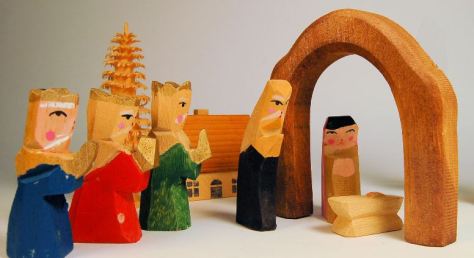
‘A cold coming we had of it, Just the worst time of the year For a journey, and such a long journey: The ways deep and the weather sharp, The very dead of winter.’ And the camels galled, sorefooted, refractory, Lying down in the melting snow. There were times we regretted The summer palaces on slopes, the terraces, And the silken girls bringing sherbet. Then the camel men cursing and grumbling and running away, and wanting their liquor and women, And the night-fires going out, and the lack of shelters, And the cities hostile and the towns unfriendly And the villages dirty and charging high prices: A hard time we had of it. At the end we preferred to travel all night, Sleeping in snatches, With the voices singing in our ears, saying That this was all folly.
Then at dawn we came down to a temperate valley, Wet, below the snow line, smelling of vegetation; With a running stream and a water-mill beating the darkness, And three trees on the low sky, And an old white horse galloped away in the meadow. Then we came to a tavern with vine-leaves over the lintel, Six hands at an open door dicing for pieces of silver, And feet kiking the empty wine-skins. But there was no information, and so we continued And arriving at evening, not a moment too soon Finding the place; it was (you might say) satisfactory.
All this was a long time ago, I remember, And I would do it again, but set down This set down This: were we led all that way for Birth or Death? There was a Birth, certainly We had evidence and no doubt. I had seen birth and death, But had thought they were different; this Birth was Hard and bitter agony for us, like Death, our death. We returned to our places, these Kingdoms, But no longer at ease here, in the old dispensation, With an alien people clutching their gods. I should be glad of another death.
In The One Year Book of Poetry, P Comfort and D Partner, compilers (Tyndale House Pub.s 1999), December 28 & 29.
I don’t know about you, but one of my little enjoyable pastimes is to read the searches that have led people to my blog. Most are pretty straightforward and it’s obvious why the person decided to check one of my posts out. Others are just unexpected and funny, and still others seem too general or off-the-subject; of the latter, I’m glad the person visited. I wish very much that these people (anyone who visits here, really) would leave comments or questions – that would be fun!
“the samarathon woman” She probably was in good enough shape to run a marathon after constantly lugging around jugs full of water in the middle of hot desert days.
“stormcloak officer armor revealing” Really?!
“adam lanza christian fanatic” Why not “adam lanza muslim fanatic”? Just wondering . . .
“christian poem on the tongue” (No comment . . . ha ha, perhaps they’re referring to James chapter 3, which has some very harsh words regarding the use of our tongue in conveying lies, evil and hurt.)
“butter my heart three person’d god” This has made me laugh out loud more than once. Of course, it’s supposed to be “batter” my heart, not butter my heart . . . makes me feel like a turkey being prepared for God’s oven.
“hellokitty skyrim” I wonder what they’re looking for? Knowing Sanrio, they’re working to contract something with Bethesda, surely.
“skyrim 1800s” ?!??! Seriously?
“evil bible king’s famous instrument for telling time” If anyone can explain this one to me, I’d be grateful.
“can christians play skyrim” (“skyrim seems like a bad game for christians”) CAN they? Do they need permission from some pastor? You know what’s bad for Christians? Living in this world with so much evil in it! I’m not questioning God’s motive for having us live in this world, I’m only making a point. Skyrim is a game, and by today’s standards, a quite clean one that actually enjoys playing around with religious ideas and culture, and the complexities of people and politics.
“how women should play skyrim” =D Well, they could ask . . .
“god is evil quotes” Just weird and sad; glad they stopped by, though. But then again, maybe they were simply doing some research.
“what do christians think of hello kitty story” Is there a story? If I knew the story, I could form an opinion. As far as I know, Hello Kitty is simply a very successful product venture. There are some unsavory HK products out there, but if some people want to abuse the cute feline, that’s their business.
“short intellectual quotes” Out of all the pages the searcher must have gotten from this search, I’m surprised they found my page url . . . and actually stopped by.
“religious poems for dads that died” I know it’s perhaps morbid to call out this one, but it still made me laugh a bit. How can you give a poem to a dead person? Did they want poems about dads that died, or a poem for the children whose dads died? My dad died when I was young and it was completely devastating; I never thought of writing any type of poem about it.
“unthink christmas card” Not sure about this one . . . but please, don’t unthink Christmas, unless it’s the commercial aspect of today’s holiday.
There’s a search that, even though it’s from more than a year ago, I still remember and consider the oddest one to lead someone to my blog (my old blog, which DID have a recipe for a great sandwich on it), so I just wanted to share it, though it’s adult material (sort of!): “Is there a good sandwich that can make up for bad sex?” Well, a pile of McDonald’s fish filets (with some fries on the side) just might do it for me.
The “Dragonborn” addition to the Skyrim video game, which came out earlier this month (December 2012) for XBOX, has – I think – the most “Christian” oriented content overall (in Skyrim, not the other Elder Scroll games). I wish I had written down certain dialog as I played it with my high-level character, but I simply wasn’t expecting anything out of the ordinary to takes notes on! (If I start a new game, it will be some time before I can get to those dialogs again – for now, this commentary without quotes will have to do.)
This latest DLC adds additional land mass via a large island known in the Elder Scroll series as Solstheim. (Update of Dec. 24: it appears to be playable from the beginning of a new game, as I went to Soltstheim at level 6, after I fought my first dragon and made my way to Windhelm). It is no doubt loved by Elder Scroll fans since it brings in elements from Morrowind (the home of the Dunmer, or Dark Elves), and indeed, the flavor of the place is quite a bit different from Skyrim (the home of the Nords). There are various quests to be found and accomplished, but the main quest involves the defeat of the first dragonborn, Miraak, who still exists after ages because of his service to Hermeus Mora, the powerful spirit being of knowledge and fate. Miraak desired power and thus made a “pact with the devil” – a safe allusion to Mora and his top minion. The DLC takes place when Miraak has used his powers to enslave the sleeping minds and bodies of the denizens of Solstheim, whom he is using to build a temple to himself. Miraak has only a small amount of dialog, but that small amount sounds an awful lot like satanic desires and promises. In addition, he has his hypnotized followers say things that are a copy, and thus a sick mockery, of true spiritual expression.
What’s interesting, from a Christian-in-the-current-world point of view, is that Hermeus Mora’s realm is called Apocrypha. (“Apocrypha” are extra-biblical writings of various qualities some are legitimate but have some textual or factual issues, while others are outright forgeries with false “witness”). It is dark and hazy and is made up of books (literally – the walls are made of books), and all underneath and around walkable areas is a very black sea. This “sea” has black slithery arms coming out of it all of the time, and they will whip you and hurt you if they can. The most dangerous creatures that stalk the place look very much akin to the old “creature from the black lagoon.” The other dangerous creatures are “seekers,” whose hideous appearance includes a lamprey-like mouth where their stomach is. These seekers of “knowledge” are never satisfied, but devour what their gut desires and not what their heart and mind discerns as true. This is my take on them, anyway, which I see as the problem with seeking and using secret – usually false – knowledge, and which is the point of this dark and eery place.
When it comes to Christianity, God chose to communicate with man and it was His desire to be known and understood. Those who purport to have “secret” knowledge of Him in order to steer someone away from God’s revelation, are not working within God’s desires for mankind.
On the other side of the coin are the Skaal of Solstheim. They are Nords of the ancient way and claim to have been given Solstheim by the All-Maker. They believe in one creator God, and the way they talk about creation and how we are to be in it, generally fits in with the Judeo-Christian biblical message. You can have an interesting conversation with Wulf Wild-Blood of the Skaal, who asks you if you can find his run-away brother whom he believes turned into a werebear (like a werewolf, only a bear). His brother could go down that path only be rejecting the call of the All-Maker. While the Skaal have beliefs that mesh with scriptures, they have others that do not – they believe in reincarnation. Conversations with fellow Skyrim players about how reincarnation doesn’t at all mesh with a loving creator God, and how it is wholly incompatible with Christ’s message and work, is a possible real-world benefit of playing this game.*
If, as a Christian, you will only play games that have pure Christian messages and signs, then Skyrim and Dragonborn aren’t for you. But if you want to play a game that actually gives a nod to God and certain Judeo-Christian beliefs and virtues in today’s world, then Skyrim is an OK game for that. I wrote about Skyrim earlier, here. That review by no means covers all the aspects of Skyrim. There are things about the game I don’t like and scratch my head at, wondering about the game maker (Bethesda) every time I think of them (there are aspects of the game you can only play if you decide to do bad and dishonorable things).
Hopefully I’ll be able to flush this review out in the future, with quotes and such. In the meantime, enjoy the Dragonborn and listen to the new leader of the Skaal: do not follow Hermeus Mora, but follow the path laid out for you (and to the Skaal, this would be by the All-Maker).
* These last two sentences were edited in after the initial posting of this review (12-20-12).
Saeed Abedini and his family. From Fox News online.
The situation for American reverend, Saeed Abedini, is getting desperate as no progress has been made in having him released from Iran’s worst prison. He was arrested in Iran on September 26, 2012, while visiting his parents and relatives. His immediate relatives were placed under house arrest as well. 32 year old Abedini has a wife and two children.
The court in Iran implemented a bail for Abedini, which is large but which his family had acquired, but no one has actually accepted the bail after several attempts at officially paying it. Officials reject their paper work and funds and tell them to get lost. Making the situation grave is the lack of diplomatic relations between the US and Iran.
When Abedini still lived in Iran he had converted to Christianity and helped found underground churches. Having had many run-ins with the government, he moved to the US and signed an agreement with the them. If he did not do any more Christian evangelical work, the Iranian government would leave him alone when he visited the country. The government has failed to keep their side of the bargain, however. Abedini has helped, and continues to help, in setting up an orphanage in Iran. He has visited his family and helped with the orphanage during a number of visits to Iran in recent years, but during this year’s trip he was imprisoned without charges.
Just prior to Abedini’s arrest, there was great news that Iranian Pastor Yousef Nardakhani was released from prison there. He had been imprisoned for almost three years and had faced execution. Compass Direct on Yousef Nardakhani’s Release.
Yes, so glad to see some perspective on this and past violence by those with mental challenges. US – please lets wake up and get these people some care BEFORE they kill people and end up in prison. It’s SO absurd that families and communities are having to deal with this alone, and even sacrifice their very lives.
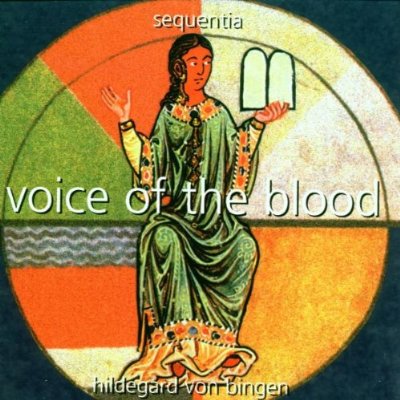
Cover from the “Voice of the Blood” cd, Hildegard of Bingen (from Amazon.com).
In church last weekend the thought came to me that the beauty of human singing is an example of a God given gift or virtue. How can singing, beautiful singing, be considered a trait that evolved? Our voices are so varied to begin with that it’s hard to think that somehow that variety evolved, but then there is also singing. Can you imagine a chimp or ape singing? The thought is laughable.
The theory of evolution is based on the survival of the fittest. Surely that works at a basic level in any environment with any species. But there are many problems with the time frame for species to actually diverge and develop (despite what basic level text books say . . . they make it sound like all is fact when it is not); and it can easily be shown that there has not been enough time for humans to have developed to their present state from their nearest assumed ancestor (for more on this, see “Science and Human Origins” Informational Review).
So besides all the other differences between us and the very small and very ape-like ancestor of ours, singing had to develop somehow, right? As already mentioned, environment plays a factor in who lives and who does not. But a biggy that evolutionists use is sexual selection. I’m not writing a scientific discourse here, but am going by my past studies (I have a degree in anthropology with an emphasis on human evolution and archaeology).
Here’s an example. Why are human female breasts so big (usually, and compared to other primates)? Well, you can imagine the answer: males had more sex with females with bigger breasts, producing more big-breasted females. And you might reflect on how that answer just doesn’t seem valid based on human sexuality, that while many men find large breasts attractive, most men wouldn’t care about that when it came to the chance for sex. And if you imagine it from a purely scientific, non-Christian viewpoint, “evolving” men probably cared even less and raped more. At any rate, scientists may try to argue that human singing is a result of not survival of the fittest in the environment, but survival of the most reproduced based on attraction, just like the breast example.
Do you think that could be so, really? A good singer (or any other charismatic person, for that matter), may have more sex partners – which in the past would result in more offspring. But, considering how beautiful good singing is, wouldn’t we all be great singers by now? Or, wouldn’t some populations have a very high per cent of great singers by now, and some have mostly lousy singers? And, of course, this type of argument can’t account for the amazing nuances/differences of the human voice itself.
No, we were created with these traits. Singing is often, if not always, associated with the spiritual. I don’t mean that singing is always spiritual, but that is has always been used in spiritual contexts as far as I’m aware. Singing is emotional, it’s often spiritual, it can induce or promote thoughts of love. We as humans think musically and mathematically, with thoughts of the music of the spheres and the singing of angels. This all coming from the survival of the fittest? I don’t think so. When we see human aggression and greed, the survival of the fittest makes sense, but when it comes to beauty like human singing, it does not.
Honestly, I never thought it would be so difficult to find a good summary of the various theological views on Christ’s second coming, or what is more technically called parousia. By this I mean a summary of the liberal view, and who promoted it and why, that proclaimed that Christ’s second coming was a misinterpretation of scripture – that despite the incredible amount and quality of verses to affirm that Christ and Paul and everyone else actually meant what they said – but that really Christ’s parousia is only His presence with us (so they tried to claim). So, that means, basically, I guess, that there’s no rapture (no glorified bodies, ever . . . .?), no hope that Christ will actually reign amongst humans, that we can build up His kingdom now and that’s about it, etc.
When I look around, when I experience my daily life with other people, when I read history, I suuuurrrre don’t see that Christ’s kingdom is blooming, growing, and all that. It seems to me that the opposite is true, that the great apostasy is upon us. “For the time will come when they will not endure sound doctrine, but according to their own desires, because they have itching ears, they will heap up for themselves teachers; and they will turn their ears away from the truth, and be turned aside to fables” (2 Timothy 4:3-4) (kind-of sounds like the liberal theology teachers themselves). Not to say that Christ isn’t among us doing His work, and we with Him. The Lord is indeed showing His love and Himself to many in many ways.
So what is my point? Well, I am doing some research for an extensive blog article that involves (it is not at all the main topic) this liberal, anti-parousia, “we can usher Christ’s kingdom in ourselves since that’s all the New Testament says anyway,” idea, and it’s just sad and difficult dealing with it. But the main thing is that I wanted to pass on some reading materials to show what is actually in the New Testament, and that our hope is not in man and what he obviously can’t do– that our hope is not misplaced in an elaborate myth (what some “Christian theologians” insist the New Testament is). The number one source is the Bible itself. Read the entire New Testament a few times and tell me if you really think it’s basically “made up.” Here is a good short but information packed essay on Christ’s second coming: Second Coming of Christ. This is a short, easy read on it: What is the Second Coming of Jesus Christ? And, I don’t necessarily agree with all that is in this article – maybe I just don’t know the right Christians – but it’s contents are worth considering: The Theology of the End and the End of Theology.
Christ is the suffering servant and the King, as outlined in the Old Testament. He was the suffering servant during His time on earth, and when He returns it will be in His role as King. Jesus said, “I will come back and take you to be with me that you also may be where I am” (John 14:3). “Men of Galilee . . . why do you stand here looking into the sky? This same Jesus, who has been taken from you into heaven, will come back in the same way you have seen him go into heaven” (Act 1:10-11; see also Matthew 24:29-30). “And now, dear children, continue in him, so that when he appears we may be confident and unashamed before him at his coming” (1 John 2:28; see also John 3:3).
Good Shepherd fresco from the Catacombs of San Callisto under the care of the Pontifical Commission for Sacred Archeology (Photo credit: Wikipedia)
Below is half of a relatively long (but actually concise) treatment of evidences or evidential steps for the view that the Christian faith is rational, and even desirable, to hold. Thanks for reading, and may the God of all creation bless you.
______________
For the person who wants to know that there is reason to believe a holy book–that there is evidence to back it up–different areas of apologetics have those answers. In fact, there is more evidence for the truthfulness of the Bible today than ever before, excepting when the events actually occurred. This essay assumes that the person searching for a legitimate holy book already believes that there is a deity of some sort; it does not cover arguments for the existence of God. What this essay does cover, in concise form, are the issues of reliability of the Old and New Testaments, fulfilled prophecies, miracles, and Christ’s resurrection.
Old Testament Reliability
How was the Old Testament written and copied? What we Christians refer to as the Old Testament is the same as the Jewish Septuagint, which is the Greek translation of the Hebrew scriptures, called the Tanakh. The content of the Tanakh and the Septuagint is the same, but the two are formatted differently. The Old Testament follows the same formatting as the Septuagint. The Septuagint was translated from about 250 BC to 150 or 100 BC and was used by the scattered Jews of the diaspora.
The Tanakh itself was written from about 1400-400 BC. Moses and other prophets were believed to possess the word of God because of the signs (miracles) they did, coupled with their openness (“transparency”). Moses was obviously literate, and because of his high upbringing, may have been literate in three languages. He no doubt, along with the people in general, knew the stories of other cultures and had copies of various source documents. Moses’ telling and retelling of events was considered God inspired.
At the time of Christ, the books of the Tanakh were established and accepted as canon. Those who copied the Tanakh beginning AD 70 (after the destruction of the temple) were called Talmudists. They had very specific rules for transmitting the Tanakh. Because damaged copies of the Tanakh were purposefully destroyed, very old copies do not exist. The Massoretes (or Masoretes) were the copyists for the Tanakh from AD 500 – 900. They, too, had very specific rules for copying, and any imperfect copies were destroyed. They are noted for adding marks to the text that represent vowels, as Hebrew did not have vowels and concern was growing over the continued pronunciation of the language. Whoever the copyists were through time, they all took God’s command in Deuteronomy 12:32 very seriously: “See that you do all I command you; do not add to it or take away from it.”
There have been archaeological finds in recent centuries to confirm the historicity of the Old Testament, and the Dead Sea scrolls additionally confirm accurate copy transmission. With the 200+ scrolls that date from approximately 250 BC to AD 125, we have the oldest copies of scripture, and these tell us that the accuracy of transmission is nearly 100%. A Qumran copy of Isaiah 53 has only three truly variant letters from the more recent Massoretic text, and these three letters do not change the text meaning in any real way.
There are many archaeological finds that corroborate the OT, with these representing only a sample:
The Moabite Stone. Mentions “Yahweh” and events in 2 Kings 3.
The Taylor Prism. From Nineveh, it describes the siege of Jerusalem by Sennacherib an corresponds to 2 Kings 18-19, 2 Chronicles 37, and Isaiah 36-37.
The Cyrus Cylinder. After Cyrus began ruling Babylon (539 BC), he ordered that Babylonian captives could return home. This is told of in Ezra 1:1-3 and 6:3 (see also 2 Chronicles 36:23 and Isaiah 44:28).
The Tel Dan Stele. This is an Aramaic inscription found in Israel. It is about Hazael’s victory over Ramoth Gilead, as in 2 Kings 8:28-29, and conveys that David’s dynasty ruled in Jerusalem.
The Gilgamesh Epic. Found in the great library of Nineveh, it in part describes a flood not unlike that in Genesis 7-8.
New Testament Reliability
There has been a plethora of interest in “lost gospels,” which leads some to doubt the manner in which the New Testament (NT) was put together. Then there are those who also question the accurate transmission of the words in the NT, saying that parts were added or taken away at later times. All these issues are really non-issues, promulgated by detractors of the faith and sometimes believed by neutral parties who simply don’t take the time to look into these matters further. Concerning when the books of the NT were written and how they became canon, providing a chronological order seems like it would be clearest, and that is provided below. As for the accuracy of textual transmission, however, here is a good summary:
“A simple comparison of the text of the Bible with the text of other religious, historical, and philosophical documents from the ancient past proves the vast superiority of the biblical record. Less than one tenth of one percent of the biblical text is in question, whereas no such accuracy of transmission exists for the Qur’an, the Mahabharata, or the Iliad. Some ancient records such as Caesar’s Gallic Wars of Tactitus’ Annals, exist in less than ten copies, and these copies date from 1,000 years after their originals. By contrast, over 5,000 copies of the New Testament exist, the vast majority of them dating less than 200 years after the original text and some fragments less than 50 years after the original text. No book from ancient history has been transmitted over the centuries with greater clarity and accuracy than the Bible” (Geisler and Hindson p 100).
So when was the New Testament written? The books that were considered canon and that make up the New Testament were written not all that long after Christ’s death and resurrection, by those who were Christ’s disciples/apostles or associates of the apostles. In other words, by close eye witnesses of Jesus, or persons who learned directly from those eye witnesses. Jesus lived from about 4 BC to AD 33. The book considered earliest in the NT is James, written around AD 45-48, and the most recent book is Revelation, written by AD 100. In light of the prior quote regarding biblical transmission, it is known that the copies that now exist reflect the originals very reliably. That is, what is used for our bible translations today can very confidently be considered “original.”
But how do we know that the books of the NT are the ones that the early church read and thought reliable (had divine inspiration), and that important books weren’t left out? The books of the NT had been circulated and read amongst the widespread churches (in Europe and the greater Middle East of today), and certainly not in the region of Rome only! Books considered scripture had apostolic authority, which was important very early on because of the rapid development of false teachings. So, we know that the books were all written by AD 100, and that they were widely circulated (and copied); there are codices of the gospels and of the letters of Paul from the early 2nd century.
Partly as a result of some influential persons (such as Marcion) trying to redefine and delete parts of scripture, “lists of canon” began to be written down. The first generally accepted one dates to the late 2nd century and is known as the Muratorian Canon; it had excluded Hebrews, James, 1&2 Peter, and 3 John. The early church father Tertullian (c. 150 – c. 229) had quoted 23 of the 27 books that became the NT. Those excluded or disputed on some lists were done so for various reasons, but not because some churches thought they were inauthentic; often it was because a heretical group happened to like the book, so then some questioned it. The Eastern and Western churches differed early on and this is reflected in the books supported or unsupported at different times (examples are Hebrews and Revelation). Later, most believers accepted James, 2 Peter, 2 and 3 John, and Jude, yet some did not want to accept these. However, the Eastern church accepted an official list in 367 which includes all the books of the present NT. In 393 and 397, councils of the western church also accepted the NT canon as it is today.
What of some books that weren’t included in canon? From the church father Eusebius, who had investigated possible canonical books, we know of some old “spurious” books. The Didache had instruction in it and was used by the early church, but it faded from use and its authorship was in severe doubt. The Acts of Paul had been written by an overzealous admirer, not Paul. The Epistle of Barnabas was read and admired, but it was not written by Paul’s partner Barnabas. The Shepherd of Hermas was widely read and may be all true, but it was written in the early 2nd century by someone other than an apostle or an apostle’s associate. The Apocalypse of Peter was written in the first half of the 2nd century, so Peter the Apostle was not the author. Other books that some critics like to bring up, like the Gospel of Thomas, were written far later and were never considered apostolic whatsoever; they are simply made up, forgeries, etc.
Now, are there historical or archaeological evidences that corroborate the NT? While not everything can be corroborated, there are outside sources that confirm aspects of NT writings. These help to show that the texts are indeed historical and not made up later. Written sources for Jesus and Christians are (1) the Roman historian Tacitus (55-117) in his Annals (15.44); (2) Pliny the Younger, a Roman Governor, in a letter to the Emperor in about 112; (3) Josephus, a 1st century Jewish historian (some of his writing or copies of it are questioned, but others are not; there is definite reference to Jesus in Josephus’ writings); (4) Jewish Rabbinical writings called the Babylonian Talmud; and (5), the 2nd century Greek satirist Lucian.
Archaeological finds also corroborate the NT, and they continue to grow in number. Here is a small sample:
The ossuary of Caiaphas (Luke 3:2 and others), discovered in 1990.
The Pilate Stone, discovered in 1961, has Pontius Pilate’s name on it and where he governed.
The Gallio (or Delphi) inscription (dated to about 52) speaks of Gallio, the same being mentioned in Acts 18:12; discovered in 1905.
Sergius Paulus inscriptions (there is more than one inscription bearing that name) confirm the proconsul of Cypress, as is mentioned in Acts 13:7.
The Pool of Siloam, excavated in 2004. As recorded in John 9:1-11, Jesus did a miracle there.
Fulfilled Prophecies
When considering the Old Testament prophecies fulfilled by Christ, it is exciting to simply read over an annotated list of them. There are different lists, however, with the highest number of fulfilled prophecies going up to 400. The listed number of “major” fulfilled prophecies varies as well, ranging from about 61 to 121. In MacDonald’s list of chronologically ordered fulfilled prophecies, he presents 44 (he does not say that these are the only ones he considers “major,” however) (MacDonald 1995). Here is one list just for your quick online reference: Prophecies that Jesus Christ Fulfilled.
One of my favorite lists is by D. James Kennedy – not because of the list itself, but because of the story around it. He had spoken to a highly educated man, a writer, who thought that the bible was simply written by man; he had no knowledge of the evidences for the validity of the scriptures. So Kennedy asked the man to tell him who it was he had read about, after reciting many verses to him. The man said that the verses clearly referred to Jesus Christ. But the man was completely surprised when Kennedy told him that all the verses he read were from the OT, the last book of which was written 400 years before Christ. He went on to tell him, “No critic, no atheist, no agnostic has ever once claimed that any one of those writings was written after His birth. In fact, they were translated from Hebrew into Greek in Alexandria some 150 years before He was born.”
So it is that verses such as (1) Micah 5:2, “But you, Bethlehem, Ephrathah, though you are little among the thousands of Judah, yet out of you shall come forth to Me the One to be ruler in Israel, whose goings forth have been from of old, from everlasting,” (2) Isaiah 53:3, “He is despised and rejected by men, a man of sorrows and acquainted with grief. And we hid, as it were, our faces from Him. He was despised, and we did not esteem Him,” (3) Psalm 22:16, “They pierced my hands and my feet,” (4) Psalm 22:18, “They divided my garments among themselves, and they cast lots for my clothing,” and (5) Psalm 34:20, “He protects all his bones; not one of them is broken,” refer to Jesus though written centuries before His birth.
One of the most fascinating prophecies of the Messiah is found in Daniel 9:24-27, and it concerns the timing of His coming. It is not in some of the basic lists, no doubt because it is not easily deciphered or shown in a few words. To put it very briefly, this prophecy provides a window of time as to when the Messiah would be around. When the Hebraic terms are taken into account, and then taking into account which possible scripture(s) is meant by the rebuilding of Jerusalem, and then also taking into account the different calendars (ancient calendars kept 360-day years), a time frame emerges that encompasses the time that Jesus lived (and was crucified) (Powell 2006).
There is so much more that can be known concerning the fulfilled prophecies of Christ that cannot be easily shown in a list, such as Christ in the meanings and symbols of things, like the lamb and shepherd, and symbols and events related to the feast days of Israel. Unique among religious faiths is the fulfillment of prophecies found in the Old and New Testaments. “You will find no predictive prophecies whatsoever in the writings of Buddha, Confucius, Mohammed, Lao-Tse, or Hinduism. Yet in the Scripture there are well over two thousand prophecies, most of which have already been fulfilled” (Kennedy xxix).
Chong, Timothy. “Bible, Canonicity.” In The Popular Encycolopedia of Apologetics, by Ergun Caner Ed Hinson, 101-102. Eugene: Harvest House Publishers, 2008.
Copan, Paul. Is God a Moral Monster? Making Sense of the Old Testament God. Grand Rapids: Baker Books, 2011.
Dowley, Tim, Editor. Eerdman’s Handbook to The History of Christianity. Grand Rapids: Wm. B. Eerdmans Publishing Co., 1977.
Garrett, Duane A, General Editor. NIV Archaeological Study Bible. Grand Rapids: Zondervan, 2005.
Geisler, Norman, and Ed Hindson. “Bible, Alleged Errors.” In The Popular Encyclopedia of Apologetics, by Ergun Caner Ed Hindson, 97-100. Eugene: Harvest House Publishers, 2008.
Hart, David Bentley. Atheist Delusions: The Christian Revolution and Its Fashionable Enemies. New Haven & London: Yale University Press, 2009.
Keller, Timothy. The Reason for God: Belief in an Age of Skepticism. New York: Dutton, 2008.
Kennedy, D. James. “Christ: The Fulfillment of Prophecy.” In The Apologetics Study Bible, by Ted, General Editor Cabal, xxviii-xxix. Nashville: Holman, 2007.
MacDonald, William. “Prophecies of the Messiah Fulfilled in Jesus Christ.” In Believer’s Bible Commentary, by William MacDonald, xviii-xxiii. Nashville: Thomas Nelson Publishers, 1995 (1989).
Nappa, Mike. True Stories of Answered Prayer. Carol Stream: Tyndale House, 1999.
Powell, Doug. Holman QuickSource Guide to Christian Apologetics. Nashville: Holman Reference, 2006.
Ricci, Carla. Mary Magdalene and Many Others: Women Who Followed Jesus . Minneapolis: Augsburg Fortress Publishers, 1994.
Sailhamer, John H. Biblical Prophecy. Grand Rapids: ZondervanPublishingHouse, 1998.
Yates, Gary E. “Bible, Transmission of.” In The Popular Encycolopedia of Apologetics, by Ed, and Ergun Caner Hindson, 107-110. Eugene: Harvest House Publishers, 2008.
Thou art indeed just, Lord, if I contend
With thee; but, sir, so what I plead is just.
Why do sinners’ ways prosper? and why must
Disappointment all I endeavor end?
Wert thou my enemy, O thou my friend,
How wouldst thou worse, I wonder, than thou dost
Defeat, thwart me? Oh, the sots and thralls of lust
Do in spare house more thrive than I that spend,
Sir, life upon thy cause. See, banks and brakes
Now, leaved how thick! laced they are again
With fretty chervil, look, and fresh wind shakes
Them; birds build–but not I build; no, but strain,
Time’s eunuch, and not breed one work that wakes.
Mine, O thou lord of life, sen my roots rain.
In The Poems of Gerard Manley Hopkins, WH Gardner and NH MacKenzie, ed.s (Oxford Univ Press 1967), 106-107.
___________
Denial
By George Herbert
[Note: The original poem has various justifications that could not be reproduced here, which does take away from the poem a bit, in my view, so the reader may want to find a printed version of this.]
When my devotions could not pierce
Thy silent ears;
Then was my heart broken, as was my verse;
My breast was full of fears,
And disorder.
My bent thoughts, like a brittle bow,
Did fly asunder:
Each took his way; some would to pleasure go,
Some to the wars and thunder
Of alarms.
As good go anywhere, they say
As to benumb
Both knees and heart, in crying night and day, Come, come, my God, O come,
But no hearing.
O that thou shouldst give dust a tongue
To cry to thee,
And then not hear it crying! all day long
My heart was in my knee,
But no hearing.
Therefore my soul lay out of sight,
Untuned, unstrung;
My feeble spirit, unable to look right,
Like a nipped blossom, hung
Discontented.
O cheer and tune my heartless breast,
Defer no time;
That so thy favours granting my request,
They and my mind may chime,
And mend my rhyme.
In A Book of Religious Verse, H Gardner, ed. (Oxford Univ Press 1972), 124-125.
___________
When I Consider How My Light Is Spent
By John Milton
When I consider how my light is spent
Ere half my days, in this dark world and wide,
And that one talent which is death to hide,
Lodged with me useless, though my soul more bent
To serve therewith My Maker, and present
My true account, lest he returning chide;
“Doth God exact day-labor, light denied?”
I [foolishly] ask; but Patience to prevent
That murmur, soon replies, “God doth not need
Either man’s work or his own gifts; who best
Bear his mild yoke, they serve him best. His state
Is kingly. Thousands at his bidding speed
And post o’er land and ocean without rest:
They also serve who only stand and wait.”
In The One Year Book of Poetry, P Comfort and D Partner, ed.s (Tyndale House Pub.s 1999), May 16 page.







 With Christian Eyes