Category Archives: Christian

A Beautiful Life: Amanda Berry Smith, 19th century black female evangelist

Amanda Smith (Wikimedia Commons).

I’ve always wanted to write about Amanda Smith, and here I’ll introduce her.  I’m sure she must be known in some circles, but when I first read about her over a decade ago, I was actually shocked.  I had never heard of her, even though she was an international evangelist and missionary.  Why is that?

Generally, we tend here, in America, to not learn much history, and when we attempt it, it seems all stale and dry, and no one seems to remember much.  Otherwise, I think we are still a male dominated culture, no matter what people say or how we can point to how long respect and equality have been taught in schools.  Amanda was black and female, and she experienced much prejudice on both counts in this country.  During her stays in other countries, including Great Britain, she was treated with respect and without prejudice.  Also, religious history and biography are not taught in school much, and churches basically stick to teaching the Bible or their own flavor of doctrine, and ignore historical and biographical lessons.  You can find quite a few references to Amanda online, but I read of her in Six Qualities of Women of Character by Debra Evans (Zondervan Publishing House 1996).

But what about Amanda; what is her story?  Amanda was born into slavery, in Maryland, in 1837.  Thankfully, her family was one that was permitted to stay together.  She knew her grandmother and her father, although her father worked so incredibly hard, she probably saw him little until their eventual freedom.  Her parents were faithful Christians, and her mother and grandmother prayed for the salvation of their young mistress, Celie.  Celie indeed became saved, but soon after contracted typhoid fever and died.  Her death bed wish to her parents was to let free her slaves, who were her Christian siblings.  Her parents granted her request and Amanda became free at the age of 13.

While she experienced the faith of her immediate family, she felt that she needed a conversion experience.  She needed to make a commitment herself.  This she did at a Baptist revival meeting in 1856; she was forever changed and strengthened by relationship with Christ that began then.  Her life was hard and she needed the Lord’s strength!  She married a man at 17, and he turned out to be an alcoholic.  Their marriage was full of strife, but it didn’t last long as her husband was killed in the Civil War.    She had a daughter by this marriage, Mazie, and Amanda worked hard indeed for her well-being.

Her second marriage wasn’t much better.  The man she married tricked her into thinking he was going to be appointed minister in a local church, which Amanda was thrilled about.  But after the marriage, she found that he in fact had given up the thought of ministering for Christ.  Can you imagine this deception, how it would feel to one who was overjoyed at the thought of being able to serve her Lord fully, and in fellowship with a group of other passionate believers?

After this, desiring affirmation from God, a confirmation of her salvation and desire to be close to God and serve Him, she prayed.  She encountered the Holy Spirit twice one night in September 1868,

. . . a wave came over me, and such a welling up in my heart . . . . How I have lived through it I cannot tell, but the blessedness of the love and the peace and power I can never describe.  O, what a glory filled my soul!  The great vacuum in my soul began to fill up; it was like a pleasant draught of cool water, and I felt it.  I wanted to shout Glory to Jesus!  . . . . Just as I put my foot on the top step I seemed to feel a hand, the touch of which I cannot describe.  It seemed to press me gently on the top of my head, and I felt something part and roll down and over me like a great cloak!  I felt it distinctly; it was done in a moment, and O what a mighty peace and power took possession of me!  (Amanda Smith, in An Autobiography:  The Story of the Lord’s Dealings with Amanda Smith [1894], as quoted in Evans pp 180-181.)

Amanda now felt that the Lord was with her, in control of her life no matter how hard it was, and she prayed constantly and learned from her Lord during the most tedious of times.  She talked with anyone she could about Christ, finding it easy after taking the effort to start.  While her husband was alive, her ministry was local, but after he died things changed.  She began ministering at meetings in New Jersey, and soon found herself being invited to speak and sing at revival meetings all across the U.S.  She soon felt God telling her to minister in Africa and India, but she was to go to Great Britain first.

While fearful of crossing the Atlantic, she finally realized that her fear showed a lack of trust in God.  She eventually repented and made the watery trek.  God had a surprise in store for Amanda, and no doubt a confidence boosting mission it was:  the captain of the ship asked Amanda to conduct the ship’s services.  Though there was prejudice against her on that voyage, she won everyone over by the time the trip was over.

In Great Britain, she was welcomed with open arms.  It didn’t matter that she was black, or female.  She had thought that her time there would be about three months, but she preached around the whole of England and Scotland for two years.  She met and was respected by those in the upper class, and these helped her in her future work for the Lord.  Her daughter’s room and board in America were paid for, so she needn’t worry about that, and her trip to India finally became a reality.  The poverty and the very poor treatment of women she saw there “gripped her heart instantly.”  The experience made her realize something that affected her ministry the rest of her life–that evangelism must be coupled with the meeting of practical human needs as well.

Next, she ministered in Liberia, touching and influencing many lives there for eight years.  When she came back to the United States she worked with African-American orphans and opened an orphanage in the Chicago area.  She was able to do this with the funds garnered from her memoirs.  In her final few years of life, Amanda was able to enjoy Florida in a donated home.  She died in 1915, having lived a beautiful life of giving and loving.

A missionary to India, Bishop James Thoburn, said this of Amanda:

Through my association with her I learned many valuable lessons, more that has been of actual value to me as a preacher of Christian truth than from any other person I have ever met (Evans p 186).

Thank you, Lord, for blessing Amanda and blessing us through her example!

America the Greedy: Homes on Land-lease land

In Anaheim one day.

Hello everyone – how are you all doing?  It’s been an unusually long time since I made a blog post, but looking for mortgages (loan shopping), looking for properties, taking cars into shops and looking for a new car, etc., surely takes one time up!  Since I’ve been in this mode and have learned some new things, I thought I’d pass a little of my new-found knowledge along.

So we are low-income (and recently lost some monthly income) and our rent went up.   But we have some funds to use for a down-payment, so it’s time to buy a condo if we can find one.  Why?  Where we live, it costs less per month to pay a low-end mortgage and homeowner’s association fees (HOA), than it is to rent.  Seems silly, huh?

Leaving the vagaries of renting vs paying a mortgage aside, there’s this thing that exists in our country called a land-lease (not all states allow this for condos/houses, apparently, and for good reason).  I have read a number of realtor’s comments and articles on this and this is what I have to say:  don’t buy into the idea that there are good reasons to buy a condo or house on leased land.  Buying a manufactured home in a mobile home park MAY be worth it, but I’m not talking about mobile homes.

Ok, so this came as a shock to me that you could BUY a condo on land you don’t own.   The lease tends to be a lot, and they also have high HOAs.  So how, possibly, could this help anyone but the leaseholder?  But wait, you might say.  What if you buy the home and the lease is finally paid up – don’t you own it all then?  That would make sense, right?  And it would make up, maybe, for paying the lease for all that time (up to 99 years, I’ve seen).  But NO, you BUY a condo, but when the lease is up it’s NOT YOURS.  This is what I’ve read; this is my understanding.  If you buy a condo or home on leased land and you want to sell and get your money back from the investment you made in the property, you might be dreaming.  If the lease is almost up, no one in his/her right mind is going to spend their good money on a home that will be “theirs” for only few years!

I saw a condo here recently that was very attractive, very cute, in a nice area (it only had one parking spot, however).  They were asking a fairly low price for the condo itself ($139K), but the lease was around $3,300 annually right now (this is actually a low lease), with scheduled increases to $6,814 annually by 2031.  The HOA was a very high $584 per month.  Another listing didn’t provide either the lease cost or the HOA.  Ok, another is one of those deals where the listing agent sucks in unwary people:  a nice condo listed for a ridiculously low price (about 25% of comparable ones in the area), with a bit higher than average HOA, and NO mention of it being a land-lease.

Finally, one in the city where I live.  An OK looking condo for not all that cheap of a price (in a perhaps an OK area, but not a great area), with $412 HOA and no lease price provided.  Let’s say you were able to put down 20% on a mortgage for this place (but good luck with even finding a bank to give you a mortgage for this type of property).  The monthly payments would be about $780 per month.  Property tax would be minimal.  There’s the $412 HOA, and the lease is . . . what?  Just for the heck of it, let’s provide a lease that is kind-of average for a mobile home lease in the region: $1,000 per month.  That would leave you paying $2192 per month for you basic housing needs.

We’re looking to buy a small regular condo and our monthly costs will be between about $1,025 and $1,420, and that includes property tax.  So how does the land-lease option help lower income people, or help to save on monthly costs?  It doesn’t; it only helps the landowner.  And you will not gain equity in that home.  You will be lucky if you get the same amount back for it as you paid.  This is what I’ve read from real estate agents and others.  One good side to owning, some people try to suggest, is that the place will be better maintained and generally nicer than a cheaper condo or apartment, so it’s better for families.  Well.  I say don’t throw away your hard-earned cash and be patient, do some more searching, etc.  (Build good credit; it’s kind-of astonishing how much of a difference one-half of one percent makes on your monthly payment.)  Save that money for your kids’ college education and don’t just throw it at some land-owner who’s sitting back making all kinds of cash off you for simply roosting on his land.

Female Hajj Pilgrims to Saudi Arabia Sent Back Home

This is from a very short article in Bloomberg online, and there are other articles to be found by googling:

Nigeria has protested to Saudi Arabia’s authorities over the detention of more than 1,000 female pilgrims who arrived in the kingdom for the annual Hajj pilgrimage without male guardians, state-run Radio Nigeria said. . . . Saudi Arabia enforces restrictions that are interpreted from the Wahhabi version of Sunni Islam. Women can’t travel or get an education without male approval or mix with unrelated men in public places.

As a Christian, I am at a loss as to why anyone would voluntarily become a Muslim in the first place, but when I see stuff like this, I am out-and-out flummoxed.  So, women must be controlled and herded like lesser beings, AND, they can’t even be in public with other men because . . . why???  Oh, men can’t control themselves.  They’ll just start doing some Mardi Gras moves in the street.  Really??  Belong to a religion that is so controlling, that seems to acknowledge and even promote the idea that human males are as good as randy rabbits, and that seems to not control its tyrannical and extremely violent members no matter what it does?  (And I won’t even get into all the persecution that goes on in the world against Christians at the hands of Muslims.)

Wow.  Sorry, but there is simply no comparison between Christianity and Islam.  And don’t go whining (atheists) about ancient pockets of “Christian” history (a lot of actual Christians died in trying to get false and violent actions to stop).  Sure, there have been wolves in sheep clothing that have done bad things in the name of Christianity.  It happens everyday in every area of life – I mean, charlatans seeking power and all of that, using whatever thing people have positive feelings about.   What you do is look at the founder of the faith.  Is s/he like that (false, after power, money, etc.)?  I won’t get into Muhammad here and the history of Islam, but I think it worth looking at Christ and the history of those who actually follow Him and his teachings.

Christ was sin-free and was not married; he didn’t go after multiple wives or even minor wives; he didn’t leave any heirs for everyone to argue about or over.  He lifted women UP from their low status at the time He visited us here on earth.  Women could follow Him and learn from Him.  In fact, He said it was better for a woman to learn from Him, to take the time and do that – as it was more important – than to serve Him or other men!!!  Wow!!  Why would any woman NOT want to follow Jesus?  If you want to know more and discover some pretty cool information that you just don’t hear about all that often, see New Testament Views of Women.   You may want to read about the woman at the well whom Christ talked with too.

In the future, I’ll try and post an article about the good in the history of Christ’s true followers, like those who founded hospitals (hospitals that were free) and universities.  People seem to have forgotten the parts of Christian history, too, when Christians died in order to stop those who did violence in Christ’s name.   In the meantime, if any Muslims come here, don’t go hatin’ on me.  Actions are actions, and the action reported on in the press was done and promoted by a whole country, and a whole section of Islam.  It’s no secret.  If you want to explain how your own sect of Islam is not like that in the comments, go ahead, but know that WordPress comments are always moderated.

Christian Poems VIII: Nicholson, Aquinas, Priest

Graveyard crosses (by saavem, http://www.sxc.hu/photo/1397939).

The Burning Bush

by Norman Nicholson

When Moses, musing in the desert, found
The thorn bush spiking up from the hot ground,
And saw the branches on a sudden bear
The crackling yellow barberries of fire,

He searched his learning and imagination
For any logical, neat explanation,
And turned to go, but turned again and stayed
And faced the fire and knew it for his God.

I too have seen the briar alight like coal,
The love that burns, the flesh that’s ever whole,
And many times have turned and left it there,
Saying:  “It’s prophecy–but metaphor.”

But stinging tongues like John the Baptist shout:
“That this is metaphor is no way out.
It’s dogma too, or you make God a liar;
The bush is still a bush, and fire is a fire.”

In The Earth is the Lord’s: Poems of the Spirit, H. PLotz, ed. (Thomas Y. Crowell Co. 1965), 57.

_______________

“Adoro te supplex, lateens deitas”
(beginning stanzas)

by Thomas Aquinas

Godhead here in hiding, whom I do adore
Masked by these bare shadows, shape and nothing more,
See, Lord, at thy service low lies here a heart
Lost, all lost in wonder at the God thou art.

Seeing, touching, tasting are in thee deceived;
How says trusty hearing? that shall be believed;
What God’s Son has told me, take for true I do;
Truth himself speaks truly or there’s nothing true.

On the cross thy godhead made no sign to men;
Here thy very manhood steals from human ken:
Both are my confession, both are my belief,
And I pray the prayer of the dying thief.

In The Poems of Gerard Manley Hopkins, W.H. Gardner and N.H. MacKenzie, ed.s (Oxford Univ. Press 1967); Hopkins had translated this Aquinas poem.

__________________

You Wait

by Victoria Priest

God abounds, is all around;
      His love for me endures.
But I, up in the air then on the ground;
      Smitten now, but later all demurs;
      Oh love!  How foul am I!
Your love abounds, is all around;
      You yet wait for my return.

C.S. Lewis’s Conversions: Atheist to Theist, Theist to Christian

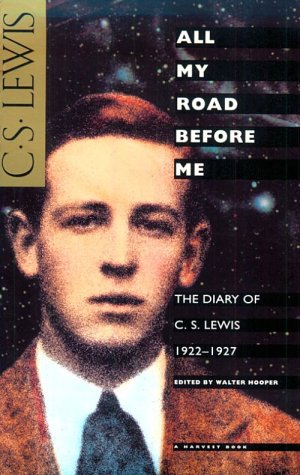
Rare early picture of CS Lewis, on the cover of “All My Road Before Me” — from his early and agnostic or atheistic days.A Christian Conversion Experience:  C.S. Lewis

Contemporary apologetics so often focus on the issues of biblical reliability and understanding in relation to science, and on the question of evil, as these are the currently contested concerns.  One apologetic that points towards the existence of God, however, is one that is generally not “scientific” enough, and that is a changed life.  Not a temporary change, which can indicate a simple excitement of a person’s will, but a permanent change evidenced by the long term.   So let’s look at the conversion experience of a well-known person, C.S. (Jack) Lewis.  Lewis was an Oxford and Cambridge Professor (English and Philosophy) and the well-known author of both fictional works like The Chronicles of Narnia and of highly valued scholarly works.

To anyone who comes in contact with atheistic thought, what Lewis wrote to his best friend in 1916 (below) will seem quite familiar.  What made him come to that conclusion, and what made him change his mind?

“I believe in no religion.  There is absolutely no proof for any of them, and from a philosophical standpoint Christianity is not even the best.  All religions, that is, all mythologies to give them their proper name, are merely man’s own invention” (Hooper p. 9).

Lewis, or Jack, was brilliant from early age, having been tutored at home until he was nine, when his mother died.  As if this great sorrow was not enough, Lewis’ dad sent him away to school, from their home in Ireland to England.  Lewis’ older brother, Warnie, attended the very small school with him, but Jack hated it, and with good reason.  The headmaster, a Reverend, was abusive and eventually deemed insane.  At his next school, Lewis experienced an occultist head matron.

One can see the progression of Lewis’ road to apostasy from his parents’ Anglican faith:  God did not heal his mother, one school leader was a cruel and crazy believer, and the other was a non-believing occultist.  By the time Lewis attended his third school, he was an atheist.  Hating this school as well, Lewis’ father sent him to learn under a distinguished tutor, who happened to be an atheist also.  Lewis was superb at languages and translating.  As his tutor wrote, Jack had “a sort of genius for translating . . . .  He is the most brilliant translator of Greek plays I have ever met” (Gromley p. 36).

He went on to learn and teach at Oxford, with WWI service (and related injury and recovery) sandwiched in.  After the war he lived with his adopted family, a much older atheist woman and her daughter.

So what would cause Lewis to stray from his atheism?  A couple of strongly held ideas played their parts.  One was the concept and experience of what Lewis termed “joy” – a pang of intense bliss and longing, followed by a strong desire to experience it again.  The other was his concern, from an early age, that if Christianity were true it could be shown that paganism prefigured it, or that Christianity fulfilled paganism.  Indeed, Lewis felt his pangs of “joy” when reading the northern pagan mythologies that he loved so much.

Jack Lewis wanted to be his own man; he did not want to acknowledge a power or diety that demanded loyalty.  Through the years, however, seeking truth and being drawn to authors and friends who helped him with answers to his search for “joy” as well as his concern over God’s communication with the pagan world, Lewis’ heart and mind opened enough to hear God give him a choice.

“. . . a fact about myself was somehow presented to me.  I became aware that I was holding something at bay, of shutting something out. . . .  I felt myself being, there and then, given a free choice. . . .  I could unbuckle the armor or keep it on. . . .  The choice appeared to be momentous but it was also strangely unemotional.  I was moved by no desires or fears.  In a sense I was not moved by anything.  I chose to open . . . .  Then came the repercussion on the imaginative level.  I felt as if I were a man of snow at long last beginning to melt.  The melting was starting in my back – drip-drip and presently trickle-trickle.  I rather disliked the feeling” (Lewis p. 123).

This experience of Lewis’ happened in 1929, and it was “conversion” to belief in God, not in an afterlife or in Jesus Christ.  Lewis still thought that parts of Christianity were a kind of myth, yet he wanted to know the truth and to live truth.  God gave Lewis many nudges, even via an ardent atheist who thought that it really did seem as though God made the pagan myths come true through Jesus Christ.  This atheist’s admission shocked Lewis.  Jack’s good friend J.R.R. Tolkien helped him with this issue, too, as did Hugo Dyson, on a pivotal walk in September 1931:

“Tolkien was convinced that myth, such as the Norse myth of the death of Balder, or the Greek myth of Psyche and Eros, was not the opposite of fact.  These stories were a way of expressing truths deeper than fact. . . .  [Tolkien declared that] not only did the truth in myths come from God, but a writer of myths could be doing God’s work in the world.1 As Tolkien talked, there was a sudden rush of wind out of nowhere, as if to underline the message.  The three men held their breath, feeling the importance of the moment” (Gormley p. 95).

Later that month Lewis had a second, more subtle, conversion experience.

“As I drew near the conclusion, I felt a resistance almost as strong as my previous resistance to Theism. . . .  Every step I had taken, from the Absolute to ‘Spirit’ and from ‘Spirit’ to ‘God,’ had been a step toward the more concrete, the more imminent, the more compulsive.  At each step one had less chance ‘to call one’s soul one’s own.’ . . .  I know very well when, but hardly how, the final step was taken.  I was driven to Whipsnade [Zoo] one sunny morning.  When we set out I did not believe that Jesus Christ is the Son of God, and when we reached the zoo I did.  Yet I had not exactly spent the journey in thought.  Nor in great emotion. . . .  It was more like when a man, after long sleep, still lying motionless in bed, becomes aware that he is now awake” (Lewis pp. 129-130).

So, finally, Lewis found that myth had become fact (that is, Jesus was “the god that died”) and that the pangs of “joy” had been sign posts to God.

As Lewis had written in Surprised by Joy, “all” is required of a person who acknowledges and worships his maker, and Lewis gave his all.  He is considered to be the greatest apologist of the 20th century, having written Mere Christianity, The Problem of Pain, The Screwtape Letters, and more.  In addition, he was a very popular layman preacher in Oxford.  As a “secular” scholar and author, he wrote poetry, the highly regarded “A Preface to Paradise Lost,” The Discarded Image, and others.   Lewis was the president of Oxford’s Socratic Club from 1942-1955; this was a philosophy group that delved into the pros and cons of the Christian faith.

As if the schedule demanded by all that was not enough2 – don’t forget that he taught as well – Lewis was kind enough to answer all his letters (as he became “popular” he had the help of his brother, and then his wife).  He always helped those in need–in a very personal way when the opportunity arose–and in a more general way through significant monetary giving.  His apologetics show a concern and love for the common man, being theological and philosophical explanations open and accessible to all.   Jack’s life was one humanly lived and beautifully lived.

_____________

Notes

  1. Indeed, as probably all of you readers know, J.R.R. Tolkien wrote the great “modern myth,” The Lord of the Rings.   It’s likely that many fewer are aware of Lewis’ re-told myth of Psyche and Cupid (or Eros) in Till We Have Faces.
  2. Lewis had a truly unbelievable photographic memory, easily quoting pages from books that someone happened to mention.  This gift was obviously a very great help to his studies, writing, lectures, etc.

____________

Sources

Gormley, Beatrice. C.S. Lewis: Christian and Storyteller. Grand Rapids: Eerdmans Books for Young Readers, 1998.

Hooper, Wlater. C.S. Lewis: A Complete Guide to His Life & Works. New York: HarperSanFrancisco, 1996.

Lewis, C.S. “Surprised by Joy.” In The Inspirational Writings of C.S. Lewis, by C.S. Lewis, 1-130. New York: Inspirational Press, 1994 (1955).

© Vicki Priest 2012 (this is an edited version of my article at Examiner.com, published 2011)


Christian Poems VII: Donne, Herbert

Heart aflame (Vicki Priest).

HOLY SONNETS (vi)

By John Donne (1572 – 1631)

Batter my heart, three-person’d God; for, you
As yet but knock, breathe, shine, and seek to mend;
That I may rise, and stand, o’erthrow me, and bend
Your force, to break, blow, burn and make me new.
I, like an usurped town, to another due,
Labour to admit you, but O, to no end.
Reason, your viceroy to me, me should defend,
But is captiv’d, and proves weak or untrue.
Yet dearly I love you, and would be loved fain,
But am beroth’d unto your enemy:
Divorce me, untie, or break that knot again,
Take me to you, imprison me, for I
Except you enthrall me, never shall be free,
Nor ever chaste, except you ravish me.

In The Oxford Book of Christian Verse.  D. Cecil, ed. (Clarendon Press 1940), p 87.

___________

LOVE II

By George Herbert (1593 – 1633)

Immortal Heat, O let they greater flame
Attract the lesser to it:  Let those fires,
Which shall consume the world, first make it tame,
And kindle in our hearts such true desires,

As may consume our lusts, and make thee way.
Then shall our hearts pant [for] thee; then shall our brain
All her inventions on thine Altar lay,
And there in hymns send back thy fire again.

Our eyes shall see thee, which before saw dust;
Dust blown by wit, till that they both were blind:
Thou shalt recover all they goods in kind,
Who wert disseized by usurping lust:

All knees shall bow to thee, all wits shall rise,
And praise him who did make and mend our eyes.

In The One Year Book of Poetry.  P. Comfort and D Partner, ed.s (Tyndale House Pub.s 1999), Feb. 14.

__________

“BUT ART THOU COME, DEAR SAVIOR?”

By Anonymous

But art Thou come, dear Saviour? hath Thy love
Thus made Thee stoop, and leave Thy throne above

Thy lofty heavens, and thus Thyself to dress
In dust to visit mortals?  Could no less

A condescension serve? and after all
The mean reception of a cratch and stall?

Dear Lord, I’ll fetch Thee thence!  I have a room
(‘Tis poor, but ’tis my best) if Thou wilt come

Within so small a cell, where I would fain
Mine and the world’s Redeemer entertain,

I mean, my heart:  ’tis sluttish, I confess,
And will not mend Thy lodging, Lord, unless

Thou send before Thy harbinger, I mean
Thy pure and purging Grace, to make it clean

And sweep its nasty corners; then I’ll try
to wash it also with a weeping eye.

And when ’tis swept and wash’d, I then will go
And, with Thy leave, I’ll fetch some flowers that grow

In Thine own garden, Faith and Love, to Thee;
With these I’ll dress it up, and these shall be

My rosemary and bays.  Yet when my best
Is done, the room’s not fit for such a guest.

But here’s the cure; Thy presence, Lord, alone
Will make a stall a court, a cratch a throne.

In The Oxford Book of Christian Verse.  D. Cecil, ed. (Clarendon Press 1940), pp 260-261.

Hearthfire (Skyrim): The Quest for Butter

Original home with main hall being added. http://bethsoft.com/en-us/games/hearthfire

(If you’re looking for more of an overall review of Skyrim, please see this article as well:  Christian Parents, Should you let your kids play Skyrim?)

The newest Skyrim DLC is a mini one, called Hearthfire (this review is based on the XBOX 360 game).  It allows the player to build up to three houses on property outside of the cities or towns, and to adopt one or two orphaned children.  The trailer promised more flexibility in building, in my view, so at first I was disappointed in Hearthfire on that ground.  But, after playing it for some time and building all three homes, I am disappointed and annoyed even more.  Not totally disappointed, mind you, and I’m not advocating not buying it and trying it out, but I do want to present what is annoying and what needs to be fixed.  HOPEFULLY, Bethesda will get around to making some fixes and making some additions to this DLC.

Let’s take a look at adoption first.  Instead of simply allowing you to adopt the children already orphaned and being forced to live in the Riften (yuck!) orphanage, you have to decide amongst the four new orphans in the towns and them.  There are now more orphans than ever to choose from . . !  No matter what you do, there will always be orphans.  When playing Skyrim before, I wanted only to adopt some out of the orphanage, but now there are others – it just never ends and you are not allowed to adopt more.

Anyway, the kids are a nice addition for the most part.  (If you don’t want children bugging you to play with them, maybe you should forget about adopting any in the first place, however.)  It’s fun giving them things, and they will give you things once in a while, too.  One day my son gave me a unique and odd green robe to wear.  They love when you give them daggers.  You can improve and enchant their wooden swords, and duel wield them yourself if you want a bit of a fun challenge.  A problem with giving them items, to me, is that you are very limited in what you can give.

Now, for the building bit – I’ll get to the hunt for butter after this.  The three homes you can build are on three specific pieces of property you can buy from the Jarl’s or their stewards.  One is near Whiterun, although it’s part of Dawnstar hold.  Another is outside of Solitude, with a view of the land bridge that is that city, though it is a part of Morthal hold.  The third is close to the lake south of Riverwood – a beautiful area that is like having a vacation home in the woods – and is a part of Falkreath hold.

I am not going to go through all of the addition choices, but will mention a few that give notice for some reason.  You can build what is in a provided list for each room/addition, but you don’t have alternate choices within the list.  You don’t have a choice between a bed and a table for a certain spot, for example – there’s is only one thing designated for that spot – you can only add it or leave it open.  And, you cannot demolish a wing later in case you change your mind about the kind of house you want.

All the homes start off with a small starter room (home!), and in order to add the specialty wings, you must build the main hall attached to the first starter room.   The starter room has a bed and fire pit in it, and so it is livable as is.  However, if you hire a steward – very advisable since not all the mill owners will sell you wood, as the add-on claims – then where do both of you sleep?  This is actually more of a problem later.

You will have the ability to add two small beds and a double bed in the main hall for you and your spouse, and your  kids (forget “choice” – there is no other options for this area, nor any other, in these Hearthfire houses).  However, the steward and housecarl always sleep in the beds that are for the kids, or one of them may sleep in your own bed.  This is a problem with the game.  If you choose to build the bedroom wing, this is not a problem.  But if you choose to build a different wing and use those main hall beds, then good luck!  The problem is only compounded by the fact that there is only one bed left in the original building for both the steward and the housecarl.  This obviously was not thought through by Bethesda, and I find it quite astonishing.

The storage room was a very major disappointment.  Seriously, Bethesda couldn’t spring for a dragon claw holder and some other holder for specific items – like the various named jewelry you can find – especially since everything always pops out of display cases and off of shelves?  This really fries me!  Come one, Bethesda . . . really!?!  Give us something for the money.  The cellar is a bit interesting in that way:  you can build a shrine holder and all the shrines to the gods.  But a storage room that doesn’t store all those specialty items?  Wow and weird.

The homes do not incorporate anything from the Dawnguard DLC.  It seems like the ability to add new plants and new creatures, like from the Soul Cairn and the Vale, at least, should have been designed into this new DLC.  It becomes obvious that this add-on was planned from the beginning.  Skyrim had orphans and they asked to be adopted, yet you could not adopt them.  There is no Dawnguard content in Hearthfire, except for one thing: you can give your child an armored dog from Fort Dawnguard (a nice surprise).  So, why wasn’t this simply part of Skyrim to begin with?  My “other half” is really into the Elder Scrolls, though Morrowind specifically.  He told me that in the past, an add-on such as this would’ve been free.  It seems Bethesda held some of the content out in order to make some more cash, while providing a not so great product.

Which brings us to the butter quest.  There’s not a formal quest for butter, of course, but there is an actual one.  Butter is as hard to find as gold- if not harder – as far as I can tell.  You will want butter if you build the kitchen wing (it probably has the best looking wing interior), which has an “oven” for baking.  Butter is an 0ft-needed ingredient, but good luck finding it!!!   You can’t make it, even though you can own cows now and there is a butter churn in the kitchen.  So far I have only received one butter out of the churn.  I have searched high and low for butter, looking to find it in various places, and to buy it.  I never find it (it isn’t laying around like soup or stew), and have been only offered it to buy about three times from various vendors.  Wow.  Who knew baking could be so hard?

So if you want to have something new to do in Skyrim before the next big DLC comes out, and you like having children, then Hearthfire would be worth the $5, in my opinion.  But otherwise, the choice is of course up to you, especially if you want to bake but don’t feel it worth hours of your time in a quest for butter!

November 9 Update (XBOX):   After months, the churn finally had a new bowl of butter in it.  BUT, within a short time, it had butter in it again.  Perhaps there was an update that loaded that we didn’t notice, or perhaps it’s very random!  Also, the best places I’ve noticed to buy butter are from the town stands, from the vendors selling vegetables and other foods (that is, the dark elf in Riften and the two humans in White Run and Windhelm).


The 9/11 Attacks and Protests in Libya and Cairo

Very briefly, since I’m leaving for work soon, the current US administration’s immediate response to the violent protests in Libya and Cairo was not only extremely lame, but anti-US law.  In an article I read last night, which I can’t yet locate this morning, administration officials said that such a film that sparked the violent events should not have been made and that American freedom does not extend to criticizing other religions too much.

Whaaa . . . . ?!?!?!  They didn’t use the words “too much,” but it was the diplomatic way of saying the same thing.  If this is so, then why, of why, have I had to experience militant atheists condemning Christianity and Christians – often in very vile and childish ways – for a number of years now.  Not long enough for the fascist government to locate them?

In a newer article this morning I see that the administration is doing some back-up and corrections.  Former President Clinton is saying that there is no excuse for the violent acts that happened yesterday.  Finally!!!  Our government needs to defend us, not militant Muslims.  We have freedom here.  We have freedom to investigate something and say what we think about it.  We even have the freedom here to make fun of that thing.  American government – please start defending us and stop making yourself out to be mega wimps to these people!

This wasn’t just about the film!  Has no one noted that these events took place on 9/11, yet the film has been out a while (the film being the Innocence of Muslims)?  People, please wake up.  These were not spontaneous acts, but planned acts.  And I bet the governments, or at least factions in the governments, knew about them.

Anyway, I simply couldn’t believe what I read last night.  If I find those quotes from US officials later today or tomorrow, I will publish them.  If America implemented what they said, we’d all be in trouble, and they also show the bizarrely weak and misguided spine of our government.  Thanks for reading.

“The Way My Ideas Think Me:” An Explanation

The Way My Ideas Think Me (Jose Garcia Villa) is a playful and familiar (as opposed to formal in a religious sense) poem that may mask the seriousness of the subject matter.  The first stanza presents a difficulty, a problem, the tension.  The second stanza is fun, as if the author is in a playland; the third stanza flows from it – though something is getting serious enough for the author to become angry.  The fourth stanza presents action to relieve the earlier presented—and the building—tension.   Some specifics are below each stanza (these are my current and concise thoughts on the poem, without influence from other literary critics).

The way my ideas think me

Is the way I unthink God.

As in the name of heaven I make hell

That is the way the Lord says me.

This stanza, and poem, would be easier if the author seemed to be saying that he makes his own life hell, but he says he makes hell “in the name of heaven.”  How would you be making your own life hell “in the name of heaven”?  When we do something in someone else’s name, it’s outward – in witness, in action with someone or something else.  The author, then, seems to be saying that his ideas are contrary to God – he “unthinks” God with his incorrect notions of God and His will – and he witnesses or puts into action those incorrect notions.  These actions can push people toward hell more than toward God; they can make life worse for everyone involved instead of better.  The author hears from God, however, letting him know of his false and detrimental ways.

And all is adventure and danger

And I roll Him off cliffs and mountains

But fast as I am to push Him off

Fast am I to reach Him below.

But now we have this fun stuff.  Well, is making hell in the name of heaven serious, or not?  The life of the Christian can certainly seem like a dangerous adventure, and I think the author is simply stating this in attractive terms so that we’ll pay attention.  He isn’t talking missions trips, however.  Maybe the author thinks it’s challenging and maybe a bit fun to see how far he can go with God – how much “on the edge” activities he can do (sinning or border-line behavior)—without losing Him.  After all, he pushes God away.  The author is “on top” or up high, and he pushes God down.  However, he doesn’t actually want to get rid of God, but quickly reaches back to Him.

And it may be then His turn to push me off,

I wait breathless for that terrible second:

And if He push me not, I turn around in anger:

“O art thou the God I would have!”

The author recognizes his behavior and wants acknowledgment from God – that He’s around and that He’s going to give guidance – also that He has the righteous authority to do so.  If He isn’t such a God, what’s the point?  What is the point of life without a God who is good, moral, has authority in these matters, and has the ultimate capacity to teach, guide and judge?  If you keep on going down the wrong road, would you rather God left you alone, or that He intervened – as a loving parent would?  The author recognizes that there should be consequences to our actions – he waits for God to push him off the mountain.

Then he pushes me and I plunge down, down!

And when He comes to help me up

I put my arms around Him, saying, “Brother,

Brother.” . . . This is the way we are.

God is there for the author–he’s not alone.  God pushes him off the high place (perhaps that he made for himself), but afterwards God also extends His hand and gets the author back up on his feet.  He is so glad to have such a friend, such a God.  With all his foibles and human delusions (like thinking we can do stuff on our own and be our own king of the mountain) he can still depend on his Lord, and even delight in him as “brother.”  And who is our “brother” but the Lord Jesus Christ, who died for us to be adopted into God’s family?  We can sin and make mistakes, but Jesus will never leave us if we continue to seek Him.

Christian Poems VI: Carson, Schnackenberg

Jupiter image (jelega at stock.xchng, http://www.sxc.hu/photo/1155282)

[I WONDER]

By D.A. Carson

I understand that matter can be changed
To energy; that maths can integrate
The complex quantum jumps that must relate
The fusion of the stars to history’s page.
I understand that God in every age
Is Lord of all; that matter can’t dictate;
That stars and quarks and all things intricate
Perform his word—including fool and sage.

But knowing God is not to know like God;
And science is a quest in infancy.
Still more:  transcendence took on flesh and blood—
I do not understand how this can be.

The more my mind assesses what it can,
The more it learns the finitude of man.

In The Poetic Bible, C Duriez, ed. (Scribner Poetry 1997), 180.

__________

SUPERNATURAL LOVE

By Gjertrud Schnackenberg

My father at the dictionary-stand
Touches the page to fully understand
The lamplit answer, tilting in his hand

His slowly scanning magnifying lens
A blurry, glistening circle he suspends
Above the word “Carnation.”  Then he bends

So near his eyes are magnified and blurred,
One finger on the miniature word,
As if he touched a single key and heard

A distant, plucked, infinitesimal string,
“The obligation due to every thing
That’s smaller than the universe.”  I bring

My sewing needle close enough that I
Can watch my father through the needle’s eye,
As through a lens ground for a butterfly

Who peers down flower-hallways toward a room
Shadowed and fathomed as this study’s gloom
Where, as a scholar bends above a tomb

To read what’s buried there, he bends to pore
Over the Latin blossom.  I am four,
I spill my pins and needles on the floor

Trying to stitch “Beloved” X by X.
My dangerous, bright needle’s point connects
Myself illiterate to this perfect text

I cannot read.  My father puzzles why
It is my habit to identify
Carnations as “Christ’s flowers,” knowing I

Can give no explanation but “Because.”
Word-roots blossom in speechless messages
The way the thread behind my sampler does

Where following each X I awkward move
My needle through the word whose root is love.
He reads, “A pink variety of Clove,

Carnatio, the Latin, meaning flesh.”
As if the bud’s essential oils brush
Christ’s fragrance through the room, the iron-fresh

Odor carnations have floats up to me,
A drifted, secret, bitter ecstasy,
The stems squeak in my scissors, Child, it’s me,

He turns the page to “Clove” and reads aloud:
“The clove, a spice, dried from a flower-bud.”
Then twice, as if he hasn’t understood,

He reads, “From French, for clou, meaning a nail.”
He gazes, motionless.  “Meaning a nail.”
The incarnation blossoms, flesh and nail,

I twist my threads like stems into a knot
And smooth “Beloved,” but my needle caught
Within the threads, Thy blood so dearly bought,

The needle strikes my finger to the bone.
I lift my hand, it is myself I’ve sewn,
The flesh laid bare, the threads of blood my own,

I lift my hand in startled agony
And call upon his name, “Daddy daddy”—
My father’s hand touches the injury

As lightly as he touched the page before,
Where incarnation bloomed from roots that bore
The flowers I called Christ’s when I was four.

In The Vintage Book of Contemporary American Poetry, JD McClatchy ed. (Vintage Books 1990), 535-537.