Happy Thanksgiving to All – by which we mean, all those in the Upper Class in America. (Photo credit: Wikipedia)
If there’s any hope for America, it’s in people like David Kaelin, the President and CEO of Game Over Videogames. He wrote a memorandum to his employees regarding the Thanksgiving holiday and it ended up being posted at Boycott Black Thursday, a Facebook page. It is almost impossible to read the small image there, but an enlarged copy can be seen at a Nice World thread: Black Thursday/Friday. I’ve written it out here for your Thanksgiving joy, and as a reminder that there are still people in business who think of their employees as humans (that is, a thing that has thoughts and needs other than those of a robot) and are not afraid to say what they think of certain employers.
There is no shortage of information available on the internet regarding what the Bible says about sin and salvation in general, and homosexual acts as sin in particular. I came across an article by Kevin Smart (I think it’s actually by his wife, however!) at Light & Life Communications and thought it was good, so I want to share it. Also, the article contains references to biblical verses regarding homosexuality, so I’ve written them out here for your reference.
For anyone who comes to this article and wants to rave about how I’m picking on a certain sin and somehow that negates the points made–please, don’t be absurd. Sin is sin, no matter WHICH sin it is (if one can in all seriousness claim that the Bible doesn’t condemn homosexual practices, then in all seriousness, it doesn’t condemn anything). The reason why Smart’s article exists, and others like it, is because so many people are trying to make homosexual acts NOT a sin when they clearly are in God’s view. The worldly embrace of homosexuality has entered the church and thus it’s a big issue indeed. Who would accept a church that embraces adultery the same way? That would be funny, wouldn’t it, to see a bunch of leaders in churches who are proud practitioners of adultery? Adulterous acts and homosexual acts are both sexual sin–they are outside of God’s provision of marriage between one man and one woman.
This is the ongoing notebook, or journal, of a guardian in Destiny. It contains information on gameplay, game characters, and the storyline. . . . last updated on 10-7-14. For the my “likes and don’t-likes” of the game, see the second part (especially) of Destiny, A New Kind of Online Multiplayer Video Game .
Second Birthday
Well, this is awkward. And sad . . . that is, I’m sad. The reason: one moment I’m battling some earth invaders, the next I’m talking with this little floating angular thing which appears to be staring at me with one bright bright eye, and he – yes, he – is saying how I was dead for a long time but I’m alive now . . . by some unstated, unexplained voodoo . . . and how he’s my “ghost.” Then run run run.
So, what year is it? 2726?* Did my family leave any descendents that are now alive? The Traveler I know of, but all this is new. Or, I guess, the result of what was beginning when I was killed so many years ago. So, now there are these “ghosts” The Traveler made before it went into a sort-of hibernation, and I draw power (“light”) from my ghost, or is it The Traveler? This power is awesome, so don’t think I’m complaining. Just confused, so far. Hmmm. I am a powerful Titan now, but with much to learn . . . and of my past, much to forget. Even my name, apparently, since it is Amenta but my ghost only calls me Guardian.
A Later Day
I have learned much but haven’t been in any mood to write. I have done what I ought to, have been going through the motions since my second birth, and now am beginning to get used to my very unexpected new life; all that I knew, all the people I liked and loved, gone . . . in a flash . . . and yet everyone wants to dance.
Here’s a pic of me. Not very good, taken before sunrise at The Tower. But it’ll have to do for now. I will return later with some of my experiences, but know one thing – it is as annoying as you have imagined having to take a potty break. Oh, and know a second thing. With all the incredible tech that goes into the armor, weapons, ships, teleportation, etc., they still can’t get me a helmet with night vision . . . How crazy is that??
Me, Amenta, at The Tower (yes, I have legendary blue armor on – a bright thing in my new life).
The Sword of Crota – Oh Happy Day!
I had the most fun today. Patrols can be fun and relaxing, and the missions – well, they can be fun, but those thick-skinned bosses can be a bit tedious as well! But then I get this mission to find the “Sword of Crota,” some old super powerful sword. Sounds like a legend that turns out to be, if anything, just an old cool looking piece of steel. But no, I found the Sword of Crota and it was all that it was touted to be. Wielding that thing against enemies was like playing an aerobics version of whack-a-mole. Yes, you actually whack the ground with a sword! You can slash around with it, too, and slicing up the annoying Hive lackeys was quite satisfying. Of course, I defeated the three powerful Swarm Princes that guarded it. They’re not very good guardians if they can’t stand up to their own weapon. But then again, look who was wielding it. 😉
(I wonder when I’m going to find a blade I can wield against enemies. That Crota Sword was just so much fun, but I find there is some force that doesn’t allow me to pick up any Hive swords I find laying around. Hmph.)
How is ANYONE Alive Anymore?
I have been through many battles now on the planets we had settled in our Solar System. Besides the heart-wrench I feel when seeing all things abandoned and destroyed, especially on wild and beautiful Venus, there are all the enemies. The Traveler has so many enemies – why? The Darkness is The Traveler’s foe, but why does The Darkness have so many apparent minions that fight each other? How can these “civilizations” go on, fighting and killing so much? Well, THIS guardian is helping to relieve them of their miserable existence, but, there are just so many. It’s like they breed and grow to adulthood daily . . .
In any case, there are four different enemies: Fallen, Hive, Vex, and Cabal. The Fallen; I expected a race having the name “Fallen” to be human, at least, but these things have four arms. So, the Fallen are insectoid humans? They are piratical with no real home, apparently feeling most comfortable with their military “houses”–one is called “Devils,” another “Exile,” again making me wonder about a possible human past. I’ve been told that the weird purple spew that I see when they die is their souls coming out, but I’m going to ask around about that more; I wonder if The Speaker knows?
The ancient, undead Hive are moon-based, but invade Earth too, fighting us and the Fallen. Their moon settlements are vast and amazing, even though their floors, chambers, halls, outdoor grounds, bathrooms (no doubt), and anywhere a Hive member has walked, are littered with human bones. I don’t know that humans are their enemies so much, more like their meal source.
The Vex; how I hate the Vex. They occupy Venus, and they are biological-mechanical hybrids (abominations that, to all appearances, have traded in their biological bodies for mechanical ones) with no desire whatsoever to communicate – exterminating us is their only desire.
I wonder if the Cabal are just imperialistic opportunists who don’t care about The Darkness or The Light, but only go forth and conquer in the name of power and money? Whatever their motives, they fight any Vex they see on Mars (a VERY GOOD thing), but they also attack Guardians, so . . . another day, another enemy.
Mom, Where do Servitors Come from?
One of Aksor’s servitors.
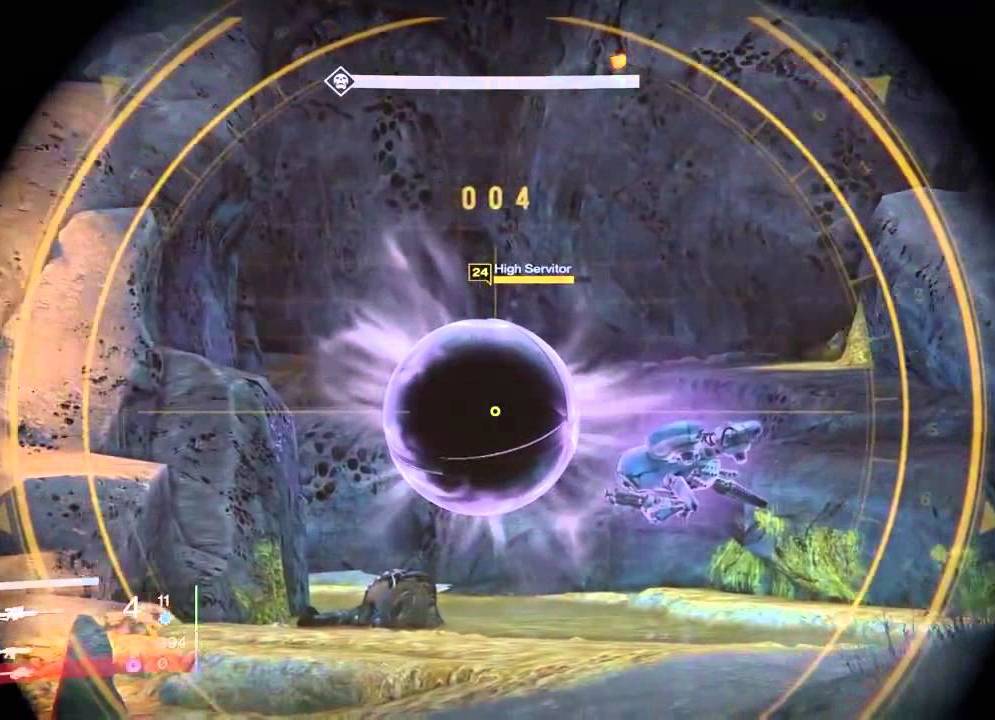
Went on this strike mission on Venus, at Ishtar’s Sink, and ran into an Archon Priest. What a bear and a bug it was to take him down! He was an amusing foe, though, with his wicked laugh and his presumed curses at us. His name was Aksor, and he was of the Fallen House of Kings. Besides noting my team’s victory, I wanted to record something else odd and amusing the Archon did. Servitors are everywhere and I don’t know how they all come into being, but Aksor makes servitors appear to assist him in an odd way. Maybe he doesn’t do this all the time (or didn’t, I should say), but as I was standing in front of him at one point, he squatted – yes, squatted – and emitted purple energy all around him. Then pops out a servitor. OK. So, was Aksor really female and she births those things, or is Aksor going to the bathroom, or is Aksor a male that drops a ball now and again? No matter which might be correct, all methods would imply either a limited number of drops or a necessary regeneration time. At least it didn’t smell.
New Friends
Banshee-44 and Phil
So I’ve been around for a while and have made some new friends. I took a pic of two of them together – aren’t they cool? One is the gunsmith at The Tower, Banshee-44–he’s on the left in the photo. The other is Phil, a strapping Exo Warlock; he’s good to have by your side on strikes. He has those exotic Sunbreaker gauntlets, which are just so awesome (and I lent him some coin for their purchase . . . . he owes me ^_^ )!
Banshee-44 and Phil are both Exos and get along great. I don’t mind just listening to them talk, especially since Banshee-44 is just so funny. When they first met Banshee dryly said to Phil, regarding his face paint, “Are those bite marks? Nasty . . . “.
When I first met Banshee, he said, “Have we met? I know that gun.” One time when I approached him it was early, and he said, “Nothing like a new gun in the morning.” “Indeed, indeed,” I said to him, and “If I purchase a new firearm from you, perhaps all three of us could go have some coffee and danish together.” I didn’t end up buying a gun that day, but next time I do I need to be there in the morning so we can get our Danish!
The Queen’s Wrath
The Awoken Queen said she expected me to answer her calls for assistance after she helped me gain access to the Black Garden, and she has wasted little time in calling! But as the Queen is rewarding diligence handsomely for doing her bidding, I am pretty much at her beck and call. She has two new shades to color armor, which I would love! – but, one of them requires that I do A LOT of her quests. I will see if I can accommodate her while her emissary is with us at The Tower (she is only with us for about two weeks, though I’m pretty sure she’ll be back again). It IS pleasant seeing her ship docked out past the large tower gate courtyard, with its huge streamers flapping in the breeze. Her bounties can be fairly easy, but her missions . . . that is another thing altogether.
The Black Garden
What a time I had at The Black Garden. I made it there, and I made it out alive; I fought the Vex and the Sol Progeny, alone, and have lived to tell of it. Or rather, I would live to tell of the beauty of that garden. If I can find a way back to the garden, I will go and maybe be able to get an image of it, an image worthy of its beauty and remembrance. The images I have seen of it come out so green, and no doubt that is the spiritual essence of the place – or so it was.
The walkway in the center, which is part stairway and travels downward, is beautiful in itself; but from it you can see the utter vastness of the garden. Its huge, depthless chasms, its field of black flowers that release red petals that float, float up, up; it’s so odd, and it inspires awe. Before you get to that area there is an interior sort of winding garden area with pools of water. I mention this because they, too, release something that floats–water coated gas bubbles emerge from the water, travel upwards, and dissipate. I want very much to return.
I want to mention a curious thing related to the enemy that “lived” in that timeless, placeless place. What is called The Black Heart was there, a disturbing, roiling mass of what looked like black oil. It had called the Sol Progeny to fight me, and these three Sol Progeny had been–to all appearances–lifeless statues. The Progeny were brought to life and emanated dark energy.
The thing I find curious is that I too was lifeless, and I was brought to life and draw on the power of the one who reanimated me, The Traveler. His energy is light, though. Just something that occurred to me. There are powers in this universe that control life and death, that can channel their own power through a living thing. I wonder if it’s someone’s unchangeable “destiny” to belong to a power that is dark or a power that is light. I’m glad I’m with the light, but for those with the dark, do they ever wish they weren’t? Do they ever think of “changing sides,” but cannot? Or once your being flows with whichever energy, is it even possible to think of being different? I’m thinking of it objectively now, but I am not tempted to change.
Who Am I, Really?
I have memories of battle, sort-of, and I knew how to use a high powered weapon right after my reawakening . . . it all seemed right and seemed to fit. But, I don’t know if all my “memories” are really my own. I mean, it dawned on me that I was found by my ghost amongst a ton of cars that were obviously in a jam, no doubt a jam that was headed outside the city; I wasn’t found at a battleground. All were dead, and I had seen more than one skeleton. All the dead there were very dead for a very long time. Yet, somehow, I was reanimated, flesh and all. Since The Traveler has the power to do that, He no doubt has the power to make me “know” things, like how to handle a weapon or two . . . and make it seem like my own memory. Or maybe I happened to be a Guardian (soldier) who happened to be running away . . . yeah.
I wonder if any Warlock has figured this out yet, but is simply holding out on us.
Black Garden Memories
I asked my ghost, and he was able to provide me some images from The Black Garden! It’s exciting, even though they are not very good. My ghost is more than amazing, but images simply can’t capture the all-encompassing beauty of The Black Garden. Here are just a couple, but I’ll be putting more together in a little photo album.
Me and my ghost at the Black Garden, just before the battle to destroy the Black Heart begins.
Me sitting at an interior garden area. It was so peaceful . . . after I eliminated my attackers.
As Days Go By
The Queen’s Emissary will depart soon, but I’m confident I’ll at least be able to buy a couple of weapons (and the “class armor” item, which for me, is just a fancy butt banner) before she’s gone. I was able to win her favor to a degree and obtain the Queen’s Emblem and a new shade of color for my armor–they are both very nice. But I will not have done enough by the time she leaves to have earned the special armor shade or the exclusive emblem. I’m a good guardian, but I not the best–at least for her purposes.
I know guardians who like fighting it out in the Crucible and who have guardian friends who can accompany them on the hardest missions. Those kinds of things are needed to win the highest favor of the The Lady of the Reef. I do some “strikes” with others, even the hardest Vanguard strikes, but the very hardest things, no, I’m not qualified yet to do them. My friend Phil, whom I mentioned earlier (and he’s in that great photo!), he’s very good but he’s still not able to do the hardest missions yet. He and I–we do many missions, even hard ones–by ourselves; still, the social guardians are the most highly rewarded.
PS: It took many tries at The Lady’s “Kill Order,” but I finally won the Queen’s Armor (the “chest plate”). I have it on in the two photos here.
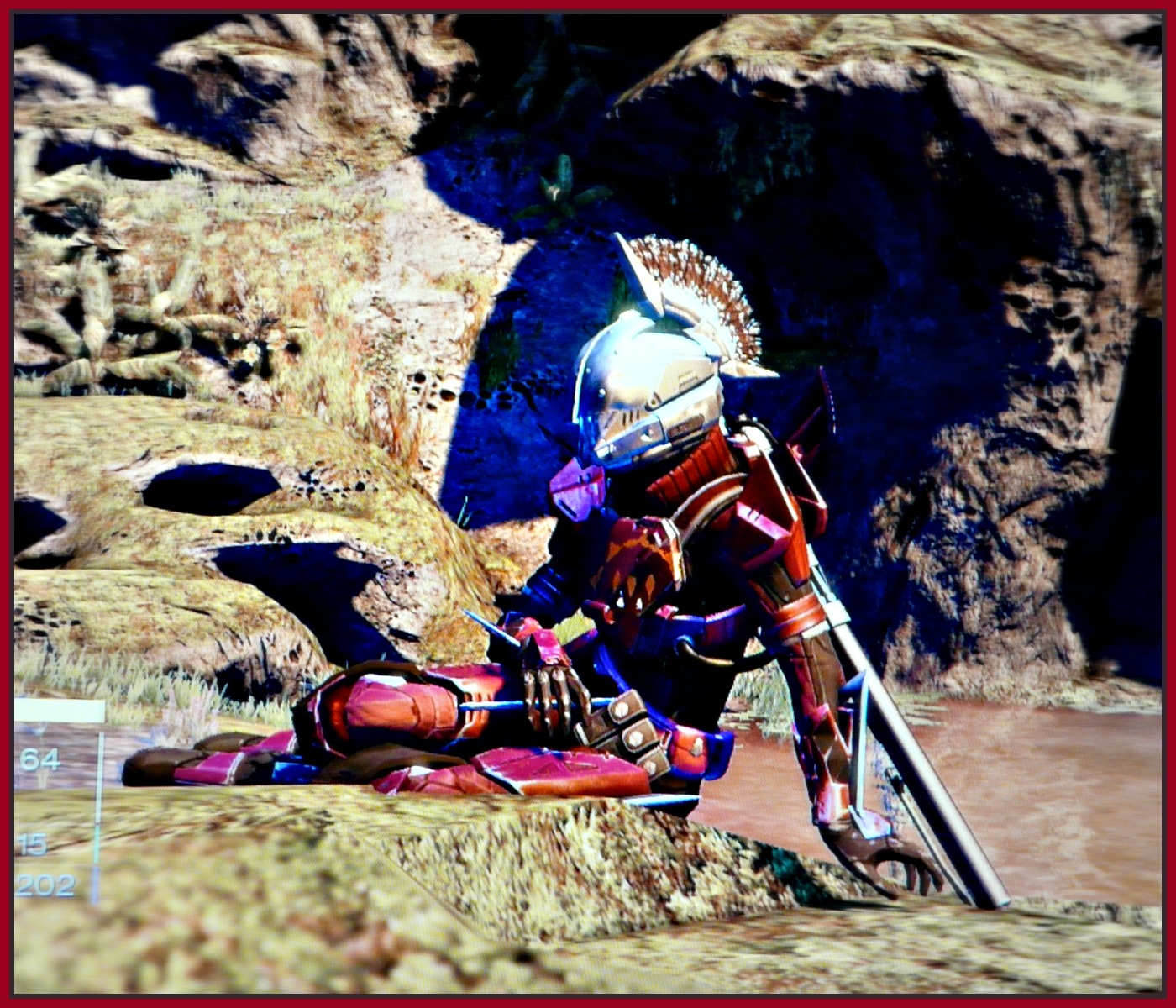
Me with my new helmet (Helm of Saint-14) and the Queen’s Guard Plate armor, on Venus.
More Guardian Training, Fewer Missions
Now that the Queen’s emissary is gone, someone else has set up shop in our tower: Lord Saladin. He’s from the Iron Banner and has some nice things for sale for those who prove themselves in the Crucible. I’m not very interested in training against guardians in the Crucible (I much prefer targeting real enemies), but he’s offering special bounties and missions there; Phil already made a reputation with Lord Saladin in his first day of doing his quests! Anyway, the machine gun he offers is just . . . awesome. It’s practical looking but in a clean, stylish way, with just the right amount of embellishments. It’s called “Jolder’s Hammer.” So, maybe I’ll be persuaded to do Saladin’s wishes! Or if Phil is nice, he may buy me one of those pretty machine guns. 🙂
The Queen had given guardians missions to do in the worlds, but no so with Saladin. So, I’ll just be going around, doing some strikes and such, and collecting Relic Iron from Mars and gathering all the other collectable things a guardian can to improve armor and weapons, and to bring to the guilds for trade. I’ll have enough this week to buy the last weapon that I want that is actually purchasable right now. After that, I’ll have less to do. I think it will be time to catch up on some reading! I might as well add these photos I took, too. I wish they could really capture the beauty or other aspect of the place that I see when I’m there.
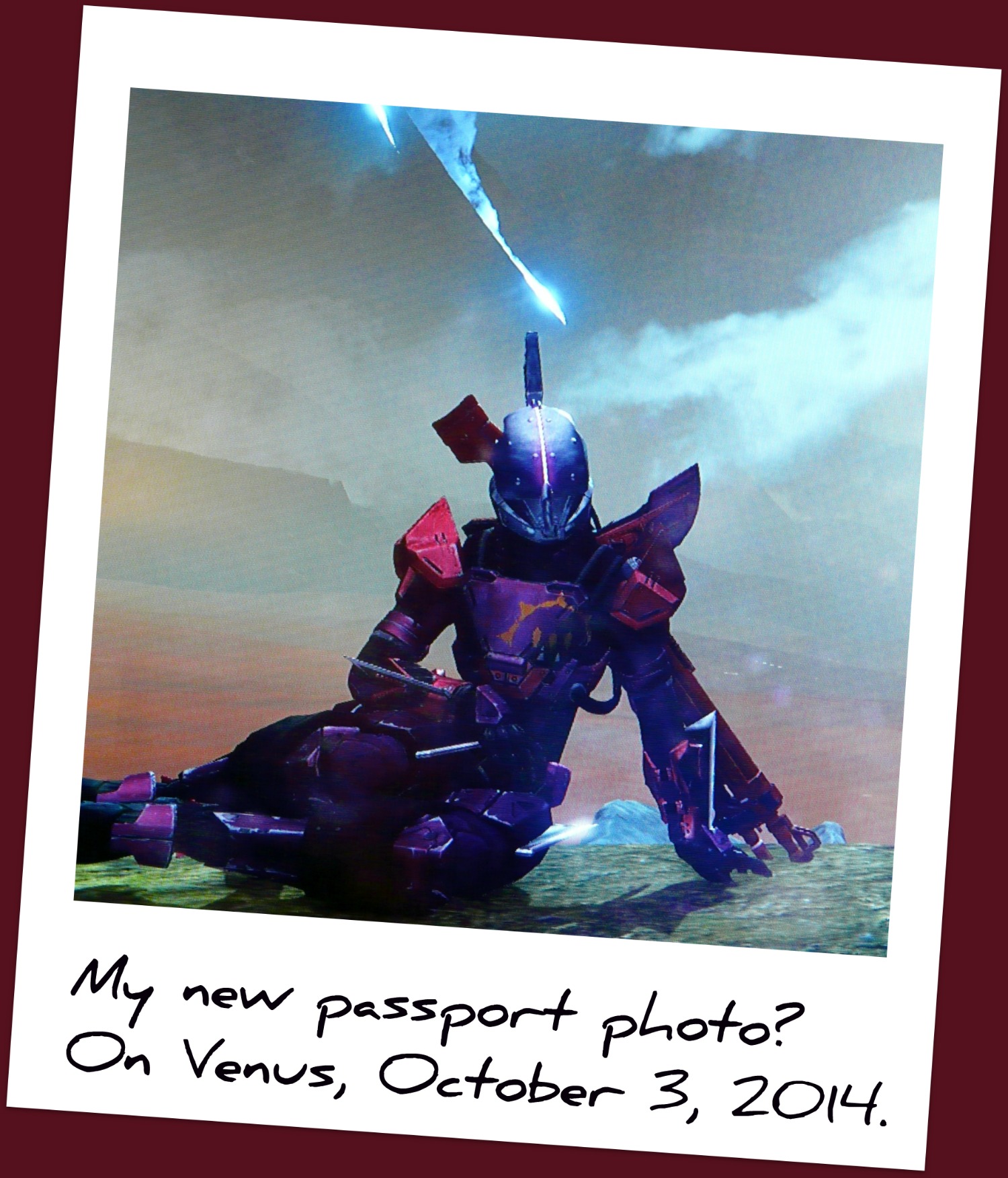
This area is so beautiful – this photo is only part of the whole. There’s a little pond at the bottom of the waterfall, and I often see a rainbow there. So very peaceful compared to much of . . . everywhere.Venus is so beautiful, but it has its creepier and drearier aspects. Red water, decrepit buildings, bizarre clouds.Venus, how beautiful it was; the manmade there didn’t take over and overwhelm the natural. But Venus’ nature can’t be tamed. White-blue “lava” can be seen behind the buildings as “comets” fly through the air. I call this my Venus at night postcard.
Going All Out Against The Hive
Since Eris Morn came to the Tower, I’ve been sent off to kill off more Hive enemies. This is OK by me, but I haven’t gone after Crota himself yet . . . Eris is interesting and I’d like to know more about her, but she’s pretty tight-lipped. Or, maybe, she doesn’t really know enough about herself–what happened to her–to even tell me. I know she’s a former Guardian who is the only survivor of a group that hunted Crota, but how the Hive took away her light, and how she ended up having darkness and Hive elements while still remaining with The Light, is a mystery. At least to me. Why does she hold that orb of dark light with a shard of something floating in it? Since the Hive had used a shard of the Traveler to weaken it, maybe Eris is doing the same thing to The Darkness. I hope we can find out more about her. Maybe she’ll open up at the Tower pub??
________
* The game is set 700 years in the future, but from “near” our present time, when – as you can see in the opening of the game – humans had landed on Mars. So, I made up a “we landed on Mars” future date and added 700. This is the date for my character’s rebirth, not an official date from Bungie.
For a recent review, or impression, of Destiny after its first DLC was released, see Don’t Buy Destiny . . . Unless (honestly, if you like shooters and that’s what you’re after, Garden Warfare might be a better choice).
Some would say I’m a bit of a tom-boy, but when it comes to Hello Kitty, I’m all girl. If, somehow, you’ve missed the ubiquitous feline adorning girls and women alike, let me tell you a bit about her; if you came here trying to figure out if she’s actually diabolical, I’ll get to that. Hello Kitty is the star in the line-up of successful characters created by Japan’s Sanrio Company, Ltd. (Sanrio, Inc., is its U.S. subsidiary). Now at the ripe age of 40, she is more popular than ever and is one of the most successful brands in the history of marketing. She is so popular that Sanrio–without advertising–brings in $7 billion a year from her character alone.
Sanrio’s perspective is to spread happiness, love, and friendship. Their success in selling seemingly innumerable products, running popular theme parks, and even having Hello Kitty painted on airplanes (EVA Airways), shows that people desire to connect with those values.2
An image from Chernobyl, Russia, filtered by author (found at http://bit.ly/1t2nfGr). This looks eerily like an image from the Fallout video game series.
Contents
About Honest Hearts
Psalm 137
Stephen Vincent Benet’s “By the Waters of Babylon”
The Influence of Psalm 137 and the surmised influence of the By the Waters of Babylon story in Honest Hearts
About Honest Hearts
The Fallout video game series takes a player on dangerous adventures through various regions of the United States after a future nuclear war with China has taken place. The series is one of the more successful in the “role playing game” (RPG) genre, taking place in “post-apocalyptic” times (2161 and forward). “Honest Hearts” is a 2011 add-on to the Fallout New Vegas game of 2010, taking place in what is Zion National Park in the real world, year 2281. While it’s obvious that people died in the park due to the historic nuclear cataclysm, the park itself is mostly unscathed by this point in time.
There are two outside leaders, both Mormon and both from the recently destroyed “New Canaan,” who lead two neighboring tribes, the “Sorrows” and the “Dead Horses,” in Zion Canyon. However, these two leaders have wildly different backgrounds and, not surprisingly, their views on how to handle the invading “White Legs” tribe are miles apart. It is no secret that the White Legs want to kill the Zion Valley inhabitants, just as they destroyed New Canaan. But what will the player do? Aid Joshua Graham and the tribals that wish to stay in Zion by meeting the White Legs head on, or will you side with the more pacifist Daniel and help the Sorrows flee the valley for a new home?
Considering that there were no women that had any kind of leadership role in the religion of Israel at the time of Christ, it is truly radical that there are so many women mentioned in the New Testament who promoted the faith and who in fact had leadership roles. Jesus led the way for women to not only find salvation and comfort in him, but to realize what Galatians 3:28 says: “There is neither Jew nor Greek; there is neither slave nor free; there is neither male nor female; for you are all one in Christ Jesus.” That the latter church chose, for the most part, to forget Jesus’ lifting up of women and change words in the translation of Paul’s writings – some are shown below – is unfortunate (to say the least) and makes arguing for the accuracy of many translations more difficult.
But who were Paul’s co-workers, and what level of leadership did they really have? For right now, let’s focus on three: Priscilla, Phoebe, and Junia. There is so much that could be covered that information on their roles is presented in a concise list format:
Priscilla. Apparently well-educated, and thus from an influential Roman family.
Priscilla and Aquila, her husband, taught Apollos more about Christianity after they had heard him speak publicly (Act 18:26). Priscilla was the primary teacher, as evidenced by her name being given first. Of the six times she and her husband are mentioned in the NT, she is first four times. “The order of names in ancient times indicated priority of role and importance” (Schmidt 178). St. Chrysostom (AD 347-407) confirmed that Paul placed Priscilla first for good reason. Significantly, whether ahead of her husband or not, she taught a man.
She is acknowledged as being well known by the gentile churches (Romans 16:4). She would not have been well known unless she had leadership functions. Paul refers to her as synergos (Romans 16:3), the same word he used for Timothy and Titus, who preached and taught. She was a “fellow worker” (synergos) with Paul, not a silent and passive female.
One of the oldest and largest catacombs in Rome bears her name, as do several monuments.
No one really knows who wrote the Book of Hebrews, and the suggestion that Priscilla wrote it is not discounted even in the Archaeological Study Bible (Garrett); some suggest, too, that she “polished up” Paul’s letter to the Romans.
Phoebe. Carrier of the Roman epistle to Rome from Corinth, a 400 mile journey.
In Romans 16:1-2, Phoebe is referred to as a diakonos, or deacon. “Deaconess” was not a word at that time and was first used in AD 375. The common word “deacon” is most often translated “minister” in the King James Version, though it is rendered “deacon” three times; however, when that word is used with Phoebe, the KJ translators used “servant” instead. Amazingly, the slightly earlier Miles Coverdale bible had kept the word “minister” for Phoebe, but recent translations still use “servant.”
Paul called himself a deacon (diakonos) in 1 Corinthians 3:5, and it is used for Timothy in Acts 19:22. Deacon is used with “co-worker” (synergos) and commonly meant someone who teaches and preaches; the person would have some authority in the church. Another thing to consider is that the term deacon was masculine and only males functioned as deacons in Greek culture. Paul very well knew what he was doing when he used that term for Phoebe.
Paul not only said Phoebe was a deacon, but a prostatis (Romans 16:2) as well. Prostatis “meant ‘leading officer’ in the literature at the time the [NT] was written” (Schmidt 181). To us it would mean something like “superintendent.”
Origen (AD 185-254), who was not a feminist, wrote that based on Romans 16:1-2 Phoebe had apostolic authority.
Junia
Junia is found in Romans 16:7, where the name is still often mistranslated “Junias.” The name “Junias” was non-existent at that time. The Archeological Study Bible (Garret, p 1860) notes that “the more common” reading in Greek is “Junia.” She probably was the wife of Adronicus, the other person mentioned in that verse. For the greater part of church history—the first 1300 years—all acknowledged that the person was a female! Why did bible translators in the last several hundred years change Adronicus’ companions name? Because Paul referred to them both as apostles, and outstanding ones at that. St. Chrysostom, St. Jerome, and Peter Abelard all considered the person to be a woman.
Paul did not restrict the word “apostle” to the twelve only (he called James an apostle and interchanged it with the word diakonos), as is common today. Origen wrote that women had “apostolic authority” in the church based on Romans 16.
The note on Romans 16:7 in the Apologetics Study Bible (ASB) goes almost as far as what Origen wrote and thought, but why can’t our Christian culture acknowledge what Paul actually wrote? Interesting, isn’t it? I, the author of this paper, am female, yet I have a bit of a hard time personally accepting female church leaders. I believe my view is based on both personal and cultural factors, but knowing what Paul wrote and what Christ did, I would not argue that a congregation is wrong in having a female leader. This is the note from the ASB (Cabal, p 1704):
Many claim that Junia (or Junias), designating one of Paul’s relatives, could be either a man’s or a woman’s name. In fact, the masculine form, Junias (as a contraction of Junianus), has not been located elsewhere, whereas the feminine Junia is common. Of course, if this person was a woman, this would be an intriguing fact, particularly since Paul called Andronicus and Junia “apostles.” J.D. G. Dunn suggests they were husband and wife—a reasonable assumption. The precise status of all who are called apostles isn’t clear. Some were close associates of the apostles, such as Barnabas (Ac 14:14) and James (Gl 1:19), but also see the Greek term apostolos in 2 Co 8:23 and Php 2:25.
When it comes to the question of women in Christian leadership, 1 Corinthians 14:34-35 and 1 Timothy 2:11-15 are used to show God’s disfavor of women having such roles. In light of both the whole New Testament and of all of Paul’s extant writings, we know that these passages are contradictory; they at least seem so without looking deeper into the social contexts or possible translation issues. Some scholars even propose that 1Timothy was not written by Paul, and therefore not genuine. However, in this article we will explore some possible reasons for Paul having written 1 Corinthians 14:34-36, even though he acknowledged females praying and prophesying in chapter 11 of the same epistle.
1 Corinthians 14:34b-35 states: “women should remain silent in the churches. They are not allowed to speak, but must be in submission, as the Law says. If they want to inquire about something, they should ask their own husbands at home; for it is disgraceful for a woman to speak in the church” (NIV 1984).
Why would Paul say this when he commended many women who had house churches? These include Mary (mother of Mark), Nympha, Priscilla (with Aquila), and Apphia. These house churches did not follow sexist synagogue rules. Also, Mary, Jesus’ mother, prayed with the other disciples. Women apparently spoke at Pentecost (even though “men” are mentioned, the text states that the Holy Spirit rested on all who were there, and Peter quotes Joel concerning women prophesying as well as men) and Tabitha was a disciple. Considering that Paul writes of women praying and prophesying in church earlier in the same letter, why would he then write verses 14:34-35?
One explanation is that these verses were added later—called an interpolation–and there is a possibility of this. These verses are commonly found at the end of the chapter in various manuscripts and seem to have been added by scribes early on (but later than Paul). However, since no early manuscripts have been found that do not entirely omit the verses, the interpolation explanation remains only a hypothesis. Another thing to consider, however, is the command for women, or wives, to ask explanations of their husbands at home later. At the time 1 Corinthians was written, there were many more women in the church than men, so were they to ask their unbelieving husbands about Christian truth?
Katherine Bushnell, a conservative scholar, agrees with the interpolation theory: “[Bushnell] buttressed her argument by saying that it was not like Paul to use the laws and traditions of the Jews ‘as a final authority on a matter of controversy in the church. He spent a large share of energy battling against these very “traditions” of the Jews, as did his Master, Jesus Christ’” (Schmidt 188-189).
While the interpolation theory seems like a plausible explanation, not all those who dismiss the direct but contradictory message of 1 Corinthians 14:34-35 agree with it. Another explanation is provided C.S. Cowles. She provides a word study showing that some women were being referred to, not all women; that the “silence” was that of voluntary restraint; and that the “speak” referred to—and there are 30 different Greek words for “speak”—has the meaning of “talk” or “chatter.” Paul wasn’t saying that women could not pray or prophesy, only that the women who were talking during service needed to not be disruptive. She defends the use of the word “law” as Paul’s way of appealing to social convention.
Regarding the admonition for wives to consult with their husbands at home, Cowles believes that the women had felt free to ask questions during service since the early services were not formal, but quite social, and it had gotten out of hand. She does not try to explain why women with husbands are the only ones referred to here, nor the related criticism of them having to possibly rely on unbelieving husbands.
Another explanation, which is highly possible and thought by many to be most likely, is that Paul is quoting from a letter (or stating an argument) from the Judaizers. Judaizers wanted traditional oral law enforced in other ways and places as well (for example, they wanted males to be circumcised), and these verses are very similar to the actual Jewish oral law prohibiting women to speak during services. Considering how the law is cited in this passage–which would be highly out of character for Paul, the explanation that those verses are a quote makes perfect sense. Also, the verse immediately following is a rebuke: “Did the word of God originate with you? Or are you the only people it has reached?” (14:36). Is Paul rebuking the Judaizers for trying to silence women, when Paul already acknowledged that women can speak and prophesy in church (11:5), and when Paul so often commended the women co-workers, deacons, and even ministers or apostles that he knew and worked with? It seems so.
But why don’t we know for sure that verses 34-35 are a quote? Quotation marks of any kind were not used in these ancient writings. However, it is accepted by many NT scholars that 1 Corinthians has many quotes within it, but not all agree that 34-35 is a quote. One of the scholars who does believe that it is a quote from Jewish oral law, however, is Neal Flanagan, a Catholic. He has written that since it is a quote and that Paul rebukes those who would silence women, it is then a text that reaffirms 1 Corinthians 11:5 as well as Galatians 3:28.
Christ is primarily known as the savior of the world – his sacrifice being for all who want to dwell with God (Jesus’ blood removes our sin so that we are able to be in the presence of the sinless God). But Jesus did something quite significant and often overlooked (as evidenced throughout the writings of the New Testament): He raised the status of women to the same level as men. Many would argue that men and women have a few different responsibilities in regard to the family and church, but in God’s sight the sexes have equal standing: “There is neither Jew nor Greek, slave nor free, male nor female, for you are all one in Christ Jesus” (Galatians 3:28).
There is a great deal that can be written on this topic–including the contradictory teachings of, and actions by, some church leaders and Christian men. But first, let’s look at some social mores that exhibit the status of women in Israel and the surrounding cultures at the time Jesus walked the earth, and some that are still with us today in various parts of the world.
Female babies are of low worth: In past and present non-Christian cultures, female worthlessness is widespread. Female babies were commonly the victims of infanticide. While that continues today, in places where ultrasound is available many more female fetuses are aborted than male fetuses (especially in China and India). Christians do not value females less than males and do not abort or kill female babies.
Polygyny and divorce: Polygyny was permitted though not very common in ancient Israel; it was relatively common elsewhere. In Greece, a man had one wife but he also had a legal mistress (so, essentially, a 2nd wife). Polygyny was not approved by God, though there are a number of instances of it recorded in the Bible. The NT clearly reiterates God’s will that one man be married to one woman; polygyny is not allowed in Christianity. A man could divorce his wife easily in ancient Israel, but the NT does not allow for this.
Complete control of wife and children by father or husband: In Rome, fathers had total control over family members, and a husband had absolute power over his wife; he could sell a daughter to her future husband. All these powers became illegal some years after Christianity became legal in Rome (374/313). Women also were granted the right to own property and have guardianship of their own children. In Greece, wives had segregated quarters and could not visit male guests of her husband’s in her own home. As in ancient Israel, women in Greece were not to speak in public. Women simply had a very low status in Greece and ancient Israel, and in Israel at the time of Christ, women’s legal witness was virtually non-existent. This obviously changed with Christ’s work.
Clitoridectomy: The removal of the female clitoris, and often other genital parts, is a common practice in many African countries (and is found in countries where Africans have immigrated to). This is condemned and outlawed in Christian-based countries.
Binding feet, China: In order to be more attractive to men, girls used to have their feet bound so that they remained “small.” The fact is, the foot only became very disfigured and it often became severely infected. Because of Christian missionary pressure in the 19th century, the Chinese government outlawed the practice of female foot binding in 1912.
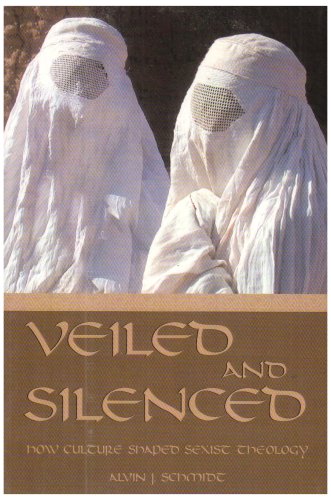
There are other practices around the world (past and present), like burning or burying widows alive (in India), arranging marriages of female children (this still occurs in China, India, and parts of Africa), maintaining double standards for adultery, and the forced wearing of veils, that make obvious the widespread low status of women but which are condemned by Christianity. As Alvin Schmidt, author of How Christianity Changed the World, said in an interview, “Geroge Sarton, a historian of science, once said, ‘The birth of Christianity changed forever the face of the Western world.’ As far as I know, Sarton had no love for Christianity. He merely said what history revealed to him. Another historian, for instance, has said, ‘The birth of Jesus Christ was the turning point in the history of women.’”
Now let’s look more specifically at how women were viewed and treated by Israel when Christ lived, and what Christ did to elevate women. Today when we read the New Testament (NT) text alone, we simply cannot understand how radical so much of what Jesus did was; our culture reflects in so many ways the changes that Jesus began. The radical things Jesus did seem normal to us now, so we must look into the context of the times to fathom the changes that he wrought.
At the time of Christ¹ women existed for the pleasure of men. If a woman did not bear a male child or didn’t please her husband in some way, he could divorce her with ease. A woman could not divorce her husband. Women were not to speak in public with men (men should not even give a greeting to a woman in public), they were not to testify in court, they were not supposed to read the Torah (Law), nor were they to be taught. As a rabbinic teaching advised (Sotah 3.4), “Let the words of the Law be burned rather than committed to a woman . . . . If a man teaches his daughter the Law, it is as though he taught her lechery.” Also, women were set apart from men in synagogue worship, either by a partition or by being in separate rooms.
Each one of the above negative aspects of womanhood in ancient Israel was reformed by Jesus, as it was never God’s will that such treatment of women exist. First, regarding a man’s ease in divorcing his wife, Jesus told his disciples that it was not to be—that instead a man could divorce his wife for unfaithfulness only (Matthew 19:4-9). Second, what about women speaking to men in public? To the great shock of his disciples, Jesus not only spoke to women in public, but also to a Samaritan woman publicly (she was very shocked as well) (John 4:5-29)–both no-nos in ancient Israel. In speaking with the Samaritan woman at Jacob’s well, Jesus also taught her. Jesus both spoke and taught to Martha in public (John 11:25-26). Jesus taught Mary, Martha’s sister, and commended Mary for wanting to learn from him (Luke 10:38-42). Another woman followed Jesus in order to be healed. She was not only healed by him, but he talked with her and blessed her publicly (Mark 5:25-34).
These are not the only interactions that Jesus had with women. There are very many recorded in the NT. Of very real significance, however, is Jesus’ appearing to women first after his resurrection (Matthew 28:1-10; Luke 24:1-12; John 20:1-18). This put women in a whole new realm of being chief witnesses. Remember, women could not testify or be a witness in court. The fact that Jesus appeared to women first, and told them to go and tell the male disciples of his resurrection, had to have really driven home the message of women’s spiritual equality to the disciples—once they accepted the truth of Jesus’ resurrection that the women were telling them. After Jesus’ ascension into heaven, the believers, both male and female, met and prayed together (Acts 1:14). As the fellowship of believers grew they met in houses for “church,” and many of these houses were owned by women. The possibility of the women as leaders in these early churches will be included in another of this series.
_________
Note 1. How Israelite men viewed and treated women changed and varied through time, and was no doubt influenced by the cultures that surrounded them. This essay is interested only with the status of women at the time of Christ.
The second and third articles in this series can be found here:
God According to God, by Gerald Schroeder (HarperOne 2009)
If the discoveries in physics over the past century are correct, then that physically condensed energy of the big-bang creation is totally the expression of metaphysical wisdom (cited in Gen. 1:1) or information (J.A. Wheeler) or idea (W. Heisenberg) or mind (G. Wald). Physics not only has begun to sound like theology. It is theology (p 156).
God According to God, written by a MIT trained physicist and applied (Jewish) theology professor Gerald L. Schroeder, is a fascinating read (even if the subtitle, A Scientist Discovers We’ve Been Wrong About God All Along, seems a bit of a stretch). It’s an important read, too, if one takes the accolades on the cover seriously. For example, “A remarkable book. The science as well as the meaning of this universe and of life are discussed with insight, rigor, and depth,” says Nobel Prize (physics) awarded Charles H. Townes.
What’s really amazing about this book is that it combines modern science with theology in such a human way. It’s written for the layman, yes, but it is written to show that not only is belief in God not inimical to science, but that modern science is actually proving God (or at least the metaphysical), and that taking God and the Bible seriously (and not simplistically or superficially) reflects reality and how we are to live in it. The God of the Bible is simply not the god the critics so energetically and often vehemently criticize.
“The world gets its share of free reign and when a mess arises, the God of the Bible may enter to aid in the repair. Nipping the potential evil before allowing it to flourish would be a compassionate world-management system, but that fails to match the blueprint brought by the Bible. The logic lies in the need for an unhampered free will. God hides the Divine presence sufficiently to allow each of us to make our own choices, for better or worse, freely within the confines of our physical and social landscape . . .“ (p 205).
After the introductories, Schroeder presents issues regarding the origin of life, and how much “science” popularly held is not accurate or true. For instance, there is no logical reason why RNA would have developed on its own in our prebiotic world; everything is against it happening. He refutes Stephen Hawking’s (and Scientific American’s) embarrassingly optimistic view of life happening on its own, providing data on how it would be impossible for random mutations to create the variety of proteins used in earthly life.
Earth itself is unique and improbable. The elements in our universe that make life possible are surprising and improbable too, with carbon being the most unlikely. While carbon is common, it is not at all easily made. The astronomer Sir Fred Hoyle, who was an agnostic before the means by which carbon could be abundantly formed was discovered, later said: “Some supercalculating intellect must have designed the properties of the carbon atom, otherwise the chance of my finding such an atom through the blind forces of nature would be utterly miniscule” (p 62).
For the Christian who has read other layman-oriented resources regarding origin of life and evolution issues, and facts about the specialness of earth, I recommend reading this book as well. In combination it is about the most informative and wonderfully written as you’ll find. Also for the Christian, Schroeder offers some eye-opening insights into Genesis and the possibility of nature as rebel (his other biblical interpretations from the Jewish perspective are also very much worth chewing on). He ties in the possibility of nature rebelling with what we are learning of nature at the quantum level. We now know that atoms are not the smallest units of matter, but the particles that make up atoms do not behave like matter. They may even be waves, and they seem to behave in way that indicates “mind.”
The European conception of “evolution” includes the metaphysical, and apparently many leading scientists are leaning toward the view that nature has “mind.” Neurosurgeon Frank Vertosick, Jr., talks of the “microbial mind,” Freeman Dyson (physicist, Institute for the Advanced Study, Princeton) and others show that “Atoms are weird stuff, behaving like active agents rather than inert substances. They make unpredictable choices between alternative possibilities . . . . It appears that mind . . . is to some extent inherent in every atom” (p 95). Mathematician and physicist Sir James Jeans wrote (pp 90-91):
“There is a wide measure of agreement which, on the physical side of science approaches almost unanimity, that the stream of knowledge is heading towards a non-mechanical reality; the universe begins to look more like a great thought than a great machine. Mind no longer appears as an accidental intruder into the realm of matter. We are beginning to suspect that we ought rather to hail mind as the creator and governor of the realm of matter.”
We cannot see or understand this “mind” in nature, and we cannot even understand our own brain-mind connection. We may know that chemical reactions take place in our brain that are related to specific activities, but we still do not understand how we remember, think, or imagine. Just as there is something else to nature than predictable natural laws, there is more to us than the physical. “The dogmatic myth of materialism has been proven to be wanting, more fantasy than fact. . . . in the words of Nobel laureate and biologist George Wald, ‘The stuff of which physical reality is composed is mind-stuff. It is mind that has composed a physical universe’” (p 151).
Schroeder’s thesis can be summed up thusly:
“Within the subatomic world, there is a probabilistic pattern established by the laws of nature. Individual quanta, however, may ‘choose’ not to follow the given path. So too is the history of humanity. Torturous though the trend may be, God has a plan for humanity. The microengineering of that plan is largely up to us. There is a flow from pagan barbarity toward the elusive goal of peace on earth, goodwill to all. Each of us, as individuals, chooses whether to enhance or impede the flow toward the Divine goal” (p 215).
Authors Cited
Dyson, Freeman. “Progress in Religion” (acceptance speech, Templeton Prize), March 2000.
Heisenberg, Werner. Physics and Beyond (New York: Harper & Row, 1971).
Vertosick, Jr., Frank. The Genius Within (New York: Harcourt, 2002).
Wald, George. “Life and Mind in the Universe,” Quantum Biology Symposium, International Journal of Quantum Chemistry 11 (1984): 1-15.

















 With Christian Eyes