Français : Bourges – 7 place Gordaine – Plaque commémorative Simone Weil (1909-1943) professeur à Bourges en 1935-1936 (Photo credit: Wikipedia)
Who is, or was, Simone Weil? If increasing attention in the way of books and a newer documentary mean anything, particularly considering her death was some 70+ years ago, then she’s obviously “somebody.” At least two meanings of the word “prodigy” apply to Simone: (1) she was known to be a genius from a very young age and is a recognized philosopher, and (2) by her short, painful, yet beautiful and selfless life. Being a Christian mystic and having been “adopted” by Catholics (Simone never became a member of any church), had perhaps contributed to a certain level of obscurity until more recent years.
All books that bear Simone’s name were published after her death (1943), with one of the most well-know being Waiting for God (WfG; 1951), a collection of spiritual letters and essays. Much has been made of her spiritual life – and rightly so – but for a biography that focuses on her philosophy, see Palle Yourgrau’s Simone Weil (Reaktion Books 2011). A 2010 documentary made the film festival rounds and is now on DVD: An Encounter with Simone Weil. The odd film focuses on life, death, suffering generally, and on these words of Simone’s specifically: “Attention is the rarest form of generosity.” (I wrote a fairly in-depth review of the documentary here: Secular Girl Activist meets Christian Girl Activist . . .)
Simone was born in France in 1909 to agnostic Jewish parents. At the age of six she could quote classic poetry, and despite interruptions in her education (and the onset of migraines), she received her baccalaureate at the age of 15. Simone had a deep desire to know “truth,” so she attended graduate school and became a teacher of philosophy.
Do not think that she lived comfortably from the “ivory tower.” As early as age five she refused to eat sugar because the French soldiers could not have it, and she maintained this practice of food-denial all of her life. She chose not to turn the heat on in her rented rooms since the unemployed could not afford it themselves, and gave much of her salary to the poor and to workers’ causes. She was very politically active, striving to secure better conditions for factory workers, and was involved with the defense of her country during World War II.
Simone seemed to apply her whole self towards realizing her convictions. Even though frail, she was always working, thinking, writing—incessantly doing. She even went so far as to travel to war-torn Spain, in 1936, to fight against the Fascists. She was a pacifist but felt so strongly about the cause that she volunteered for the most dangerous assignments. Because of a severe cooking-related accident, however, Simone did not stay there for very long. And her witness of an execution of a 15-year-old boy by the people she supported, among other things, caused her to not return.
Perhaps the personal experience of war caused a crack in Simone’s idealism that became an entryway for God. In 1937, Simone wrote of an encounter while at Assisi: “something stronger than I was compelled me for the first time in my life to go down on my knees” (WfG pp 67-68). Then in 1938, while having severe migraines during Holy Week services, Simone had the experience of separating herself from the pain to enjoy the beauty of the service and to receive understanding of the passion of Christ. That same year, while reciting a Christian poem about accepting Christ—which she claims she hadn’t understood as such—Christ indeed “came down and took possession of me” (WfG p 69).
Though she accepted Christ, Simone’s writings are controversial. Some do not believe Simone was really a Christian; she had consideration and respect for other religions, and some fairly unorthodox theological views. In her “religious” writings, she often wrote of wrestling with God over truth. Though she wrote about spiritual truths found in other religions, or even myths (CS Lewis and JRR Tolkien held similar views), in the final analysis only Christ is truth: “Christ likes us to prefer truth to him because, before being Christ, he is truth. If one turns aside from him to go toward the truth, one will not go far before falling into his arms” (WfG p 69). A useful work in this regard is Simone Weil’s Apologetic Use of Literature (Marie Cabaud Meaney 2008).
Her friends in faith were Catholic, but she refused to enter the church because of its history and its exclusionary practices. Despite being an “outside Christian,” she wrote conventional ideas like: “It is not my business to think about myself. My business is to think about God. It is for God to think about me” (WfG pp 50-51), and “. . . I think that God himself has taken it [her soul] in hand from the start and still looks after it” (WfG p 73). Going deeper into her thought we find: “Only obedience is invulnerable for all time” (WfG p 63), and “. . . I always believed that the instant of death is the center and object of life” (WfG p 63). Significantly, and counter to some who attempt to claim that Simone was not a Christian, she told a friend a few months before she died: “I believe in God, in the Trinity, in the Incarnation, in the Redemption, in the teachings of the Gospel” (from Simone Weil, by Stephen Plant, p 33).
“This straw-targeting of Christianity is now drearily commonplace among academics and intellectuals—that is to say, among those who would not allow a first-year student to get away with the vulgar caricatures in which they themselves indulge with such insouciance” (p 52).
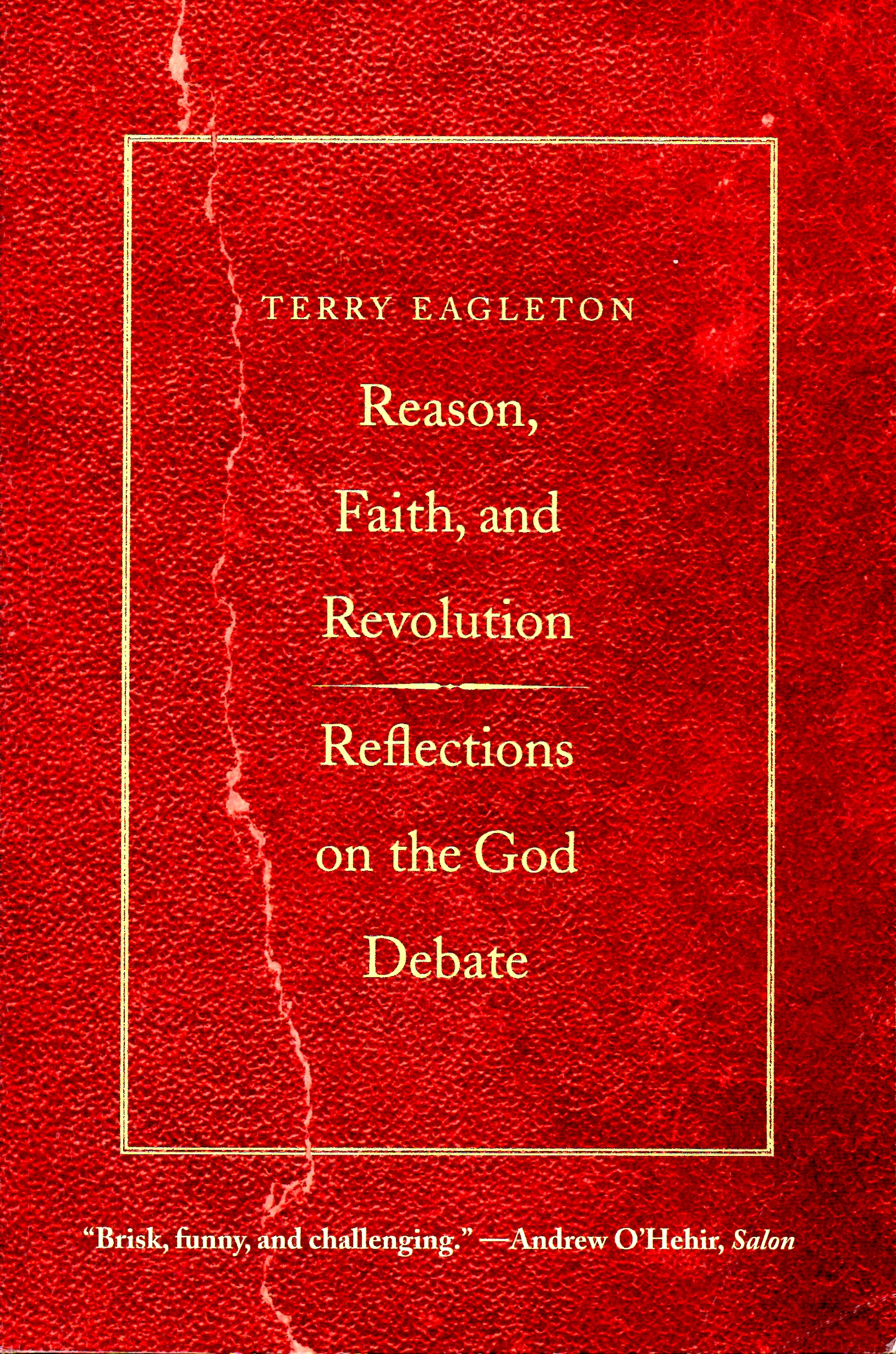
Terry Eagleton’s invective against anti-theist’s claims about religion, and Christianity in particular, is one of wit, humor, and sauce. One hopes that those that are curious about the popular anti-God rhetoric, but who are basically outsiders—neither informed and faithful Christians or card-carrying anti-theists—will be the prime readers and beneficiaries of this “lecture series” book. Not that there isn’t a good deal that those in the other groups can get out of it. Indeed, as the Booklist review asserted, “serious Christians may be [Eagleton’s] most appreciative readers.” But on the opposite side Eagleton himself opined that there was not a “hope in hell” that Ditchkins, that is Richard Dawkins and Christopher Hitchens, would read his work or be moved by it.
Eagleton, who is a professor both of English literature and culture theory, and who also writes philosophically (in fact, this book has been rated as important in philosophy), presents how the various arguments against religion that Dawkins and Hitchens vehemently espouse are very seriously misinformed and flawed. “. . . the relations between these domains [poetry and other language types] and historical fact in Scripture are exceedingly complex, and that on this score as on many another, Hitchens is hair-raisingly ignorant of generations of modern biblical scholarship” (p 54). He shows how Dawkins’ views, which reflect Victorian era progressivism, are simply unreasonable and unrealistic.
“We have it, then, from the mouth of Mr. Public Science himself that aside from a few local hiccups like ecological disaster, ethnic wars, and potential nuclear catastrophe, History is perpetually on the up. Not even beaming, tambourine-banging Evangelicals are quite so pathologically bullish. What is this but an example of blind faith? What rational soul would sign up to such a secular myth?” (pp 87-88).
Regarding Ditchkins and science, Eagleton discusses how “Dawkins falsely considers that Christianity offers a rival view of the universe to science” (p 6), and that “His God-hating is by no means the view of a dispassionate scientist commendably cleansed of prejudice. There is no such animal in any case” (pp 65-66). “[Scientists] are peddlers of a noxious ideology known as objectivity, a notion which simply tarts up their ideological prejudices in acceptably disinterested guise” (p 132), and Dawkins, for example, “castigates the Inquisition . . . but not Hiroshima” (p 133). While anyone is welcome to criticize superstition, the current culture has sunk into scientism, which refuses to take anything seriously that “cannot be poked and prodded in the laboratory” (p 72). “Ditchkins does not exactly fall over himself to point out how many major scientific hypotheses confidently cobbled together by our ancestors have crumbled to dust, and how probable it is that the same fate will befall many of the most cherished scientific doctrines of the present” (p 125).
In chapter 1, Eagleton presents basic Christian beliefs not only to show that Ditchkins does not have an understanding of them, but to also promote them as quite respectable. Of course, throughout his book Eagleton gives little quarter to “fundamentalists;” he praises Jesus and his radicalness, and those who actually follow His teachings to help the poor and seek justice. He also contrasts this Christian mandate to love socially to the liberal humanist (of which Ditchkins is an example) legacy of love being kept private. Yet another significant difference between Christianity (and for persons like Eagleton who hold a more socialist view) and the liberal humanism of Ditchkins is the matter of sin and redemption. To Ditchkins, there is nothing to redeem. Humanity is steadily progressing, even if catastrophes like World War II have happened.
“In my view,” Eagleton writes, “[scriptural and orthodox Christianity] is a lot more realistic about humanity than the likes of Dawkins. It takes the full measure of human depravity and perversity, in contrast to . . . the extraordinarily Pollyannaish view of human progress of [Dawkins’] The God Delusion” (p. 47). Christianity believes that there are “flaws and contradictions built into the structure of the human species itself,” and so violence in history is not just due to historical influences; and Christianity is hopeful. It is “outrageously more hopeful than liberal rationalism, with its apparently unhinged belief that not only is the salvation of the human species possible but that, contrary to all we read in the newspapers, it has in principle already taken place. Not even the most rose-tinted Trotskyist believes that” (pp 48-49).
There are all kinds of fun passages like those already quoted in Eagleton’s book. It can be very useful to Christians who want to be able to cite a seemingly non-Christian critique to the anti-theist crowd. Conservatives be warned, however, that Eagleton presents and is supportive of Liberation Theology (he is a Marxist who aligns himself with “tragic humanism”), and is very critical of modern capitalism and western foreign policy. He has good, though general, arguments for the atheism of capitalism and the disconnect between the West’s religious rhetoric and its actual practices (which, interestingly, he often places on liberal humanism). Indeed, Christianity’s lack of following its leader has brought much criticism upon itself, “Christianity long ago shifted from the side of the poor and dispossessed to that of the rich and aggressive” (p 55).
Eagleton points out the good that historic Christianity has done, which Ditchkins refuses to acknowledge, while pointing out hypocrisies of some liberals. Some examples:
“The values of the Enlightenment, many of them Judeo-Christian in origin, should be defended against the pretentious follies of post-modernism, and protected, by all legitimate force if necessary, from those high-minded zealots who seek to blow the heads off small children in the name of Allah. Some on the political left, scandalously, have muted their criticism of such atrocities in their eagerness to point the finger of blame at their own rulers, and should be brought to book for this hypocrisy” (p 68).
“Such is Richard Dawkins’s unruffled impartiality that in a book of almost four hundred pages, he can scarcely bring himself to concede that a single human benefit has ever flowed from religious faith, a view which is as a priori improbable as it is empirically false . . . . and this by a self-appointed crusader against bigotry” (p 97).
Speaking of empiricism and truth, I found chapter 3 more interesting the second time I read it. It’s really a pleasant read and borders on the mystical in places. Eagleton writes lucidly on how we understand truth and what is reasonable and rational. A set of examples about what is reasonable and rational, relative to what is true, is (1) that of humans previously thinking that the sun circled the earth – since it certainly looked that way it was rational to think – and (2) what we know of certain nuclear particles in our present time. These particles are said to go through two different spaces at one time. This is not rational or reasonable, yet we think that it is true. He continues with a discussion that promotes the concept of “love” being a precondition of understanding, concluding that “The rationalist tends to mistake the tenacity of faith (other people’s faith, anyway) for irrational stubbornness rather than for the sign of a certain interior depth, one which encompasses reason but also transcends it” (p 139).
“Yet the Apocalypse, if it ever happens, is far more likely to be the upshot of technology than the work of the Almighty. . . . This, surely, should be a source of pride to cheerleaders for the human species like Ditchkins. Who needs an angry God to burn up the planet when as mature, self-sufficient human beings we are perfectly capable of doing the job ourselves?” (p 134).
English: An early engraving by Blake for the Book of Job (Photo credit: Wikipedia)
Our God is amazing: He revealed to Job much of His distant future plan of Jesus as our redeemer, mediator, and savior. There are basically three ways that you can see Jesus in Job. First, Job suffered even though he was righteous; he didn’t suffer as a result of sin. This concept leads the way for the understanding of the suffering nation of Israel and the suffering savior. Second, utterances Job made that directly relate to Jesus’ role in our lives, including our bodily resurrection. Third, though seemingly controversial, is the role of Elihu as mediator.
So, how long ago was it that God revealed these things in what is now the Book of Job? While it is not known exactly when the book itself was written down, there are a great many reasons to accept the patriarchal period as its setting (it is thought to be the oldest book of the bible): there was no priesthood yet, since Job had acted as priest for his family; wealth was measured by livestock; and, Job lived to be over 200 years old. Other little details, too, point to the period described in the first part of Genesis. So Job spoke spiritual truths relating to salvation and end-times glorification long before Jesus came to us, or the Holy Spirit instructed the apostles in such matters.
Now let’s explore each of the three ways that Jesus is foreshadowed through Job. In the beginning of Job we are shown this scene: angels presenting themselves to God, when one in particular—Satan—insults Him. Satan accuses God of, basically, bribing people to believe in Him. “Does Job fear God for nothing?” “You have put a hedge around him . . . . You have blessed the work of his hands . . . . But stretch out your hand and strike everything he has, and he will surely curse you to your face” (1:9 -11). Even though God told Satan that Job was “blameless and upright” and that “there was no one on earth like him” (1:8), God allows Satan to destroy virtually all that Job has. This is Job’s first test. It is a test of faith, and Job passes. After all of his children, and most of his servants livestock are killed, Job declares: “The Lord gave and the Lord has taken away; may the name of the Lord be praised” (1:21b). Job suffered for all those righteous who came after him so that they would not need to feel guilt over suffering. It is established here that suffering is not necessarily a sign of sin in a believer’s life. Our Lord Jesus was blameless and he suffered much for our sake. Also, future believers needed to be ready to accept a suffering Messiah.
Poor Job, however, is given a second test. Some would say that he didn’t completely pass this second test, yet after God came and spoke with Job, He said that Job was right and his three friends erred (42:7). At any rate, the second test was an attack by Satan on Job’s personal being. Satan claimed that if Job felt that he was going to die, he certainly curse God (2:3-8). After his illness begins three of his friends come to comfort him, but they also end up trying to convict him of sin. They felt that he must be harboring some secret sin, or else why would he be suffering so? Job gets more and more angry with his friends because he can find no sin within himself that he needs to confess, and he finds their logic wrong: righteous people do indeed suffer at times. In Job’s responses to his friends’ accusations he speaks prophetically.
In verse 9:33, Job stated: “If only there were someone to arbitrate between us, to lay his hand upon us both.” Job is referring to himself and God. Job’s friends aren’t helping at all (they are, in fact, making things worse), so Job wishes for someone to accompany him to God’s court—a mediator. But when we get to verses 16:19-21, we find that Job realizes that there is in fact a mediator! “Even now my witness is in heaven; my advocate is on high. My intercessor is my friend as my eyes pour out tears to God; on behalf of man he pleads with God as a man pleads for his friend.” We now know that the name of our mediator—our friend in heaven—is Jesus.
A few chapters further, and Job gets downright glorious. He boldly said to his irksome friends: “I know that my Redeemer lives, and that in the end he will stand upon the earth. And after my skin has been destroyed, yet in my flesh I will see God; I myself will see him with my own eyes—I, and not another. How my heart yearns within me!” (19:25-27) Doesn’t that sound familiar?
The third way that Jesus is hinted at in Job is through Elihu. Elihu is not one of Job’s friends that came to visit him, but someone who had been listening to the dialogues. In Elihu’s discourse, he makes the point that Job justified himself at the expense of God (32:2, 33:8-11, 35:1-3, 14-16), and another point that his friends could not answer Job’s predicament and anguish (32:3, 12). He seems like a young upstart, yet he takes on the role of a bridge between Job and God (34:31-33). Indeed in verses 32:18b-19 he states: ‘the spirit within me compels me; inside I am like bottled-up wine, like new wineskins ready to burst.” The only other place in the bible where new wine and wineskins are discussed is in Jesus’ dialogue concerning the old and new covenants (Mt 9:17, Mk 2:22, Lk 5:37-39). Jesus, our bridge and mediator, is so strongly associated with wine that I couldn’t help thinking of Him as soon as I read Elihu’s exclamation. Jesus made wine for the wedding in Cana (Jn 2:9-10); Jesus told us wine is symbolic of his shed blood which is for the forgiveness of sins (Mt 26:28, Mk 14:23-24, Lk 22:20, Jn 6:53-56); and, Melchizedek, who gave wine and bread to Abraham, is viewed as a type of Christ (Gn 14:18, Ps 110:4, Hb 7:11-25). Elihu also brings up “a ransom” being found to save a man (33:24).
In his dialogue and by the placement of it, Elihu foreshadows both God coming to speak with Job and wringing Job’s repentance out of him, and God’s judgment that Job’s friends did not speak what was right (42:7; in regard to suffering in general and in regard to why Job in particular suffered). Elihu was intermediate between Job and God, and it seems that he probably prepared Job somewhat for God’s confrontation with him. In the end, Elihu is different too. God’s view of Elihu is unknown. He says of the three friends: “I’m angry with you . . . because you have not spoken of me what is right, as my servant Job has.” It seems that God’s spirit was indeed speaking through Elihu.
This brings to the end my writing about Jesus in Job, but I would like to present some additional comments on the difficult passage just presented. Why did God say that Job spoke of Him what was right when God Himself came down and sought a more humble Job? There are two things going on in Job when you think about it. One is Job’s tests and how he and his friends viewed God’s role in suffering. The other is Job’s relationship with God. Concerning the first subject, Job spoke what was right of God, and even prophesied. But concerning the second subject, Job’s spirit and relationship with God were taxed and Job ended up sinning. When God came to Job He never told him the reasons for Job’s suffering (subject one), but He did restore Job to a proper relationship with Him and saved Job from suffering more spiritually (subject two).
So, Elihu was a bridge between Job and God. Then Job, once restored, prayed for his friends so that God’s anger was turned away from them; Job thus became a mediator as well. Amazingly, you could say at least in a small way, that Job ended up being a suffering savior for his friends.
[In case you’ve seen this before, I had it posted at our withchristianeyes.com site]
Anastasis, symbolic representation of the resurrection of Christ. Panel from a Roman lidless sarcophagus of the “Passion type”, ca. 350 CE. From the excavations of the Duchess of Chablais at Tor Marancia, 1817-1821. (Photo credit: Wikipedia)
Below is the second half of a relatively long (but actually concise) treatment of evidences or evidential steps for the view that the Christian faith is rational, and even desirable, to hold (the first half is here). The introductory paragraph is repeated for clarity. Thanks for reading, and may the God of all creation bless you.
______________
For the person who wants to know that there is reason to believe a holy book–that there is evidence to back it up–different areas of apologetics have those answers. In fact, there is more evidence for the truthfulness of the Bible today than ever before, excepting when the events actually occurred. This essay assumes that the person searching for a legitimate holy book already believes that there is a deity of some sort; it does not cover arguments for the existence of God. What this essay does cover, in concise form, are the issues of reliability of the Old and New Testaments, fulfilled prophecies, miracles, and Christ’s resurrection.
Miracles
What is a biblical miracle, and what is its purpose and meaning? In the Judeo-Christian context, a miracle is a work of God outside of the patterns of normalcy. Miracles of healing and of being saved from death obviously show the intervention of a God who loves. Biblical miracles consistently show three things. One, they display God’s glory (they also have the effect of showing to God which persons react faithfully to His glory, and which do not). Two, they are proof that the person “performing” the miracle is from God (the source is God, not the person). And Three, they display God’s benevolence. Some examples of such miracles are found in Exodus 14:13-18, Daniel 3:16-30, Mark 2:1-12, and John 11:38-44.
Do miracles happen today? Yes, they do! Most people think they don’t because they aren’t reported in mainstream media. I knew a lady personally, one of the most stable and intelligent ladies I have ever met, who told me the story of her daughter being healed from a terminal illness. The Lord did an emotional healing of myself, and I felt His work in my whole body (I will not explain further here). Open Doors USA reported on its website, in 2002 (April 7), a cancer completely healed in China: “one young woman was healed from cancer. The doctor treating her had fainted from the shock of seeing the cancerous growth gone. We all laughed at that.” Pastor Andrae Crouch was healed of cancer (Nappa 1999). In September 2001, The Voice of the Martyrs wrote of a healing in its magazine/newsletter: a young Pakistani Muslim man was hit by a car while riding his bike, and his leg was broken. A woman came out of the crowd and prayed for him, in Jesus’ name. He felt energy move throughout his body and his leg was healed (later, she gave him a bible and was never seen again, and he became a follower of Christ). I have read of many other miracles, too, occurring at the time of a person’s salvation and others that happen that save a person from death. Some medical miracles can be read about at the World Christian Doctors Network.
What about miracles outside of the Judeo-Christian faith? There are some amazing and unexplained things that happen in the world that people might say are miracles, but which do not meet the criteria that show that they are from God. Some of these may not be explained yet, and others may be the activity of fallen angels. The magicians of Pharaoh’s court in Exodus 7 performed seeming miracles. A girl had a spirit that told the future in Acts 16 (16-24), but the spirit in her was not from God. The book of Revelation foretells of someone who will perform ungodly miracles (13:11-14). So, if “miracles” happen that do not seem like they are from God, that may in fact draw people away from God, we should not be surprised.
There are some Buddhist scriptures with interpretations that record possible miracles, but since the miraculous activities are self-aggrandizing and do not point to God (such as the changing of physical things to other physical things, flying, reading minds, passing through solid matter, etc.), they are not Godly miracles. A modern day Hindu “miracle” happened in 1995, which was apparently reported from all over the world (Hinduism Today, November 1995 [as cited in Powell 2006]). A man in New Dehli dreamt that the Hindu god Lord Ganesha wanted milk. So the man went to the temple and told a priest, who then gave the statue of Ganesha some milk. The statue “consumed” the milk. People heard of it and started offering milk to Ganesha statues all over, and the statues “consumed” the milk. This went on for 24 hours in India, but longer elsewhere. The “miracle” seems useless and it lacks benevolence; indeed, God is not transcendent in Hinduism belief and so any such displays are supernormal, not supernatural. In the Quran, it is written that Muhammad did not perform any miracles.
The Resurrection of Jesus Christ
I wonder if other Christians feel the same as I, that for some odd reason Jesus’ resurrection does not need explaining? The reality of Christ’s resurrection is a very significant topic in apologetics, however, since it is such a hard to believe event for the unbeliever. A subissue is the disharmony of the differing gospel accounts as to what happened at the empty tomb. (This issue had led me to read Mary Magdalene and Many Others: Women Who Followed Jesus [Carla Ricci 1994], and I highly recommend it!) Women were very involved in Jesus’ ministry, he taught them much as disciples, and women were the first witnesses of His resurrection. This happens to play an important role in showing the reality of the resurrection, explained below, along with other rationales for accepting the resurrection as fact.
If the resurrection did not happen, how can anyone explain the beginning of the church? That may seem like an overly simple question–after all, there are many religions today that begin and grow for what seem to be very shallow (and unreasonable) reasons. Well, today, people in the Western World, at least, do not become lion chow in a public arena, are beheaded, or are crucified, for having beliefs counter to those of the government or religious elite. In conditions like that, one would be much more careful about choosing one’s beliefs!
Today, Muslims die (kill themselves) for a belief they think is true. People will die for the truth (and, in fact, Christians do die perhaps every day in countries that are hostile to their faith). But if some critics are correct that the Apostles were promoting false beliefs, why would they die for a lie (almost all were killed for their faith)? Who would do that? The Apostles and very many early believers died for their faith, knowing it to be true; it would be absurd to die for a cause that you knew to be false. Paul, as an apostle, is very hard to explain indeed, if the resurrection had not happened. Paul was not one of Jesus’ followers, but an ardent persecutor of Christians! He had a great education and was a Roman citizen—in short, he had a privileged life and his future was bright prior to his conversion. Because of his encounter with the living God and after convincing the other apostles that he was sincere, Paul served His Lord (and thus His church), and for this he was eventually beheaded by Nero.
So there was an empty tomb . . . that doesn’t prove Jesus was resurrected, or does it? A lot of people must think the evidence pointing to Jesus’ resurrection is good, since they try and come up with all kinds of explanations countering the event. Some, like the alien theory, are down-right silly. But what of the evidence? It’s interesting that the Jews tried to cover up the resurrection right from the beginning, knowing that Jesus’ body was gone. This is more significant when one considers that the tomb had been guarded by Roman soldiers who would forfeit their lives for this kind of negligence, and, that the Jews never did find Jesus’ body (you can bet that they tried) (Matthew 27:62-65, 28:11-15).
Another bit of evidence comes to us in a less obvious way. Some critics try to claim that the story of the resurrection was made up and developed through some time by the gospel writers. Even though there is good argument against this in general, we know that in fact Paul wrote of the resurrection early on, within 20 years, at the most, after Jesus died (and prior to the gospels being written). This is in 1 Corinthians 15:3-6, where Paul tells of the many witnesses to the resurrected Jesus, many of whom were still living at that time (readers and hearers of his letter could go and ask these people if what Paul said was true).
One of the evidences is of a type that people of today cannot appreciate unless they know the historical context of New Testament times. At that time, women were held in very low regard amongst the Jews. Sometimes it is hard to see or fathom this from the texts, since women do not seem to have trouble following and supporting Jesus. But women at that time did not testify in court as the men deemed them unworthy witnesses. Yet here, women are indeed the first witnesses to the resurrection. The men at first dismissed what the women had to say about the resurrected Jesus. One can imagine, in this social context, that the men had a very hard time writing the gospels with the women’s stories included. At that time, including their witness would be the opposite of what one would present in order to prove something, and something as important as Christ’s resurrection. The fact that the women’s accounts in each of the gospels varies is also telling—it shows that the writers did not collaborate to try and come up with a totally coherent and slick story that sounded official and convincing (Matthew 28:1-10; Mark 16:1-8 [and perhaps 9-11]; Luke 24:1-12).
Sir Lionel Luckhoo, who during his lifetime won 245 consecutive murder trial acquittals (for this he is in the Guinness Book of World Records), is not alone in his thinking and assessment of Jesus’ resurrection:
“I have spent more than 42 years as a defense trial lawyer appearing in many parts of the world and am still in active practice. I have been fortunate to secure a number of successes in jury trials and I say unequivocally the evidence for the Resurrection of Jesus Christ is so overwhelming that it compels acceptance by proof which leaves absolutely no room for doubt” (Anon 2012).
Chong, Timothy. “Bible, Canonicity.” In The Popular Encycolopedia of Apologetics, by Ergun Caner Ed Hinson, 101-102. Eugene: Harvest House Publishers, 2008.
Copan, Paul. Is God a Moral Monster? Making Sense of the Old Testament God. Grand Rapids: Baker Books, 2011.
Dowley, Tim, Editor. Eerdman’s Handbook to The History of Christianity. Grand Rapids: Wm. B. Eerdmans Publishing Co., 1977.
Garrett, Duane A, General Editor. NIV Archaeological Study Bible. Grand Rapids: Zondervan, 2005.
Geisler, Norman, and Ed Hindson. “Bible, Alleged Errors.” In The Popular Encyclopedia of Apologetics, by Ergun Caner Ed Hindson, 97-100. Eugene: Harvest House Publishers, 2008.
Hart, David Bentley. Atheist Delusions: The Christian Revolution and Its Fashionable Enemies. New Haven & London: Yale University Press, 2009.
Keller, Timothy. The Reason for God: Belief in an Age of Skepticism. New York: Dutton, 2008.
Kennedy, D. James. “Christ: The Fulfillment of Prophecy.” In The Apologetics Study Bible, by Ted, General Editor Cabal, xxviii-xxix. Nashville: Holman, 2007.
MacDonald, William. “Prophecies of the Messiah Fulfilled in Jesus Christ.” In Believer’s Bible Commentary, by William MacDonald, xviii-xxiii. Nashville: Thomas Nelson Publishers, 1995 (1989).
Nappa, Mike. True Stories of Answered Prayer. Carol Stream: Tyndale House, 1999.
Powell, Doug. Holman QuickSource Guide to Christian Apologetics. Nashville: Holman Reference, 2006.
Ricci, Carla. Mary Magdalene and Many Others: Women Who Followed Jesus . Minneapolis: Augsburg Fortress Publishers, 1994.
Sailhamer, John H. Biblical Prophecy. Grand Rapids: ZondervanPublishingHouse, 1998.
Yates, Gary E. “Bible, Transmission of.” In The Popular Encycolopedia of Apologetics, by Ed, and Ergun Caner Hindson, 107-110. Eugene: Harvest House Publishers, 2008.
“All shall be well, and all shall be well, and all manner of thing shall be well,” so quotes Lewis (p 65) near the end of his published journal entries that relate to the loss of his wife, Helen. (Lewis doesn’t give the author of the quote, but it’s from Julian of Norwich’s Revelation of [Divine] Love.) When I finally got to reading this little book, I found it to be a gem of thought, writing, and emotion. In it Lewis confronts God, then affirms His love for us—even if it’s like the tough love of a dentist or surgeon. One of his stepsons (Douglas Gresham) wrote so aptly in the introduction: “It is true to say that very few men could have written this book, and even truer to say that even fewer men would have written this book even if they could, fewer still would have published it even if they had written it (p xix).
Yes, indeed. My response after reading entries in which Lewis describes his wife’s character was: “What a guy!” Lewis eulogizes, “H. [Helen] was a splendid thing; a soul straight, bright, and tempered like a sword” (p 42). He adds later: “I see I’ve described H. as being like a sword. That’s true as far as it goes. But utterly inadequate by itself, and misleading. I ought to have balanced it. I ought to have said, ‘but also like a garden. Like a nest of gardens, wall within wall, hedge within hedge, more secret, more full of fragrant and fertile life, the further you entered.’ And then, of her, and every created thing I praise, I should say, ‘In some way, in its unique way, like Him who made it” (p 63).
These laudatory quotes belie the overall tone of A Grief Observed, however. While the end is a happy one, the heart of this book includes the racking grief over the loss of a lover, the struggle with faith when God seems absent but is most needed, and the questioning of God’s goodness. Lewis put it this way: “Talk to me about the truth of religion and I’ll listen gladly. Talk to me about the duty of religion and I’ll listen submissively. But don’t come talking to me about the consolations of religion or I shall suspect that you don’t understand” (p 25).
At the beginning, in the first of only four chapters, Lewis asks, “Where is god?” He likened God’s perceived absence during his desperation as a silence behind a door, which had been slammed in his face, and then bolted. He struggled with this lack of comfort from God, writing that “the conclusion I dread is not ‘so there’s no God after all,’ but ‘so this is what God’s really like. Deceive yourself no longer” (p 7).
Lewis is angry with God and tries to understand “goodness” in His terms. He concludes that the real problem is his own shallowness of faith. His faith is like a rope that didn’t bear him when needed, he claims, being just a “house of cards.” He connects true faith with outwardness: “If I had really cared, as I thought I did, about the sorrows of the world, I should not have been so overwhelmed when my own sorrow came. It has been an imaginary faith . . .” (p 37). Amazingly, this response to grief is coming from a man that many consider the greatest Christian apologist of the 20th century.
Being a great Christian thinker, Lewis couldn’t help but comment on consolations he received from various people. He derides the feeble platitude, “She will live forever in [your] memory” (p 20, and negatively considers the ideas we hold of the dead being both joyous and brought immediately into God’s presence. His commentaries relate to his desperate perplexity over Helen’s continued existence. His prayers to God meet only silence; his questions to Him about Helen are unanswered. Lewis felt that there was a “sort of invisible blanket between the world and me” (p 3), but this blanket appears to have enveloped his spiritual life as well.
A little over half-way through his journal, Lewis experienced not only a lifting of the blanket, but a strong sense that Helen was indeed “still a fact” (p 51). When he stopped worrying about how much he remembered of her, she seemed to be, in a certain sense, everywhere. His relationship with God began to reopen and he surmised that God had needed to show him what a flimsy house his faith really was.
He realized that he should have been praising God more, knowing that the act of praise brings joy. He realized more fully that we need to love God, not our own ideas of Him, and to duplicate this in all our relationships. He accepted that there are mysteries that will be solved only in heaven, and that “our apparently contradictory notions . . . will all be knocked from under our feet. We shall see that there never was any problem” (p 71).
But Lewis leaves us with something that some people may find hard to accept: an experience of Helen, her mind meeting his. He says of it, “I had never in any mood imagined the dead as being so—well, so business-like. Yet there was an extreme and cheerful intimacy. An intimacy that had not passed through the senses or the emotions at all” (p 73). He reports more of the encounter than this quote, of course, and analyzes it in relation to intellect, love, emotions, and the resurrection of the body. As he himself concludes, “We cannot understand. The best is perhaps what we understand the least” (p 75).
Ripening grapes on old, beautifully set grape vines (danjaeger at Freeimages.com).
If bible translations are to be believed, then yes, Christ and his followers drank wine and not grape juice. Yet some Christians want to believe otherwise and insist that all Christians should never drink any amount of alcohol. Is there any merit to their reasoning?
Not according to Walter C. Kaiser Jr.: “All who have read the Bible carefully are quite aware that it makes the case for [drinking in] moderation, not total abstinence. . . . for those who are able to be moderate in their alcoholic intake: wine can make the heart happy (Psalm 104:15) . . .” (p 291). Indeed, biblically speaking, wine is not only often associated with joy, but also with salvation.
Practically speaking, ancient Israel did not have refrigeration and thus could not store grape juice unfermented. And in context, there are numerous passages that speak of wine and/or drunkenness that cannot be rationally thought of as referring to a nonalcoholic juice. Let’s look at some.
Passages that Advocate Wine or relate it to Israel
Deuteronomy 14:22-26 – In instructing the Israelites about tithing, God told them that when they needed to travel far with a tithe and it was overly large or heavy, they could sell it. Then, “use the silver to buy whatever you like: cattle, sheep, wine or other fermented drink, or . . . . Then you . . . shall eat there in the presence of the Lord your God and rejoice.”
Isaiah 5:1-7 – “The vineyard of the Lord Almighty is the nation of Israel, and the people of Judah are the vines he delighted in. And he looked for justice, but saw bloodshed; for righteousness, but heard cries of distress” (verse 7). In Mark 12:1-11, Jesus speaks of the history and the future of God’s vineyard.
Isaiah 55:1 – “Come, all you who are thirsty, come to the waters; and you who have no money, come, buy and eat! Come, buy wine and milk without money and without cost.”
Luke 5:39 – “And no one after drinking old wine wants the new, for they say, ‘The old is better’.”
Timothy 5:23 – “Stop drinking only water, and use a little wine because of your stomach and your frequent illnesses.”
Passages referring to drunkenness
Genesis 9:20-21 – “Noah, a man of the soil, proceeded to plant a vineyard. When he drank some of its wine, he became drunk and lay uncovered inside his tent.” Unfortunately, this is the first recorded incident after the ark landed and God gave humanity a new covenant, and it led to the cursing of Canaan. See also the sad and distressing incidents between Lot and his daughters in Genesis 19:30-38. Grape juice was not the cause of Noah’s and Lot’s troubles.
Proverbs 20:1 – “Wine is a mocker and beer a brawler; whoever is led astray by them is not wise.”
Isaiah 5:22 – “Woe to those who are heroes at drinking wine and champions at mixing drinks . . .”
Passages relating wine with Melchizedek, Jesus
In Abraham’s time, he–then called Abram–met a High Priest of God called Melchizedek; he was also King of Salem (meaning “Peace”). Melchizedek in fact wasn’t human, having no mother, father, or beginning or ending of days (Hebrews 7:1-3), and this Melchizedek gave Abram bread, wine, and a blessing. Abram, significantly, then gave Melchizedek a tenth of all he had just gained in a large-scale rescue mission (Genesis 14:18-20).
John 2:9-10 – ” . . . the master of the banquet tasted the water that had been turned into wine. He did not realize where it had come from, though the servants who had drawn the water knew. Then he called the bridegroom asideand said, ‘Everyone brings out the choice wine first and then the cheaper wine after the guests have had too much to drink; but you have saved the best till now’.” Here, Jesus turned water into wine, and He made it the best wine at the wedding. Knowing that Jesus is the church’s bridegroom, we look forward to the best that is still to come.
The wedding passage in John also refers to people getting tipsy or even drunk (“too much to drink”), indicating that grape juice was not what people were drinking. It might be worth considering that, despite the guests’ state, Jesus still made more wine for them.
Lastly, Jesus and his disciples drank wine at the Last Supper, which was a Passover meal (Mark 14:23-25 and others). Wine, and quite a bit of it, was an important part of the Passover meal. In Palestine grapes were harvested in late summer to early fall. At this springtime meal, then, Jesus and his disciples would have been drinking fermented grape juice–wine–from a previous year’s harvest. At this Passover, just before His crucifixion, Jesus prophesied: “Truly I tell you, I will not drink again from the fruit of the vine until that day when I drink it new in the kingdom of God.” Since Jesus had been drinking wine, he was referring to the same in that unique biblical passage. Author Michael Card (pp 103-104) happily surmises:
Parties are almost as important as prayer for a Christian because, if you think about it, the climax of the history of this world takes place at a party. It’s called the “Marriage Supper of the Lamb” and . . . it will quite literally be the party of all time. As far back as Isaiah (25:6) the prophets were catching glimpses of it.”
Isaiah (25:6) tells us:
On this mountain the Lord Almighty will prepare a feast of rich food for all peoples, a banquet of aged wine–the best of meats and the finest of wines.
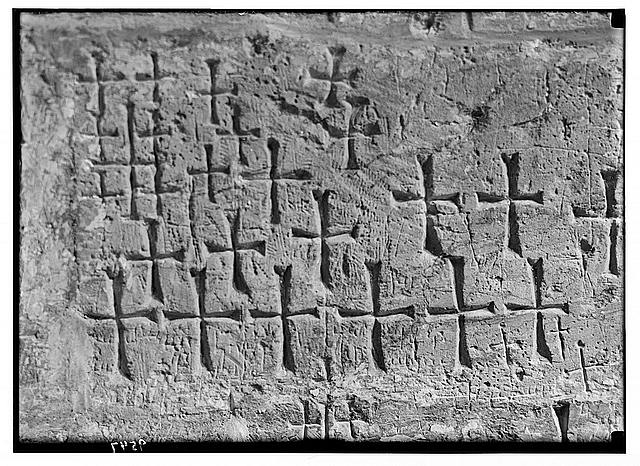
Crosses carved by pilgrims into a wall of the Holy Sepulchre, Jerusalem. (Yair Talmor, Wikimedia Commons).
“God’s Battalions: The Case for the Crusades” by Rodney Stark
“Muslims were [not] more brutal or less tolerant than were Christians or Jews, for it was a brutal and intolerant age. It is to say that efforts to portray Muslims as enlightened supporters of multiculturalism are at best ignorant.” (p 29)
In this reader-accessible but academic book, Professor Stark provides a very much needed corrective to the still accepted myths about the crusades into the Holy Land. Besides addressing the fallacies repeated as fact today (a few are given below), Stark presents a centuries-long history leading up to the crusades. Despite the reputation the Catholic Church earned over its handling of its Inquisition, at this earlier time violence was considered sinful. Even the killing of a criminal by a knight was deemed a bad thing. This may explain why Catholics didn’t respond sooner to centuries of mass murders and church destruction by Muslims in Palestine (see Moshe Gil, History of Palestine, 634-1099).
Fallacy 1: Crusaders were motivated by greed.
Fidelity 1: Piety and freeing the Holy Land, Jerusalem, were the crusaders’ motives. It must be understood that for some time Catholics believed that atonement for sins was gained through a pilgrimage to Jerusalem, for this is what their confessors told them. Obviously, this was spiritually very important to them and had nothing to do with wealth (in fact, pilgrimage was incredibly time-consuming, expensive, and dangerous). So when Pope Urban II announced that regaining Jerusalem would cleanse the liberators, it wasn’t an entirely new concept (becoming sin-free through violence was, however).
Fallacy 2: Muslims were tolerant and allowed conquered people to maintain their faith.
Fidelity 2: Depending on the time and area, conquered peoples were either (1) given the choice to convert to Islam or face death or enslavement, or (2) forced to pay heavy taxes, cease church or synagogue building, and never read scripture or pray aloud (even in their own homes).
More specifically relevant to the impetus for the crusades, and a definite show of Muslim intolerance, are the actions of the Turkish commander Atsiz. Sieging Jerusalem in 1071 or 1073, he promised the inhabitants safety if they relented. But when the city gates opened, “the Turkish troops were released to slaughter and pillage, and thousands died. Next, Atsiz’s troops murdered the populations of Ramla and Gaza, then Tyre and Jaffa” (p 97).
Fallacy 3: The crude European crusaders ruined the higher level culture of the Arab Muslims.
Fidelity 3: There are two related components of this fallacy that have been disproven but still remain in our culture. The first is that the Europeans were brutish children of the “Dark Ages.” As early as 1981 Encyclopedia Britannica refuted the long-held academic view that Europe even experienced a “Dark Ages.” On the contrary, this time period saw both the rise of agricultural
innovations that led to the biggest and strongest population ever, and many technological innovations that made the crusades possible.
Secondly, if you consider legitimate the claiming of conquered peoples’ knowledge as one’s own, then Islam “attained” high levels of it. Consider these very few examples: (1) “Arabic numerals” are Hindu; (2) Avicenna, considered the greatest of the Muslim philosopher-scientists, was Persian (this is true of many others, too); (3) Medical knowledge was from the Nestorian Christians. As conquerors, the Arabs made Arab names necessary and the Arab language mandatory for the intelligentsia.
Broken heart (base photo by Alex Bruda, Freeimages.com; filtered by author).
Did you know that the everyday expression “broken heart” (or “brokenhearted)” is considered to be derived from the Bible? Yes, even by secular sources. If you read your Bible you may already know that expressions such as going to the “land of Nod,” or having “feet of clay,” are not from fairytales or other old works of fiction.
In fact, very many idioms, phrases, and expressions in the English language originated from the Bible. This post holds a good number of them (but not all)–27–chosen specifically for their commonness. Some are so common that I not only made the list and checked it twice (see what I did there? That phrase is from the 1934 song “Santa Claus is Coming to Town“), but thrice.
The blind leading the blind. The biblical meaning may imply willful ignorance, but the saying today refers more generally to the uninformed blindly following the uninformed. “But [Jesus] answered and said, ‘Every plant which My heavenly Father has not planted will be uprooted. Let them alone. They are blind leaders of the blind. And if the blind leads the blind, both will fall into a ditch'” (Matthew 15:13-14).
A broken heart; brokenhearted. This ancient term for the depressed is from Psalms 34:18,”The Lord is near to those who have a broken heart, and saves such as have a contrite spirit.” “Brokenhearted” is first used in Luke 4:18: “. . . He has anointed Me to preach the gospel to the poor; He has sent Me to heal the brokenhearted . . . ”
By the skin of your teeth. Some explain this to be referring to the film you can feel on your teeth when they’re not clean, and thus, being saved in whatever situation by the ultra-slimmest of margins. “My bone clings to my skin and to my flesh, and I have escaped by the skin of my teeth” (Job 19:20).
Drop in the bucket. If something is like one drop in a bucket of water, it’s very insignificant. As Isaiah 40:15 says, “Behold, the nations are as a drop in a bucket, and are counted as the small dust on the scales . . .”
Feet of clay. Today this refers to someone having a secret character flaw that may cause their ruin, and is take from Daniel 2:32-33: “This image’s head was of fine gold, its chest and arms of silver, its belly and thighs of bronze, its legs of iron, its feet partly of iron and partly of clay.”
Fight the good fight. This has come to mean making a purposeful effort to work on behalf of a morally right cause. Originally it referred to the struggle to maintain one’s faith: “Fight the good fight of faith, lay hold on eternal life, to which you were also called . . .” (1 Timothy 6:12).
Fly in the ointment. This saying alludes to plans that are spoiled by a small thing, but as can be seen by the original verse below, it was meant to convey that bad behavior by an otherwise honorable person can raise questions about their true character. “Dead flies putrefy the perfumer’s ointment, and cause it to give off a foul odor; so does a little folly to one respected for wisdom and honor” (Ecclesiastes 10:1).
Labor of love. When you feel a strong purpose toward non-paid work you’re doing, then it’s a “labor of love.” “God is not unjust to forget your work and labor of love which you have shown toward His name . . .” (Hebrews 6:10, and 1Thessalonians 1:3).
Land of Nod. The Land of Nod is the place where Cain was exiled to for having murdered his brother; it has nothing to do with sleep, which it means in speech today. We can only guess, but perhaps it comes from the idea of being spiritually asleep after being cast from God. “Then Cain went out from the presence of the Lord and dwelt in the land of Nod on the east of Eden” (Genesis 4:16).
Out of the mouth of babes. The idea of this saying is that innocent people will speak in truth, without pretense, worry, or jadedness. There are two places where this comes from in the Bible, Psalms 8:2 and Matthew 21:16: “. . . And Jesus said to them, ‘Yes. Have you never read, “Out of the mouth of babes and nursing infants You have perfected praise”‘?”
Rise and shine. No, “rise and shine” is not from some teen encouragement flick, but from Isaiah 60:1: “Arise, shine; for your light has come! And the glory of the Lord is risen upon you.”
See eye to eye. Seeing eye to eye isn’t referring to a staring contest, but that people see something in the same way–that they agree. “Your watchmen shall lift up their voices, with their voices they shall sing together; for they shall see eye to eye when the Lord brings back Zion” (Isaiah 52:8).
A thorn in the flesh. Today, this simply refers to something that is continually annoying. The apostle Paul had a specific irritation, however, when he wrote: “And lest I should be exalted above measure by the abundance of the revelations, a thorn in the flesh was given to me, a messenger of Satan to buffet me . . .” (2 Corinthians 12:7). My favorite modern take on this can be found at Redjaw Cartoons.
Wits’ end. When someone is at their wits’ end, they are beyond being able to think about something (and usually quite frustrated about it). The expression comes from Psalm 107:27: “They reel to and fro, and stagger like a drunken man, and are at their wits’ end.”
Writing on the wall. This expression means that something bad is about to happen. It is from the spooky story in Daniel chapter 5, but here is an excerpt. “This is the inscription that was written [by a supernatural hand]: MENE, MENE, TEKEL, UPHARSIN. This is the interpretation of each word. MENE: God has numbered your kingdom, and finished it; TEKEL: You have been weighed in the balances, and found wanting; [UPHARSIN and] PERES: Your kingdom has been divided, and given to the Medes and Persians (verses 25-28).
A bird in the hand is worth two in the bush. This exact expression in its current form is not in the Bible, actually, but a similar biblical phrase is considered to be the first in English that means the same thing. This may seem a bit wanky, but I’m conveying what at least some etymologists say. The meaning of this phrase – to have something you know is good is not worth throwing away for things that may or may not be better – has equivalents in many languages. The phrase from the Old Testament is found in Ecclesiastes 9:4b: “A living dog is better than a dead lion.” The oldest written phrase close to its current form is found in an ancient source, but not nearly as ancient as the OT: “He is a fool who lets slip a bird in the hand for a bird in the bush” (Plutarch, c. AD 100, in Of Garrulity).
As old as the hills. Meaning “very old indeed,” this expression is a shortened version of Job 15:7: “Are you the first man who was born? Or were you made before the hills?” A similar but more specific expression is “As old as Methuselah.” This is referring to the oldest recorded person in the Bible, Methuselah, grandfather of Noah, who was said to have lived 969 years (Genesis 5:27).
Apple of my [or his] eye. This means that the “apple” referred to is the favorite of the beholder’s “eye.” There are many instances of the expression in the old testament, but notably Deuteronomy 32:10 and Zechariah 2:8
Cast your bread upon the waters. This is a less common saying nowadays (and is even absent from references), perhaps because it seems too nonsensical and doesn’t convey any meaning by itself. I love the sound of it, though, so included it here. It’s from Eccl.s 11:1: “Cast your bread upon the waters, for you will find it after many days.” Though the saying doesn’t seem to make any sense, it is an expression that hopes to invoke patience or diligence.
Set your teeth on edge. When something is upsetting or making you uptight, you might say that it’s setting your teeth on edge. This comes from a few verses in the Bible, like Jeremiah 31:29, “In those days they shall say no more: ‘The fathers have eaten sour grapes, and the children’s teeth are set on edge'” (see also Jeremiah 31:30 and Ezekiel 18:2).
Wolf in sheep’s clothing. This saying is so common, that the meaning seems rather obvious. In case this is new to you, it refers to a person who has bad intentions who is fooling people by acting innocent of any malice; they have an insincere public face, coupled with ill-will. The expression comes from Matthew 7:15: “Beware of false prophets, who come to you in sheep’s clothing, but inwardly they are ravenous wolves.”
Charity begins at home. Interestingly, this expression doesn’t come from an obvious notion or ideal, but from a criticism of men (providers of the family) having problems with being a good provider. 1 Timothy 5:8 states: “But if anyone does not provide for his own, and especially for those of his household, he has denied the faith and is worse than an unbeliever.” Jesus talks of hypocrisy in a number of places in the New Testament, especially in Matthew 23, but what he says in Matthew 15:1-9 is particularly applicable here: “But you [scribes and Pharisees] say, ‘Whoever says to his father or mother, “Whatever profit you might have received from me is a gift to God”—then he need not honor his father or mother.’ Thus you have made the commandment of God of no effect by your tradition.Hypocrites!” (15:5-7a).
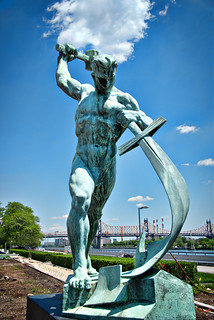
Let Us Swords into Plowshares (Photo credit: Singing With Light) At U.N. Headquarters, N.Y.
Beat swords into plowshares. I time of peace when even defensive weapons will not be necessary. From the yet to be fulfilled prophecy of Isaiah 2:4, “He shall judge between the nations, and rebuke many people; they shall beat their swords into plowshares, and their spears into pruning hooks; nation shall not lift up sword against nation, neither shall they learn war anymore.”
Salt of the earth. From Matthew 5:13: “You are the salt of the earth; but if the salt loses its flavor, how shall it be seasoned? It is then good for nothing but to be thrown out and trampled underfoot by men.”
Don’t cast your pearls before swine. This saying warns of not sharing things that are important to you with those who just don’t care, and who might even belittle you about it. The original meaning is specifically spiritual. Pigs (swine) will trample what’s thrown in front of them if it’s not ordinary food, so don’t toss spiritual food their way since they’ll only disdainfully muck it up. From Matthew 7:6, “Do not give what is holy to the dogs; nor cast your pearls before swine, lest they trample them under their feet, and turn and tear you in pieces.”
Sign of the times. From Matthew 16:3. Speaking with the Jewish leaders, Jesus said “. . . in the morning [you say], ‘It will be foul weather today, for the sky is red and threatening.’ Hypocrites! You know how to discern the face of the sky, but you cannot discern the signs of the times.”
Twinkling of an eye, In the. Neither Shakespeare nor Robert Manning were the first to write this expression, but the Apostle Paul in 1 Corinthians 15:52: “in a moment, in the twinkling of an eye, at the last trumpet. For the trumpet will sound, and the dead will be raised incorruptible, and we shall be changed.”
Note: Updated August 4, 2014. A larger part of this article was first published at Yahoo! Voices. It was integrated with a similar article here after Voices closed shop in 2014 and reverted all rights back to the original authors. Edited slightly on 10-8-2014.
The word of God came unto me,
Sitting alone among the multitudes;
And my blind eyes were touched with light.
And there was laid upon my lips a flame of fire.
I laugh and shout for life is good,
Though my feet are set in silent ways.
In merry mood I leave the crowd
To walk in my garden. Ever as I walk
I gather fruits and flowers in my hands.
And with joyful heart I bless the sun
That kindles all the place with radiant life.
I run with playful winds that blow the scent
Of rose and jasmine in eddying whirls.
At last I come where tall lilies grow,
Lifting their faces like white saints to God.
While the lilies pray, I kneel upon the ground;
I have strayed into the holy temple of the Lord.
In A Sacrifice of Praise, James H. Trott, editor (Cumberland House 2006; stanzas slightly modified)
_________________
The Rock (excerpt from Section X of Choruses)
by TS Eliot
О Greater Light, we praise Thee for the less;
The eastern light our spires touch at morning,
The light that slants upon our western doors at evening.
The twilight over stagnant pools at batflight,
Moon light and star light, owl and moth light,
Glow-worm glowlight on a grassblade.
О Light Invisible, we worship Thee!
We thank Thee for the lights that we have kindled,
The light of altar and of sanctuary;
Small lights of those who meditate at midnight
And lights directed through the coloured panes of windows
And light reflected from the polished stone,
The gilded carven wood, the coloured fresco.
Our gaze is submarine, our eyes look upward
And see the light that fractures through unquiet water.
We see the light but see not whence it comes.
О Light Invisible, we glorify Thee!
___
In T.S Eliot: Collected Poems 1909-1962 (HBJ 1963)
For a detailed and thoughtful view on being raised by gay parents, please see Robert Oscar Lopez’s Same Sex Parenting: What do Children Say? Here are some excerpts to give you an idea of his views and experience.
During the oral arguments about Proposition 8, Justice Anthony Kennedy referred to children being raised by same-sex couples. Since I was one of those children—from ages 2-19, I was raised by a lesbian mother with the help of her partner—I was curious to see what he would say.
I also eagerly anticipated what he would say because I had taken great professional and social risk to file an amicus brief with Doug Mainwaring (who is gay and opposes gay marriage), in which we explained that children deeply feel the loss of a father or mother, no matter how much we love our gay parents or how much they love us. Children feel the loss keenly because they are powerless to stop the decision to deprive them of a father or mother, and the absence of a male or female parent will likely be irreversible for them.
Over the last year I’ve been in frequent contact with adults who were raised by parents in same-sex partnerships. They are terrified of speaking publicly about their feelings, so several have asked me (since I am already out of the closet, so to speak) to give voice to their concerns.
I cannot speak for all children of same-sex couples, but I speak for quite a few of them, especially those who have been brushed aside in the so-called “social science research” on same-sex parenting. . . . I have heard of the supposed “consensus” on the soundness of same-sex parenting from pediatricians and psychologists, but that consensus is frankly bogus. . . .
I support same-sex civil unions and foster care, but I have always resisted the idea that government should encourage same-sex couples to imagine that their partnerships are indistinguishable from actual marriages. Such a self-definition for gays would be based on a lie, and anything based on a lie will backfire.
The richest and most successful same-sex couple still cannot provide a child something that the poorest and most struggling spouses can provide: a mom and a dad. Having spent forty years immersed in the gay community, I have seen how that reality triggers anger and vicious recrimination from same-sex couples, who are often tempted to bad-mouth so-called “dysfunctional” or “trashy” straight couples in order to say, “We deserve to have kids more than they do!”
But I am here to say no, having a mom and a dad is a precious value in its own right and not something that can be overridden, even if a gay couple has lots of money, can send a kid to the best schools, and raises the kid to be an Eagle Scout.
It’s disturbingly classist and elitist for gay men to think they can love their children unreservedly after treating their surrogate mother like an incubator, or for lesbians to think they can love their children unconditionally after treating their sperm-donor father like a tube of toothpaste.
It’s also racist and condescending for same-sex couples to think they can strong-arm adoption centers into giving them orphans by wielding financial or political clout. An orphan in Asia or in an American inner city has been entrusted to adoption authorities to make the best decision for the child’s life, not to meet a market demand for same-sex couples wanting children. Whatever trauma caused them to be orphans shouldn’t be compounded with the stress of being adopted into a same-sex partnership. . . .
The children thrown into the middle . . . are well aware of their parents’ role in creating a stressful and emotionally complicated life for kids, which alienates them from cultural traditions like Father’s Day and Mother’s Day, and places them in the unenviable position of being called “homophobes” if they simply suffer the natural stress that their parents foisted on them—and admit to it. . . .
That’s why I am for civil unions but not for redefining marriage. But I suppose I don’t count—I am no doctor, judge, or television commentator, just a kid who had to clean up the mess left behind by the sexual revolution.









 With Christian Eyes