If you’re familiar with the Dragon Age franchise (by Bioware), you’ve probably already made the decision to play or not to play these role-playing games. For some, a game with swearing and “sex” scenes is simply crossed off the list of playing possibilities, and Inquisition (2014; rated M17+) is no different from its predecessors in that arena (except that the “sex” scenes are more “human” than ever before, according to fans).
But with a name out of Catholic history, perhaps you’re curious. I was, and, having been fairly unfamiliar with the franchise (I didn’t know about the personal relationships aspect), decided to check out the newest installment. Let’s clarify something up front before we move on, though: viewing possible “sex” scenes is not part of any quest except voluntary “romancing”—a player can romance certain characters, or not—and avoiding romance has little impact on the rest of the game. This game is not anything like an “X” rated film–more like an R in parts. Certain characters who make up your party can be pretty much ignored, too, if desired. On the other hand, there is no sex shown when romancing the traditional and humble Cullen, who is an example of someone who wants a healthy and permanent relationship.
Imshael at Suledin Keep, with goat head-like statue and Red Lyrium (unknown online source image).
The role playing game Dragon Age: Inquisition won Game of the Year for 2014, which no doubt increased the Dragon Age franchise’s already large fan base. At its base is a typical good vs evil theme, and good morals as well as faith are included, but it is also incredibly relativistic at its core. This is very typical fare for games these days. After all, it’s more about having the largest customer base and making the most money possible. The game even has romance in it (of all sorts)—a major draw for a segment of the fan base.
Should Christians Play Dragon Age: Inquisition? is my review of the game, but there seems to be something in the game that is not relativistic, something that finds Bioware (the game’s developer) out on a little limb, that I’d like to explore here. And this something is what the demon Imshael can be seen to represent: Islam.
Dragon Age: Inquisition Crafting Materials Locations by Map (nonvendor)
When known, cloth types are included. Rare and Unique Items are Highlighted; Fade Touched Items are in Same Locations but rare.If a common item comes up rarely on a map, it is not listed for that map as it would much easier to find it on a map where it is common.
About Dragons: Most of the main maps have one dragon, except Emprise du Lion, which has three, and the Fallow Mire, which has none. All dragons drop the following on every map: dragon scales, dragon webbing, dragon bone. Therefore, the tables below list which maps yield dragon teeth and the different blood types only.
Most people nowadays are satisfied with the games that come out each year. They look pretty, aren’t too difficult (most of them anyways), and normally don’t take up too much of your time to play and beat. However, most modern games lack a certain depth and personality that some of the older games have. While many people would be quick to point out that older games are outdated, time consuming, and not user friendly, there are some old games that still have a strong (and growing!) following. One such role playing game would be The Elder Scrolls III: Morrowind. For those looking for a game without sex, gore, and with very little swearing, Morrowind might be for you.
Morrowind was the third installment in The Elder Scrolls series of games (by Bethesda), a predecessor to the much-loved Skyrim (2011), as well as Oblivion (2006/2007), games. It came out for PC in 2002; the Game of the year edition, which included all the expansions, came out the next year. It’s been more than ten years since its launch and in game years, that’s a long time—sort-of like “dog years” to today’s generation. However, Morrowind is a game that is still played widely today, and in my opinion it deserves all the attention it’s been getting.
An image from Chernobyl, Russia, filtered by author (found at http://bit.ly/1t2nfGr). This looks eerily like an image from the Fallout video game series.
Contents
About Honest Hearts
Psalm 137
Stephen Vincent Benet’s “By the Waters of Babylon”
The Influence of Psalm 137 and the surmised influence of the By the Waters of Babylon story in Honest Hearts
About Honest Hearts
The Fallout video game series takes a player on dangerous adventures through various regions of the United States after a future nuclear war with China has taken place. The series is one of the more successful in the “role playing game” (RPG) genre, taking place in “post-apocalyptic” times (2161 and forward). “Honest Hearts” is a 2011 add-on to the Fallout New Vegas game of 2010, taking place in what is Zion National Park in the real world, year 2281. While it’s obvious that people died in the park due to the historic nuclear cataclysm, the park itself is mostly unscathed by this point in time.
There are two outside leaders, both Mormon and both from the recently destroyed “New Canaan,” who lead two neighboring tribes, the “Sorrows” and the “Dead Horses,” in Zion Canyon. However, these two leaders have wildly different backgrounds and, not surprisingly, their views on how to handle the invading “White Legs” tribe are miles apart. It is no secret that the White Legs want to kill the Zion Valley inhabitants, just as they destroyed New Canaan. But what will the player do? Aid Joshua Graham and the tribals that wish to stay in Zion by meeting the White Legs head on, or will you side with the more pacifist Daniel and help the Sorrows flee the valley for a new home?
The article below is now in two parts (I and II). The first part deals with the Beta and what I learned about the game at that time. The second part shares notes about various good and maybe not-so-good aspects of the game pre-DLC (last updated 10-07-14).
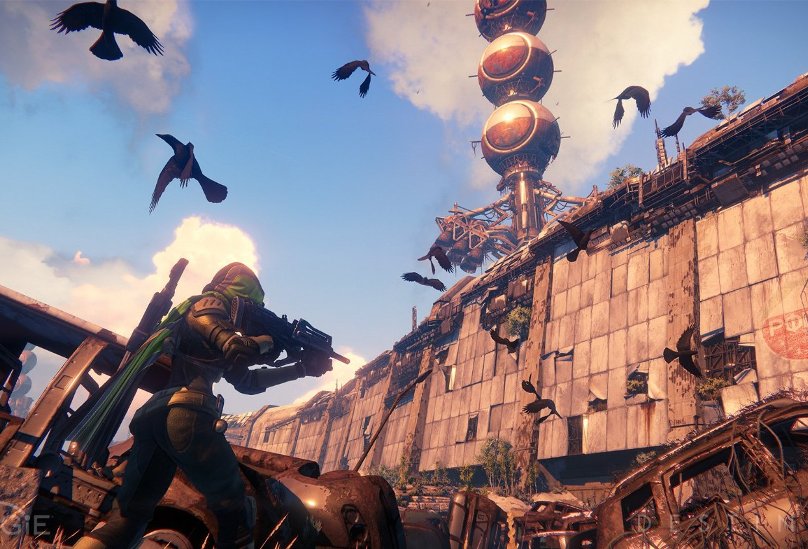
A view of the crumbling but future earth in Destiny (beta). Image from Destiny game page at Amazon.com (copyright Bungie).
I. What the Beta Spoke to Me
During the 4th weekend of July, 2014, I was fortunate to be able to play the public beta of Destiny. My son and I both played it quite a bit, getting a feel for the game. I’m glad I played as much as I did but had hoped to play more! I didn’t expect the beta to end so soon, especially not on Sunday afternoon instead of evening. That my son and I played so much, and wanted more, goes to show what a good game Destiny appears to be.
I say Destiny “appears” very good since the beta provided very little of the story and there was no indication as to the actual level of role-playing (can true choices be made or is the quest line only linear?). For me, the role-playing aspect of games is important and I buy them for that reason. I’m hoping for the best regarding the depth of the game’s story and the level of player immersion into it. The game is rated T for teen and has various game-play modes, including player vs player, making it both widely accessible and no doubt desirable to a large audience.
Leaving the formal talk aside for a moment, I can say that we loved the game so far (with some qualifications) and ended up preordering one of the special editions. Basically, it’s a new type of futuristic fantasy game that’s lots of fun!
Is it an RPG or Action-Adventure MMO, or . . . ?
Destiny is set to release on September 9, 2014, so I can’t say from experience all that this game truly encompasses, but the makers of the game describe it this way: “The next evolution of the first-person action genre that provides an unprecedented combination of storytelling, cooperative, competitive, and public gameplay, and personal activities that are all seamlessly woven into an expansive, persistent online world. Venture out alone or join up with friends. The choice is yours. Personalize and upgrade every aspect of how you look and fight with a nearly limitless combination of armor, weapons, and visual customizations. Take your upgraded character into every mode, including campaign, cooperative, social, public, and competitive multiplayer.”
Playing the beta revealed much of those elements, and from the quote above it can only be guessed that the game is not a true role playing game (RPG). It seems that it’s getting difficult these days to categorize games as true RPGs, where you develop your character via choices and action that is not simply linear (in other words, you don’t just choose your class, looks, and armor, but make choices within a branched story that have effects on your character and on other aspects of the game). This is a “first-person action” game with “storytelling.” So, it doesn’t sound like your choices change you or the story. But, we will all know after the game comes out and is played through. It’s a lot of fun in any case – I’m just not getting my hopes up that it’s a true RPG.
The MMO aspect of this game is not at all like one might think. There isn’t a horde of 100s or 1000s on one map, or area of a map. Destiny appears to allow only so many people on a map area at a time. When you are on a quest you will be doing it by yourself, essentially, unless you specifically ask someone to join you; and when playing the COD type of shooter modes, there are of course a maximum number of players on each team. There is a central area where very many (all?) players can be on at one time and interact, and this is the area where the shops and guilds are. You can interact with other players here, ask them to play with you, dance and play ball with them, and just hang out and be silly (if desired).
Gameplay: Quests, Exploration, Multiplayer, Social Tower
Note: According to the official game site, there is a game mode that has not yet been revealed. Stay tuned!
Story Quests and Exploration. For the beta, part of earth (and for a very short time, the moon) was available for quests in the main campaign and for exploration. Venus and Mars are in the Destiny environment as well. The quests were short but had increasingly long end battles. I, for one, hope that future quests have more to them besides simply running around (“busy work”) and fighting hordes at the end. Exploration mode is fun. Apparently, the whole world can be accessed through explore mode (parts were blocked during beta), where enemies respawn quickly, loot chests are hidden here and there, and “community events” randomly appear. These events involve fighting enemies, of course, and confer a daily reward when finished. I experienced many of these community events and while many were duplicates, there was one unique event that was totally insane.
Social Tower. The Tower is a large place holding the shops and guilds, where people can socialize. It overlooks The Traveler (the large orb hovering over the Earth) and the last inhabited, free city. Not all areas of the Tower were open during beta.
Multiplayer. There are two modes of multiplayer, at least so far. “Strike” involves three players fighting a boss type of situation, and the other is a team of players vs another team, called “Crucible.” The Crucible maps are very nice, but my son thought there was something missing (or the mode was lower-quality somehow) in this capture-the-point mode that he couldn’t put his finger on.
Characters Played During Beta Weekend
There are three classes of characters and three “species,” but all are “Guardians” to what remains of earth’s civilization. As mentioned earlier, both my son and I played the beta and between both of us we played all three classes of characters (but not every species) and leveled two up to the beta high of eight. All characters jump, heal fast, have their own special type of grenade, use floating (but ground-hugging) vehicles for fast travel, and have a little flying mechanical fellow that helps them out, gives them hints, etc. For an as-yet unknown reason, these little guys are called “ghosts.” Regarding physical weapons, all characters have access to the same multitude of weapons. I very much enjoyed many of the firearms, particularly the sniper rifle and the machine gun. These weapons come in different varieties, of course, which have different upgrades. All characters have a very satisfying punch attack; I’ll let you experience that yourself to understand what I mean.
Warlock Class. My son started with a Warlock class female, choosing the “Awoken” species. Warlocks are described as “mystic warriors.” Since the Awoken have swirly light lines on their faces and are the opposite of the Fallen (an enemy type) by name, it seems very appropriate that they be Warlocks. She used powerful purple swirling energy in her attacks while wearing a fairly hideous helmet.
Titan Class. I started out with a Titan Class human female. I love this character, as does my son. Titans use electric-looking attacks, and their special power area attack is awesome. This attack can kill just about anything in the radius of the Titan’s ground slam.
The special ability of the Hunter class: a short-lived but extremely powerful “fire gun.” Image from Destiny game page at Amazon.com (copyright Bungie).
Hunter Class. I was able to get through level 6 of a male Awoken Hunter Class character before the beta closed down. The hunter seems to be basically an assassin. His first found weapon was a sniper rifle and his special power is a fire gun that seems to have the power of a rocket launcher. He has no area attack. However, the hunter has a nifty throwing knife trick.
II. Like, Love, or Meh?
What I like about Destiny so far
1) Game play with item acquisition. Since I’m playing Destiny all the time, I must like something about it, right? Well, yes. But, a good part of my time playing isn’t due to how much I like the action, but how much I want to acquire or improve certain items. Since the limited-time Queen’s Wrath activities had begun I’ve been doing a number of her bounties, and some missions, in order to gain her favor and her rewards. I’m a bit tired now of doing the same bounties every day, but since I put this much effort into it already, I’m going to continue on to her 2nd reputation level in order to buy a special weapon from her emissary. In order to reach the 3rd level of reputation in the time she’ll be around, a player would have to be very good at all aspects of the game and have the time to do all the types of bounties and missions.
Another temporary event, the Vault of Glass, hasn’t even been on my radar. Well, it blipped once. In order to do that limited-time event, you need to have 6 players, but the game doesn’t match people up for this event. You have to build your own team and spend many hours doing the event. I’ve seen a few rewards from it, and they’re awesome, but I’m just not into spending time getting people together to do that. So, this temporary event should be in the “don’t like” section, but obviously temporary events will keep interest in the game up. The game isn’t a draw in the way of role-playing, puzzle solving, or mystery, so it has to have a way to keep people coming back for more.
For me, it’s been pretty fun so far, but with the whole thing being about acquiring new and interesting clothes and weapons . . . it gets a bit old. However, it does feel good to work for something and get it, even though it’s all virtual. I think if anyone could work like that in real life and get those kinds of rewards, they’d want to.
2) The look and feel of gameplay. The game is stunning. Really. The detail in the environments is fantastic, and no doubt much is missed by the average player, but the weather, and lighting especially, are really great. I love being in the game, basically, especially being on Venus. There is much feeling in the control, too, with this game. Punching, zooming along on your hovercraft, flying through the air – these are all just fun things to do.
3) It’s first person, not third. This is a part of the gameplay “feel,” but it’s significant enough to be a separate like. Being in first person makes for a more personal game.
4) There’s no gore, sex, or swearing. I personally don’t mind some of those things (depending on how much and the context), but I know Christian players and parents might want to know about these things. The characters you shoot do not “bleed,” but some of them do have something come out when you get a head-shot. The Fallen have what looks like a purple vapor come out, and the Cabal have what appears to be black oil! The Hive are undead and the Vex are mostly mechanical, so nothing special comes out of them. If you’re going to become offended in the game, it will most likely be from selfish players you might run across.
What I don’t like about Destiny so far
1) The ridiculous limit of characters you can set up to play. You are limited to three, so right now, if you want to have more characters you have to have a second online account (through XBOX or Playstation). Only three people in your family can have a character, and of course you can’t experiment with other characters unless you’re willing to delete the one you already started. According to my son, this is a bogus limitation without any technical merit. If you know differently, please leave a comment.
2) Bungie’s “customer service” is simply atrocious, as in virtually non-existent. They even have put down their XBOX customers down online (on Twitter, an XBOX help person even came onto a Bungie thread and helped XBOX players while their own staff continued to ignore them). They would prefer to have only PS4 customers. When an error message comes up while you’re playing, it says to go to Bungie help and search for a certain word. I went there and there was NO explanation by Bungie of that error code, only people asking and complaining about it, since there’s no help. This company can’t even do basic customer service things . . . at least that was true at the time I’m writing this.
Today, 10-7-2014, Bungie is doing a multi-hour fix so hopefully connectivity issues will improve, and at least they Tweeted about it to let people know. EA has been a whole universe better about customer service and letting people know about downtimes (they put messages up IN-GAME), and even having information and help at their website. Given EA’s past reputation, this should really be a kick in Bungie’s pants– but as can be surmised, they very much don’t seem to care.
3) The incredibly bare-bones story. As in, virtually no story. The story that does exist in game is of course used to explain why you’re on a bounty or mission, but it’s really just a shoot and loot type of game, at least so far. Still, I look forward to writing more about the story in the future.
Right now it looks as though a basic good vs evil scenario was concocted–one that will have little chance of offending anyone. If you’re a Christian you could lament the main mysterious but benevolent power, “The Traveler,” since it helped man progress materially. The force it commands, “light,” seems like simply a force. It uses its power to bring your character back to life, with no mention of where your soul was while you were dead (or how it “refleshed” you). Destiny will have added content and is set to be a trilogy, so who knows what details will emerge about The Traveler and its power, and how they relate to the spiritual realm.
I need to mention something here that cracked me up when I found out and it has to do with Christianity–but the message seems quite mixed. There is a very hard to get exotic machine gun called “Super Good Advice.” It is obtained through the bounty called “A Voice in the Wilderness.” Yes, John the Baptist’s message was “super good advice,” but, he didn’t shoot you dead with a machine gun in order to get his message across. At first, I thought the developers were just having fun with saying something positive about Christianity, but now I’m not so sure.
Upon seeing the weapon’s color–red, white, and blue–and the description, “This weapon is full of it,” I think they could be using Christianity to put down America. It could be just my inclination, but it seems to be saying that America, which seems like a Christian nation, really just likes to solve problems with violence. I wouldn’t agree with that; I’d say that America manipulates through money, and that obviously, money is power. There are times that morally, we should intervene on the behalf of innocent victims, and we don’t–the opposite of this gun’s possible message.
4) The lack of match-making by the game in order to play certain part of the game. The need for self-made teams in order to win the best stuff, as mentioned concerning the Vault of Glass above, is obviously biased toward a certain range of players.
5) Team members that act like they’re not part of a team. Again, this is a shooting game, and good shooter players tend to be fast and in it for themselves (one person on my team yesterday was a completely selfish . . . ). If you’re more like me, someone who likes to scout and snipe before jumping into things, the teams are not great and the multiplayer shooter is . . . nonexistent for me right now (my son and I play on one account so if you ever find us, you’ll see he does just fine in the Crucible multiplayer). It would be a nice change of pace to be on a more none-autobahn-minded minded team (although, certain Destiny missions favor fast playing). For that to happen, you need to put your own like-minded team together.
6) As a shooter game, a significant amount of playtime is simply spent on shooting/attacking sub-bosses and bosses . . . for a long, long time. My son is faster at boss killing than I am so for him it’s not as bad. I’m still trying to learn the difference in our play styles so that I can go through boss battles faster, but no matter how good you are, it’s still “busy work.”
Statue of Talos in Whiterun, with Shrine in front, Dragonsreach to left, giant Eagle in middle, and old Companion’s home to right.
I wrote about this dlc already (at dragonborn dlc wordpress) but wanted to convey some more information about the Skaal’s religious views, and generally about the playability of the new dlc content. So basically this is an addendum to the linked article; please see it if you would like more coverage of the Dragonborn dlc.
Dragonborn DLC playability. First. when we got the DLC I was playing a game where I had a high level character, over 60, and I was getting close to wrapping all the quests up. Playing at this level in Solstheim is relatively easy. Only Karstaag was a difficult opponent (surprising battle, that was!). But, beginning a new game and going through it so far – I’m now level 11 and had gone back to Solstheim after first going there at level 6 – I can say Solstheim is not a place you’ll get through easily for a while. Of course, the game level setting can be adjusted to its lowest level, but I’m going to bet that fighting off random lurkers will prove pretty impossible for a low level character. I wanted very much to make it to Neloth and so I swam there. The only real problem I had was when my companion, Lydia, wouldn’t just swim along and ignore a Lurker. *People ask when “the quest” starts with the DLC. There are various quests, but the main quest with Miraak will activate after you go and see the Greybeards for the first time. A couple of his cultists will meet you somewhere and attack you.
The Skaal and their religions views. The Skaal are most interesting, as their visiting researcher (like an anthropologist amongst a far away and dying tribe) frequently points out. Unlike the majority of Nords, they believe in an All-Maker god and not in the pantheon of deities. If you never read the book, Children of the All-Maker, or don’t talk to Frea after the main quest is over, you would very much think that the Skaal believe in a Judaic type of God. They talk or write of going to be with the All-Maker after they die, and seeing others that have passed on there too. They also allude to spirtual consequences that are Western, not Eastern (there is the call of the All-Maker, and ignoring it has consequences).
YET, oddly, the two sources I mentioned say they believe in reincarnation, even for humans. So, it doesn’t make much sense (you can’t be with the All-Maker visiting relatives while also being another person on earth). Interestingly, there are real-world people groups in Asia that, when found by missionaries in the past, have shown that they believe in God and even had premonitions of Christ. But this is not what is happening with the Skaal. I would give Bethesda some credit for actually taking apparent early Norse belief in reincarnation and adding it into the game (as evidenced in the real-world Norse Poetic Edda). However, having the religious leader (“shaman”) pray in an Eastern religious fashion takes away from this seeming historical reference.
The “Dragonborn” addition to the Skyrim video game, which came out earlier this month (December 2012) for XBOX, has – I think – the most “Christian” oriented content overall (in Skyrim, not the other Elder Scroll games). I wish I had written down certain dialog as I played it with my high-level character, but I simply wasn’t expecting anything out of the ordinary to takes notes on! (If I start a new game, it will be some time before I can get to those dialogs again – for now, this commentary without quotes will have to do.)
This latest DLC adds additional land mass via a large island known in the Elder Scroll series as Solstheim. (Update of Dec. 24: it appears to be playable from the beginning of a new game, as I went to Soltstheim at level 6, after I fought my first dragon and made my way to Windhelm). It is no doubt loved by Elder Scroll fans since it brings in elements from Morrowind (the home of the Dunmer, or Dark Elves), and indeed, the flavor of the place is quite a bit different from Skyrim (the home of the Nords). There are various quests to be found and accomplished, but the main quest involves the defeat of the first dragonborn, Miraak, who still exists after ages because of his service to Hermeus Mora, the powerful spirit being of knowledge and fate. Miraak desired power and thus made a “pact with the devil” – a safe allusion to Mora and his top minion. The DLC takes place when Miraak has used his powers to enslave the sleeping minds and bodies of the denizens of Solstheim, whom he is using to build a temple to himself. Miraak has only a small amount of dialog, but that small amount sounds an awful lot like satanic desires and promises. In addition, he has his hypnotized followers say things that are a copy, and thus a sick mockery, of true spiritual expression.
What’s interesting, from a Christian-in-the-current-world point of view, is that Hermeus Mora’s realm is called Apocrypha. (“Apocrypha” are extra-biblical writings of various qualities some are legitimate but have some textual or factual issues, while others are outright forgeries with false “witness”). It is dark and hazy and is made up of books (literally – the walls are made of books), and all underneath and around walkable areas is a very black sea. This “sea” has black slithery arms coming out of it all of the time, and they will whip you and hurt you if they can. The most dangerous creatures that stalk the place look very much akin to the old “creature from the black lagoon.” The other dangerous creatures are “seekers,” whose hideous appearance includes a lamprey-like mouth where their stomach is. These seekers of “knowledge” are never satisfied, but devour what their gut desires and not what their heart and mind discerns as true. This is my take on them, anyway, which I see as the problem with seeking and using secret – usually false – knowledge, and which is the point of this dark and eery place.
When it comes to Christianity, God chose to communicate with man and it was His desire to be known and understood. Those who purport to have “secret” knowledge of Him in order to steer someone away from God’s revelation, are not working within God’s desires for mankind.
On the other side of the coin are the Skaal of Solstheim. They are Nords of the ancient way and claim to have been given Solstheim by the All-Maker. They believe in one creator God, and the way they talk about creation and how we are to be in it, generally fits in with the Judeo-Christian biblical message. You can have an interesting conversation with Wulf Wild-Blood of the Skaal, who asks you if you can find his run-away brother whom he believes turned into a werebear (like a werewolf, only a bear). His brother could go down that path only be rejecting the call of the All-Maker. While the Skaal have beliefs that mesh with scriptures, they have others that do not – they believe in reincarnation. Conversations with fellow Skyrim players about how reincarnation doesn’t at all mesh with a loving creator God, and how it is wholly incompatible with Christ’s message and work, is a possible real-world benefit of playing this game.*
If, as a Christian, you will only play games that have pure Christian messages and signs, then Skyrim and Dragonborn aren’t for you. But if you want to play a game that actually gives a nod to God and certain Judeo-Christian beliefs and virtues in today’s world, then Skyrim is an OK game for that. I wrote about Skyrim earlier, here. That review by no means covers all the aspects of Skyrim. There are things about the game I don’t like and scratch my head at, wondering about the game maker (Bethesda) every time I think of them (there are aspects of the game you can only play if you decide to do bad and dishonorable things).
Hopefully I’ll be able to flush this review out in the future, with quotes and such. In the meantime, enjoy the Dragonborn and listen to the new leader of the Skaal: do not follow Hermeus Mora, but follow the path laid out for you (and to the Skaal, this would be by the All-Maker).
* These last two sentences were edited in after the initial posting of this review (12-20-12).
In line with encouraging circumstantial thinking, like “When life gives you lemons, make lemonade,” I’m making the most of the video game DayZ by sharing with you its addictive qualities. The men in my family team-it-up in this multi-player online game, and the survival aspect is so intense it’s like they’re literally out in a gorilla warfare battlefield. Consider yourself forewarned if you haven’t played DayZ yet, and I’m assuming that’s the case since if you had, you’d be playing it right now instead of reading this.
DayZ is actually a mod made for the military simulation game, ARMA 2. This mod places the player in an apocalyptic zombie world of survival, but it’s the other online players that are more often the real danger. This game is not anything like shooter zombie games such as Left4Dead. Sure, you shoot zombies if you want to, and no doubt you’ll have to, but they are often slow or relatively easy to deal with. Well, during the day, anyway. Most online players, however, are just really horrible individuals. I say that so generally because as far as I and the men can tell, the vast majority are snipers, bandits, hackers, etc.–we’re guessing 80% to 95% of all players fall into these categories. Most will shoot you on site, which is really a “jerk” (that’s putting it kindly) move since when you die, you lose any of the hard-won items you may have found.
A good little background summary from Wikipedia: “The mod places the player in the fictional post-Soviet state of Chernarus, where an unknown virus has turned the population into zombies. As a survivor with limited supplies, the player must scavenge the world for supplies such as food, water, weapons and medicine, while killing or avoiding both zombies and other players – in an effort to survive the zombie apocalypse.”
When you first spawn, you start out with only a flash light, a bandage, and pain-killers. Wow! Nothing to fight off zombies with. You must scavenge for even the most rudimentary weapons, such as an ax or crowbar. There are of course a whole variety of guns in the game, but you must find ammo too, and unlike many online games, you have limited backpack space. You can become injured easily in the game and require morphine, blood packs, or even hospital care, in order to survive; playing as a team, the men help each other out with drugs, blood transfusions, that sort of thing. You might very well imagine playing the game for some time without really getting too deep into it yet, before some unpleasant fella (gamer, not zombie) murders you.
Which brings me to a well-known YouTube player called FrankieonPC. He’s generally a good guy and has done some pretty awesome stuff, with the help of some friends. He has shown that the game has a surprising range of multi-player capabilities. In one video where he has gotten rid of some bad guys (he, along with some other hero players, rid the servers of snipers and bandits – this really takes skill when the snipers simply bump people off upon spawning) and raided some hacker stashes, he calls all good folk to a church. They arrive on a bus. Can you believe it? There are usable buses in the game, and you can see all the people – online players – riding in the bus. Anyway, Frankie has dumped the weapons from the hackers in the church and anyone is free to take what they want. This is very cool and warm and fuzzy, and then . . . someone bombs the church!
Besides buses, there are helicopters, trucks, cars, ATVs, and even bikes, though none of these are common. Vehicles can be found (or stolen), though they may need to be fixed. Not surprisingly, you will make a desirable target as a vehicle driver. The game is open and huge, and has an awesome markable map available. Servers vary in their difficulty level (there are fewer people on the higher level servers), and they may have other differences, like vehicle spawn rate, day or night only play, and so on.
The men that I’ve lost to DayZ say that what they like most about the game is killing bandits and saving bambis (that is, newb players that are easy targets for the snipers and bandits). They like working together under pressure, helping each other survive, and finding vehicles and fixing them. The difficulties they’ve encountered include hackers with over-powered weapons, fatal glitches (like from doors and stairs), and not being able to see at night, at all, as if it were always a new moon. And, of course, they love the challenge of surviving longer than the average time of 1 hour and 8 minutes, or whatever the current figure is, as kept at the DayZ site.
(For a peek at what Skyrim looks like, and a short write up on Skyrim violence and language, see my New Skyrim Playthrough Let’s Play with Babe’s Got Bow. Don’t worry, the “Babe” is clean and mod free. June 22, 2015)
This post could be opening up a whole can of worms, but so be it. Why all the possible worms? When my son was very young I thought – based on so much of what I read and heard from Christians – that video games were just all from hell and will lead to hell. In more recent times, I have posted online with some Christians who still feel the same, though I’m hoping they don’t really think “Harvest Moon” or “Hello Kitty” games provide a direct ticket to the brimstone dungeon. There are nasty games out there for sure, games that relish dishonesty, crime, blood, gore, and killing. But does that make all video games bad? Putting aside the issue of time spent by the Christian on past-times (hobbies, entertainment, etc.), are certain video games not only fun and cathartic, but also potentially useful for stretching the mind and for witnessing? I think yes, so let’s take a look at Skyrim with its Dawnguard expansion (Hearthfire, added September 4, 2012, adds pleasantries to the game).
Beautiful Skyrim environment with flying dragon. Author screen shot.
__
The time frame in Skyrim seems to correspond nicely with the Iron Age in Northern Europe and/or France and the British Isles. Skyrim refers to a region in the continent of Tamriel, and is one of a number of games in the Elder Scrolls series. The region makes up the north central part of the continent, and its Nordic inhabitants are akin to the real world Norsemen (Vikings). For example, what is like heaven to the Vikings was called Asgard, and the honored hall Vahalla. In Skyrim, these are referred to as Sovngarde and Shor’s Hall (Hall of Valor), respectively. The Imperials, which very obviously correspond to the Romans, have kept order in Tamriel for some time, though they are present in Skyrim now in order to crush a rebellion. This isn’t just a little rebellion, but a power play that would affect all of Skyrim and its relations to the rest of the Empire. Spoiler alert: In typical historic fashion, the son of a king killed his own brother in an attempt to be high king. Each region in Skyrim has a king, and these kings choose a high king from among them. This was a spoiler since only one or two characters in the whole game actually tell you that the king killed was the usurper’s brother.
The point about this power play, however, is that the usurper, Ulfric Stormcloak, had gotten many in Skyrim behind him because he claimed that his primary goal was to reestablish the free worship of the god Talos. Talos used be just a man (Tiber Septim), but was made a god by the other gods (somehow – how this happened is unclear) and thus became worshipped, not just revered as a Dragonborn or for uniting Tamriel in the distant past. Why was the worship of Talos banned? To end a major war the Imperials and other leaders had signed a treaty with the High Elves, and part of this treaty prohibited Talos worship, as the High Elves considered Talos to be a false god.
Despite the treaty Talos worship was going on quietly, but Ulfric’s uprising changed that. Because of the rebellion, the High Elves began persecuting Talos worshippers, thus giving the Stormcloaks fuel for their fire. There are subtle complications added to the game to make the decision regarding which faction to follow not necessarily an easy one; it certainly shouldn’t be rushed. While most people in Skyrim revere Talos, there are some things said to make a player wonder about him. For instance, the self-proclaimed mouth-piece of Talos in Whiterun is annoying and may seem mad (he definitely is depicted as a melodramatic street preacher), and indeed, his feverish support of the Stormcloaks ignores both the reality of what is going on behind the scenes with the Imperials (many of whom also worship Talos) and the conniving and tyrannical nature of Ulfric and his Stormcloaks.
The Stormcloaks are pretty nasty, saying that if you don’t join them you’re against them (an enemy), yet the Imperials say no such thing. There is much more to seemingly righteous rebels behavior vs Imperial behavior, but I’ll leave that for your exploration. The Stormcloak rebellion is one of the two major plots/quests of the game, the other being Dragonborn’s (the player is the Dragonborn) destiny to rid the world of Alduin, the world-eater dragon. The quests are not totally separate. Without paying close attention, a player may totally miss that Alduin and Ulfric are intertwined.
For the Christian, Alduin is of great interest since he is a Satan figure (without the Satan figure, one could maybe take Talos to be a pagan mythological man-god). He claims to be the first born of the great god Akatosh (and some even worshipped him as Akatosh himself), but in reality he was created, and for a specific purpose. He defies Akatosh regarding his purpose, interferes with man, and is arrogant. Skyrim is full of hints and references to religion, folklore, history, and literature, although much of these are not wholly analogous. As might have been inferred by now, talking with someone about Skyrim can be a starting point to talking about Christ and even the existence of Satan.
An inquisitive player may decide it’s worth his or her time to look into the real-world peoples and such in the game. Besides the examples already discussed, there is the goddess Mara, who quite obviously corresponds to Mary, mother of Jesus. Elves are of course derived from folklore (as are the Dwarves), and their demise followed the acceptance of Christianity in European areas. The magical High Elves came from a large island to the southwest of Tamriel, and so this alludes to Atlantis. There are Bretons in the game and there are real world Bretons.
As with much fantasy in modern times, the game includes Orcs. Where did Orcs come from? Well, from the mind of JRR Tolkien (author of Lord of the Rings)! In Skyrim they are not just like Tolkien’s Orcs, but they are still a corrupted form of Elf. Without getting into a lot of detail, I was disappointed with the game in some ways. Skyrim seems to favor doing bad things, despite the character played being the Dragonborn, a person who brings good and who is in line to become Emperor. The game has achievements, and many of these involve doing evil things. This is unfortunate, and while a player is not at all required to do these things, some aspects of the game are closed-off if a player ignores these activities. The new expansion of the game, Dawnguard, seems to make up for this somewhat.
Most of the hype was directed towards the evil side of this expansion, involving vampires, but really, as far as I can see, the “good side” gains here. I also have to pat Bethesda (the game maker) on the back for making the vampires in fact gross and bad. Some may have a problem with the main vampire character being “good,” but at least they included dialogue for you to choose that shows your disdain for the whole idea, if you so choose to use that dialogue; there is also the possibility that this character will willingly give up her vampirism (become cured).
These games are made for the masses and they are not in business to lose money, so one has to take the good with the bad and make the most of it; in real life this is often murkier and harder to do than in games like Skyrim. That being said, the Dawnguard include in their ranks a witty, funny, smart, and spiritually active ex-priest. He adds a positive spiritual character that is a counter to the street preacher that so many players actually want to kill. Finally, I’ll leave you with basic good and bad points of Skyrim/Dawnguard/Hearthfire, and this quote from John Battle-Born of Whiterun.
This statement may very well be Bethesda’s commentary on the gaming world and not Skyrim, since there appears to be no connection to it and anything in the game–except perhaps that everyone that you encounter in the wild seems to want you to kill them!: “You know what’s wrong with Skyrim these days? Everyone’s obsessed with death.” Good points:
Truly beautiful to look at and wander around in: HUGE. Our world beautiful, not abstract, though there are awe-inspiring places that mix underwater concepts into air-breathing spaces.
Complicated main quests and min-quests that require you to listen to many characters to decide what’s best (if you do it right).
Religious and political aspects and some real-world history, along with the fantastic. Real world lessons in deciphering the truth, in seeing through people’s blind ideologies or loyalties.
No sex and little swearing.
Fun and rewarding; tons of play time and things to do including blacksmithing, mixing potions, exploring, etc., besides fighting bandits and doing the quests.
Absolute loads of books, notes, recipes, etc. (I believe there are over 1,000), promote reading and the value of the written word.
The new Hearthfire expansion allows the player to – finally – adopt children, as well as do some fun housebuilding.
Bad points:
Passive goriness along with some slow-mo killing scenes (however, using magic makes for really awesome slow-mo scenes).
There is much fighting, which might not appeal to some. Play yourself to decide (use the Dawnguard crossbow and you just might get hooked – forewarning you).
In Skyrim, the bad seems to be rewarded more than the good. The new Dawnguard and Hearthfire expansions seems to even this out some.
The longer you take to finish the Vampire quest, the more citizens die in the towns – regular citizens, not just stand-ins.
Glitches, apparently the more you play the more there are.
This isn’t BAD, but just saying – it could’ve used more humor (there is some subtle dry humor in the game).
The sparks spell and cast familiar spell, against a lively skeleton (well, it WAS lively). Author screen shot.
For more thoughts on Skyrim, particularly regarding its darker aspects and dealing with them with your children, see On Skyrim: A Vent from a Christian Parent (a mom who plays). November 5, 2012. I just found this out so I thought I’d pass it along, from the Bethesda Softworks site on October 26, 2012:
Earlier today, Skyrim came away as the big winner at the UK’s most prestigious gaming award show, The Golden Joysticks. The game captured the night’s biggest award, Ultimate Game of the Year, as well as awards for Best RPG and Best Moment (visiting the Throat of the World).
Skyrim women want respect, and maybe more–to be feared. Author game capture.





 With Christian Eyes
