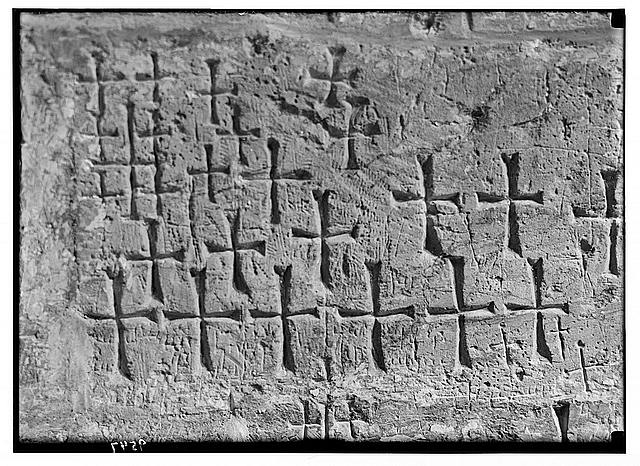
Crosses carved by pilgrims into a wall of the Holy Sepulchre, Jerusalem. (Yair Talmor, Wikimedia Commons).
“God’s Battalions: The Case for the Crusades” by Rodney Stark
“Muslims were [not] more brutal or less tolerant than were Christians or Jews, for it was a brutal and intolerant age. It is to say that efforts to portray Muslims as enlightened supporters of multiculturalism are at best ignorant.” (p 29)
In this reader-accessible but academic book, Professor Stark provides a very much needed corrective to the still accepted myths about the crusades into the Holy Land. Besides addressing the fallacies repeated as fact today (a few are given below), Stark presents a centuries-long history leading up to the crusades. Despite the reputation the Catholic Church earned over its handling of its Inquisition, at this earlier time violence was considered sinful. Even the killing of a criminal by a knight was deemed a bad thing. This may explain why Catholics didn’t respond sooner to centuries of mass murders and church destruction by Muslims in Palestine (see Moshe Gil, History of Palestine, 634-1099).
Fallacy 1: Crusaders were motivated by greed.
Fidelity 1: Piety and freeing the Holy Land, Jerusalem, were the crusaders’ motives. It must be understood that for some time Catholics believed that atonement for sins was gained through a pilgrimage to Jerusalem, for this is what their confessors told them. Obviously, this was spiritually very important to them and had nothing to do with wealth (in fact, pilgrimage was incredibly time-consuming, expensive, and dangerous). So when Pope Urban II announced that regaining Jerusalem would cleanse the liberators, it wasn’t an entirely new concept (becoming sin-free through violence was, however).
Fallacy 2: Muslims were tolerant and allowed conquered people to maintain their faith.
Fidelity 2: Depending on the time and area, conquered peoples were either (1) given the choice to convert to Islam or face death or enslavement, or (2) forced to pay heavy taxes, cease church or synagogue building, and never read scripture or pray aloud (even in their own homes).
More specifically relevant to the impetus for the crusades, and a definite show of Muslim intolerance, are the actions of the Turkish commander Atsiz. Sieging Jerusalem in 1071 or 1073, he promised the inhabitants safety if they relented. But when the city gates opened, “the Turkish troops were released to slaughter and pillage, and thousands died. Next, Atsiz’s troops murdered the populations of Ramla and Gaza, then Tyre and Jaffa” (p 97).
Fallacy 3: The crude European crusaders ruined the higher level culture of the Arab Muslims.
Fidelity 3: There are two related components of this fallacy that have been disproven but still remain in our culture. The first is that the Europeans were brutish children of the “Dark Ages.” As early as 1981 Encyclopedia Britannica refuted the long-held academic view that Europe even experienced a “Dark Ages.” On the contrary, this time period saw both the rise of agricultural
innovations that led to the biggest and strongest population ever, and many technological innovations that made the crusades possible.
Secondly, if you consider legitimate the claiming of conquered peoples’ knowledge as one’s own, then Islam “attained” high levels of it. Consider these very few examples: (1) “Arabic numerals” are Hindu; (2) Avicenna, considered the greatest of the Muslim philosopher-scientists, was Persian (this is true of many others, too); (3) Medical knowledge was from the Nestorian Christians. As conquerors, the Arabs made Arab names necessary and the Arab language mandatory for the intelligentsia.
Broken heart (base photo by Alex Bruda, Freeimages.com; filtered by author).
Did you know that the everyday expression “broken heart” (or “brokenhearted)” is considered to be derived from the Bible? Yes, even by secular sources. If you read your Bible you may already know that expressions such as going to the “land of Nod,” or having “feet of clay,” are not from fairytales or other old works of fiction.
In fact, very many idioms, phrases, and expressions in the English language originated from the Bible. This post holds a good number of them (but not all)–27–chosen specifically for their commonness. Some are so common that I not only made the list and checked it twice (see what I did there? That phrase is from the 1934 song “Santa Claus is Coming to Town“), but thrice.
The blind leading the blind. The biblical meaning may imply willful ignorance, but the saying today refers more generally to the uninformed blindly following the uninformed. “But [Jesus] answered and said, ‘Every plant which My heavenly Father has not planted will be uprooted. Let them alone. They are blind leaders of the blind. And if the blind leads the blind, both will fall into a ditch'” (Matthew 15:13-14).
A broken heart; brokenhearted. This ancient term for the depressed is from Psalms 34:18,”The Lord is near to those who have a broken heart, and saves such as have a contrite spirit.” “Brokenhearted” is first used in Luke 4:18: “. . . He has anointed Me to preach the gospel to the poor; He has sent Me to heal the brokenhearted . . . ”
By the skin of your teeth. Some explain this to be referring to the film you can feel on your teeth when they’re not clean, and thus, being saved in whatever situation by the ultra-slimmest of margins. “My bone clings to my skin and to my flesh, and I have escaped by the skin of my teeth” (Job 19:20).
Drop in the bucket. If something is like one drop in a bucket of water, it’s very insignificant. As Isaiah 40:15 says, “Behold, the nations are as a drop in a bucket, and are counted as the small dust on the scales . . .”
Feet of clay. Today this refers to someone having a secret character flaw that may cause their ruin, and is take from Daniel 2:32-33: “This image’s head was of fine gold, its chest and arms of silver, its belly and thighs of bronze, its legs of iron, its feet partly of iron and partly of clay.”
Fight the good fight. This has come to mean making a purposeful effort to work on behalf of a morally right cause. Originally it referred to the struggle to maintain one’s faith: “Fight the good fight of faith, lay hold on eternal life, to which you were also called . . .” (1 Timothy 6:12).
Fly in the ointment. This saying alludes to plans that are spoiled by a small thing, but as can be seen by the original verse below, it was meant to convey that bad behavior by an otherwise honorable person can raise questions about their true character. “Dead flies putrefy the perfumer’s ointment, and cause it to give off a foul odor; so does a little folly to one respected for wisdom and honor” (Ecclesiastes 10:1).
Labor of love. When you feel a strong purpose toward non-paid work you’re doing, then it’s a “labor of love.” “God is not unjust to forget your work and labor of love which you have shown toward His name . . .” (Hebrews 6:10, and 1Thessalonians 1:3).
Land of Nod. The Land of Nod is the place where Cain was exiled to for having murdered his brother; it has nothing to do with sleep, which it means in speech today. We can only guess, but perhaps it comes from the idea of being spiritually asleep after being cast from God. “Then Cain went out from the presence of the Lord and dwelt in the land of Nod on the east of Eden” (Genesis 4:16).
Out of the mouth of babes. The idea of this saying is that innocent people will speak in truth, without pretense, worry, or jadedness. There are two places where this comes from in the Bible, Psalms 8:2 and Matthew 21:16: “. . . And Jesus said to them, ‘Yes. Have you never read, “Out of the mouth of babes and nursing infants You have perfected praise”‘?”
Rise and shine. No, “rise and shine” is not from some teen encouragement flick, but from Isaiah 60:1: “Arise, shine; for your light has come! And the glory of the Lord is risen upon you.”
See eye to eye. Seeing eye to eye isn’t referring to a staring contest, but that people see something in the same way–that they agree. “Your watchmen shall lift up their voices, with their voices they shall sing together; for they shall see eye to eye when the Lord brings back Zion” (Isaiah 52:8).
A thorn in the flesh. Today, this simply refers to something that is continually annoying. The apostle Paul had a specific irritation, however, when he wrote: “And lest I should be exalted above measure by the abundance of the revelations, a thorn in the flesh was given to me, a messenger of Satan to buffet me . . .” (2 Corinthians 12:7). My favorite modern take on this can be found at Redjaw Cartoons.
Wits’ end. When someone is at their wits’ end, they are beyond being able to think about something (and usually quite frustrated about it). The expression comes from Psalm 107:27: “They reel to and fro, and stagger like a drunken man, and are at their wits’ end.”
Writing on the wall. This expression means that something bad is about to happen. It is from the spooky story in Daniel chapter 5, but here is an excerpt. “This is the inscription that was written [by a supernatural hand]: MENE, MENE, TEKEL, UPHARSIN. This is the interpretation of each word. MENE: God has numbered your kingdom, and finished it; TEKEL: You have been weighed in the balances, and found wanting; [UPHARSIN and] PERES: Your kingdom has been divided, and given to the Medes and Persians (verses 25-28).
A bird in the hand is worth two in the bush. This exact expression in its current form is not in the Bible, actually, but a similar biblical phrase is considered to be the first in English that means the same thing. This may seem a bit wanky, but I’m conveying what at least some etymologists say. The meaning of this phrase – to have something you know is good is not worth throwing away for things that may or may not be better – has equivalents in many languages. The phrase from the Old Testament is found in Ecclesiastes 9:4b: “A living dog is better than a dead lion.” The oldest written phrase close to its current form is found in an ancient source, but not nearly as ancient as the OT: “He is a fool who lets slip a bird in the hand for a bird in the bush” (Plutarch, c. AD 100, in Of Garrulity).
As old as the hills. Meaning “very old indeed,” this expression is a shortened version of Job 15:7: “Are you the first man who was born? Or were you made before the hills?” A similar but more specific expression is “As old as Methuselah.” This is referring to the oldest recorded person in the Bible, Methuselah, grandfather of Noah, who was said to have lived 969 years (Genesis 5:27).
Apple of my [or his] eye. This means that the “apple” referred to is the favorite of the beholder’s “eye.” There are many instances of the expression in the old testament, but notably Deuteronomy 32:10 and Zechariah 2:8
Cast your bread upon the waters. This is a less common saying nowadays (and is even absent from references), perhaps because it seems too nonsensical and doesn’t convey any meaning by itself. I love the sound of it, though, so included it here. It’s from Eccl.s 11:1: “Cast your bread upon the waters, for you will find it after many days.” Though the saying doesn’t seem to make any sense, it is an expression that hopes to invoke patience or diligence.
Set your teeth on edge. When something is upsetting or making you uptight, you might say that it’s setting your teeth on edge. This comes from a few verses in the Bible, like Jeremiah 31:29, “In those days they shall say no more: ‘The fathers have eaten sour grapes, and the children’s teeth are set on edge'” (see also Jeremiah 31:30 and Ezekiel 18:2).
Wolf in sheep’s clothing. This saying is so common, that the meaning seems rather obvious. In case this is new to you, it refers to a person who has bad intentions who is fooling people by acting innocent of any malice; they have an insincere public face, coupled with ill-will. The expression comes from Matthew 7:15: “Beware of false prophets, who come to you in sheep’s clothing, but inwardly they are ravenous wolves.”
Charity begins at home. Interestingly, this expression doesn’t come from an obvious notion or ideal, but from a criticism of men (providers of the family) having problems with being a good provider. 1 Timothy 5:8 states: “But if anyone does not provide for his own, and especially for those of his household, he has denied the faith and is worse than an unbeliever.” Jesus talks of hypocrisy in a number of places in the New Testament, especially in Matthew 23, but what he says in Matthew 15:1-9 is particularly applicable here: “But you [scribes and Pharisees] say, ‘Whoever says to his father or mother, “Whatever profit you might have received from me is a gift to God”—then he need not honor his father or mother.’ Thus you have made the commandment of God of no effect by your tradition.Hypocrites!” (15:5-7a).
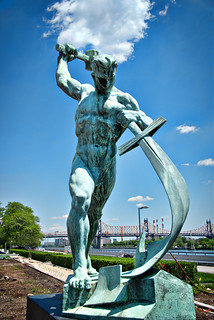
Let Us Swords into Plowshares (Photo credit: Singing With Light) At U.N. Headquarters, N.Y.
Beat swords into plowshares. I time of peace when even defensive weapons will not be necessary. From the yet to be fulfilled prophecy of Isaiah 2:4, “He shall judge between the nations, and rebuke many people; they shall beat their swords into plowshares, and their spears into pruning hooks; nation shall not lift up sword against nation, neither shall they learn war anymore.”
Salt of the earth. From Matthew 5:13: “You are the salt of the earth; but if the salt loses its flavor, how shall it be seasoned? It is then good for nothing but to be thrown out and trampled underfoot by men.”
Don’t cast your pearls before swine. This saying warns of not sharing things that are important to you with those who just don’t care, and who might even belittle you about it. The original meaning is specifically spiritual. Pigs (swine) will trample what’s thrown in front of them if it’s not ordinary food, so don’t toss spiritual food their way since they’ll only disdainfully muck it up. From Matthew 7:6, “Do not give what is holy to the dogs; nor cast your pearls before swine, lest they trample them under their feet, and turn and tear you in pieces.”
Sign of the times. From Matthew 16:3. Speaking with the Jewish leaders, Jesus said “. . . in the morning [you say], ‘It will be foul weather today, for the sky is red and threatening.’ Hypocrites! You know how to discern the face of the sky, but you cannot discern the signs of the times.”
Twinkling of an eye, In the. Neither Shakespeare nor Robert Manning were the first to write this expression, but the Apostle Paul in 1 Corinthians 15:52: “in a moment, in the twinkling of an eye, at the last trumpet. For the trumpet will sound, and the dead will be raised incorruptible, and we shall be changed.”
Note: Updated August 4, 2014. A larger part of this article was first published at Yahoo! Voices. It was integrated with a similar article here after Voices closed shop in 2014 and reverted all rights back to the original authors. Edited slightly on 10-8-2014.
The word of God came unto me,
Sitting alone among the multitudes;
And my blind eyes were touched with light.
And there was laid upon my lips a flame of fire.
I laugh and shout for life is good,
Though my feet are set in silent ways.
In merry mood I leave the crowd
To walk in my garden. Ever as I walk
I gather fruits and flowers in my hands.
And with joyful heart I bless the sun
That kindles all the place with radiant life.
I run with playful winds that blow the scent
Of rose and jasmine in eddying whirls.
At last I come where tall lilies grow,
Lifting their faces like white saints to God.
While the lilies pray, I kneel upon the ground;
I have strayed into the holy temple of the Lord.
In A Sacrifice of Praise, James H. Trott, editor (Cumberland House 2006; stanzas slightly modified)
_________________
The Rock (excerpt from Section X of Choruses)
by TS Eliot
О Greater Light, we praise Thee for the less;
The eastern light our spires touch at morning,
The light that slants upon our western doors at evening.
The twilight over stagnant pools at batflight,
Moon light and star light, owl and moth light,
Glow-worm glowlight on a grassblade.
О Light Invisible, we worship Thee!
We thank Thee for the lights that we have kindled,
The light of altar and of sanctuary;
Small lights of those who meditate at midnight
And lights directed through the coloured panes of windows
And light reflected from the polished stone,
The gilded carven wood, the coloured fresco.
Our gaze is submarine, our eyes look upward
And see the light that fractures through unquiet water.
We see the light but see not whence it comes.
О Light Invisible, we glorify Thee!
___
In T.S Eliot: Collected Poems 1909-1962 (HBJ 1963)
The following is posted at the ACLJ website, where you can read many different articles about Pastor Saeed Abedini’s imprisonment–his current unhealthy condition, President Obama’s response, how his family is doing, etc.–and sign a petition for his release (this link takes you to a separate site where you can learn about Abedini’s case as well). You may think that these petitions don’t do any good when directed at a country like Iran, but, recently Abedini wasn’t being treated for his illnesses and international outcry did cause the Iranian government to at least move the pastor to a hospital bed. Abedini wrote this message from the hospital.
Happy Resurrection Day.
On the Eve of Good Friday and Easter I was praying from my hospital room for my fellow Christians in the world. What the Holy Spirit revealed to me in prayer was that there are many dead faiths in the midst of Christians today. That Christians all over the world are not able to fully reach their spiritual potential that has been given to them as a gift by God so that in reaching that potential, the curtain can be removed and the Glory of God would be revealed.
Some times we want to experience the Glory and resurrection with Jesus without experiencing death with Him. We do not realize that unless we pass through the path of death with Christ, we are not able to experience resurrection with Christ.
We want to have a good and successful marriage, career, education and family life (which is also God’s desire and plan for our life). But we forget that in order to experience the Resurrection and Glory of Christ we first have to experience death with Christ and to die to ourselves and selfish desires.
Jesus said to His Disciples: “Whoever wants to be my disciple must deny themselves and take up their cross and follow me. (Matthew 16:24)
This means that we should not do things that we like to do (that God does not want us to do) and to do things that we do not like to do (but God wants us to do) so that He may be glorified.
So in addition to spending our days and night in doing the works of faith as described above, we should also transform our dead faiths into living and active faiths through the resurrection of Christ which is an active and constructive love that is effective.
In conclusion, let us resurrect our Dead faiths to living faiths by first dying to our selfish “resurrected” self and experiencing the cross of Jesus. Then we are able to experience the Glorious resurrection with Christ.
A Glorious life with Christ starts only after a painful death (to self) with Christ.
We will start with Christ.
Pastor Saeed Abedini Prisoner in the Darkness in Iran, but free for the Kingdom and Light
What amazes me, as it astonishes Lennox, is that anyone can rationally affirm and adhere to the 18th century philosopher Hume’s argument against miracles, which says that: miracles go against the laws of nature, therefore they don’t exist. We study nature and have found laws of nature by observation, but we can’t rightly claim that something doesn’t exist or won’t happen just because we know of such laws. What is even more odd is that Hume didn’t actually believe the Laws of Nature were necessarily always uniform: “He famously argues that, just because the sun has been observed to rise in the morning for thousands of years, it does not mean that we can be sure that it will rise tomorrow. This is an example of the Problem of Induction: on the basis of past experience you cannot predict the future, says Hume.” If this is so, then “if nature is not uniform, then using the uniformity of nature as an argument against miracles is simply absurd.”
In his usual clear style, CS Lewis points out how easily Hume’s argument can be refuted (as quoted by Lennox):
If this week I put a thousand pounds in the drawer of my desk, add two thousand next week and another thousand the week thereafter, the laws of arithmetic allow me to predict that the next time I come to my drawer, I shall find four thousand pounds. But suppose when I next open the drawer, I find only one thousand pounds, what shall I conclude? That the laws of arithmetic have been broken? Certainly not! I might more reasonably conclude that some thief has broken the laws of the State and stolen three thousand pounds out of my drawer. One thing it would be ludicrous to claim is that the laws of arithmetic make it impossible to believe in the existence of such a thief or the possibility of his intervention. On the contrary, it is the normal workings of those laws that have exposed the existence and activity of the thief.
After making some thoughtful points, Lennox concludes: “When a miracle takes place, it is the laws of nature that alert us to the fact that it is a miracle. It is important to grasp that Christians do not deny the laws of nature, as Hume implies they do. It is an essential part of the Christian position to believe in the laws of nature as descriptions of those regularities and cause-effect relationships built into the universe by its Creator and according to which it normally operates. If we did not know them, we should never recognise a miracle if we saw one.”
Lennox goes on to use biblical passages to flush out the truth that people at the time of Christ, and earlier, didn’t easily believe miracle stories either. They knew how nature worked and what was unusual or seemingly impossible. Therefore, their ancient witness is just as valid as if you or I saw Jesus resurrected. Lennox also discusses the real importance of female witnesses to the resurrection. Please see his article for the full discussion of certain anti-resurrection arguments used by skeptics, and the thoughtful responses he provides. And, have a joyful Easter!
Christ’s Entry into Jerusalem, by Hippolyte Flandrin
Biola Lent Project has a Lent devotional calendar posted. The daily entries are multi-sensory, with a written devotional, an image, and music. Here is the link to the Palm Sunday entry: April 13, 2014. In it, the author speaks of the attitudes shown by the faces in the crowd in Flandrin’s painting, and how they reflect us today, too, even though we know something that those people did not yet know about–Jesus’ resurrection. It ends with this simple prayer (of St. Benedict):
O gracious and holy Father,
give us wisdom to perceive you,
diligence to seek you,
patience to wait for you,
eyes to behold you,
a heart to meditate on you,
and a life to proclaim you;
through the power of the Spirit
of Jesus Christ our Lord.
Amen.
Lent is a period of 40 days prior to Easter (excluding Sundays). For many people it commemorates Jesus’ fasting in the wilderness. They “give up something” for Lent every year, like sweets or TV. This can yield spiritual benefits, but denying yourself things and denying yourself aren’t the same. In Luke 9:23, Jesus taught the latter.
This verse can be broken down into three parts. In the statement “If anyone desires to come after Me,” the word desires indicates that this is for sincere disciples only. In the phrase “let him deny himself,” the words let and denyhimself imply a willingness to renounce one’s selfish will and ways. And in the statement “take up his cross daily,” the word daily emphasizes a continual dying to self-will.
It’s easier to give things than to give ourselves. Yet Jesus gave Himself, and so must we. To those who deny themselves in obedient service, He has promised, “Whoever loses his life for My sake will save it” (v.24). And to His question, “What profit is it to a man if he gains the whole world, and is himself destroyed?” we are called to answer, “There is no profit!” We show that we believe this when we deny ourselves and follow Christ.
To follow Christ we must let go
Of all that we hold dear;
And as we do deny ourselves,
Our gains become more clear. —Sper
By living for ourselves we die; by dying to ourselves we live.
As believers, we use the word “salvation” so frequently, yet what does this word actually mean? Most think that salvation simply relates to how someone becomes a Christian. We probably think this way since we are living in the wake of the Protestant Reformation. The reformers spent most of their energy defending and explaining what one must do in order to become a Christian. However, the biblical and Pauline use of the term “salvation” is much broader. Salvation actually has at least three phases.
To read the remainder of Dr. Andy Woods’ article on three phases of salvation, please click BibleProphecyBlog.com.
[A sharing of one post at Bible Prophecy Blog is not an endorsement of all blog posts.]
Judah and Tamar, of the Rembrandt School (mid-1600s; Public domain).
A sermon of a well-known evangelist was being broadcast one day, and I just can’t forget him talking about how we should never lie. A little white lie? No, we should never go there. Well, Ok, but what about lying to save someone’s life? There are Christians who think it is wrong to lie in order to save someone’s life. But is this stance biblical? Is it always wrong to tell “a” lie, or is it only wrong to be a liar?
Exodus 20:16 (the 9th commandment) states, “You shall not give false testimony against your neighbor.” Does this command somehow imply that if your neighbor is evil and is about to rape your wife or daughter, that you can’t deceive the neighbor somehow in order to save your loved ones? When faced with evil and/or murderous intent, we cannot defend ourselves with words? A person in this situation could defend themselves or others physically and not be questioned, yet there are Christians who will deny the use of words in self-defense. The motive of one’s heart is what God sees and knows.
There are many verses in the bible indicating that God hates a deceitful heart, a person who deceives for fraudulent or exorbitant gain. Proverbs 11:1, Proverbs 20:23, Hosea 12:7, and Amos 8:5 all show that God hates “dishonest scales” and “false weights,” used by those who boost prices and cheat; Micah 6:11 states, “Shall I acquit a man with dishonest scales, with a bag of false weights?” Merchants like this are stealing (commandment 8, “You shall not steal”) through deception. There are other verses about usury and excessive interest as well: “He lends at usury and takes excessive interest. Will such a man live? He will not! Because he has done all these detestable things, he will surely be put to death and his blood will be on his own head” (Ezekiel 18:13). Other relevant verses are: Exodus 22:25; Leviticus 25:35-37; Deuteronomy 23:19; Nehemiah 5:7, 10, 11; Psalm 15:5; Proverbs 28:8; Ezekiel 18:8, 17, 22:12.
People who bear false witness, and people who deceive innocents as a way of life in order to take their money and resources, are liars. God is against those who hurt innocent people. There are a number of instances in the bible where persons have lied in order to save innocent life, especially in time of war, or to right an injustice that no one else had stepped in to right. For instance, in Exodus 1:15-21, Pharaoh orders the Hebrew midwives to kill newborn boys, but not girls. The midwives did not comply and when called before Pharaoh, they lied to him, because “they feared God.” God was then kind to the midwives and gave them families of their own. In this situation, the midwives did what they had to do in order to save their own lives and the lives of others; the situation was evil and not the midwives, who, “fearing God,” would not think of lying generally in life. We live in a corrupt world, not in heaven, where there will be no necessity to defend life in this way.
Before continuing our look at whether or not it is OK to ever lie, let’s look at what “sin” and “repentance” mean. Sin means “to miss the mark,” to miss the target of God’s law. Sin can be committed against God’s law, or sin can come from not doing what God commanded, like not loving your neighbor. Also, there are greater sins and lesser sins; thus a gradation of sins (see Matthew 11:20-24) is acknowledged by God. Repentance means to undergo a change of mind. When a person comes to faith in God, they undergo a change of direction in their lives, away from sin and toward Christ. Also, the will and power to repent for individual sins by the believer is assisted by the Holy Spirit.
A problem (for some) with situations like the midwives in Egypt and with the following stories, is that persons lied or deceived, yet did not repent. However, the situations required deception in order for a greater good to result, or a wrong to be righted. Some theologians view the lies in these cases as common sense morality that any child would know to be “right,” while some say that the persons must have repented of the deception in order to have been blessed or saved by God (and they were, as recorded in the Bible), and that the repentance simply was not recorded. It should be noted that in other stories of the bible where deception was committed for selfish ends, but by a person declared righteous or blessed, repentance is recorded (as with David’s adultery and murder, for example).
Tamar and Judah (Genesis, Chapter 38)
This event is placed within the story of Joseph, which may seem incongruous. However, it was this event created by Tamar that exposed Judah’s “callous hypocrisy” and is the beginning of Judah’s personal transformation that leads to his thoughtfulness shown in the rest of the story (Dunn p. 65). Tamar was Judah’s daughter-in-law. She was married to Judah’s eldest son, who died, and then to the next son, as was the custom, but he also died. Judah promised his youngest son to Tamar, following the custom again; she was to live with her own family until the son was old enough to marry. However, Judah did not keep his word. At a time when Tamar knew that Judah was coming to her area, she dressed as a prostitute. Judah voluntarily came to this “prostitute” and Tamar became pregnant. Later, when it became obvious that Tamar was pregnant but did not have a husband, Judah declared that she should be burned to death. Being brought before Judah, Tamar presented items that Judah had left with the prostitute. At that the shamed Judah declared, “She is more righteous than I, since I wouldn’t give her to my son Shelah.” Judah did not sleep with Tamar again. Jesus’ genealogy includes Tamar.
Rahab and the spies (Joshua, Chapter 2)
In following the command and gift of God, the Israelites were entering the promised land after their long trek from Egypt. Joshua, Moses’ successor, sent two spies to Jericho to obtain information about the city. The spies, perhaps questionably, went to the house of a prostitute, Rahab. Amazingly, they found a confession of faith and loyalty to the God of Israel there, in the person of Rahab. Somehow the king of Jericho knew there were spies in the city, and that they had gone to see her. Because of Rahab’s faith, she hid the spies and deceived the city guards into thinking that the spies had already left. She assisted the spies in escaping and asked that they give protection to her and her family when Israel attacked Jericho. This they did, and Rahab and her family became a part of Israel. Jesus’ genealogy includes Rahab, and her faith is commended in Hebrews 11:31. As something to consider, it seems that there was no other way for Rahab to respond in this situation. Without her deceit, it seems certain that the spies would have been goners; also, it can be seen that it was because of her faith and loyalty to God that she lied to the guards. If she did not want to protect God’s people, she would not have had any reason to lie.
Jael and Sisera (Judges, Chapters 4 and 5)
The story of Jael and Sisera is as astonishing as it is gruesome. A short description does not do the tale or context justice and it is recommended to the reader to study a few commentaries on Judges 4 and 5 (such as the Eerdman’s reference given below). The event takes place while Israel was under the jurisdiction of Canaan, and a woman prophet, Deborah, was leading her people in this state. Through God’s word, Deborah told Barak to ready men so that Sisera, the commander of the Canaanite army, could be given to him. Barak showed a lack of confidence, so Deborah prophesied that Sisera would be delivered into the hands of a woman instead. Barak, along with Deborah, attacked Sisera and his men. After intense battle, Sisera fled, but Barak followed the rest of the troops and defeated them. In the meantime, Sisera entered the tent of Jael, a member of a clan friendly to the Canaanite king. Jael, however, was loyal to Israel (and maybe she was angry since from the wording in Judges 5, she may have been raped by Sisera). She pretended to be friendly with Sisera and encouraged him to rest, but after he fell to sleep she hammered a tent peg through his temple, killing him. Jael is called “most blessed of women” in the Song of Deborah (Judges 5).
Other instances of deception in the Bible
We covered the stories of some interesting ladies of the bible, like Tamar who deceived in order to obtain what was rightfully hers (after it was clear that the other party was not honoring an agreement), and Rahab, a foreign prostitute who turned to God and lied in order to save Israelites, and Jael, a female who, through deception, defeated the powerful commander of Canaan who had attacked Israel. The reader should not get the impression that the Bible shows only females deceiving when necessary, however.
King David, before he was king and running from murderous King Saul, went to live in Philistine territory, though the Philistines were Israel’s enemy. Since David wasn’t alone but had 600 of his men with him, and their families, they needed a large area to stay in. King Achish of Gath agreed that David and his men could live there. While David lived there he went and raided towns outside of Israel, toward Egypt, and killed all who lived there so that there would be no witnesses. This was necessary for David’s deception, since he told King Achish that he was raiding Israelite towns. The king was led to believe that David was loyal to him and that Israel surely despised David. The king eventually called on David and his men to join in attacking Israel, and he had to agree. However, when the King’s commanders insisted that David and his men might turn on them and so shouldn’t fight, David went out of his way to show loyalty to the Philistine king (1 Samuel 27; 29:1-11).
Lest anyone should think that David was rewarded by God for his violent deeds here and elsewhere, he was not. David loved God, but committed sins; his later life was full of the consequences of these, and in addition, God forbade David from building His temple because of his bloodshed (1 Chronicles 22:8). Another example of a man lying in the Bible, though not anywhere near as fully and heinously as David, is in Jeremiah the prophet. In Jeremiah 38:24-27, Jeremiah is consulted by King Zedekiah, who was appointed to that position by the King of Babylon, Nebuchadnezzar. Zedekiah was surrounded by scheming men and simply asked Jeremiah to not tell these men of a private conversation they had regarding Nebuchadnezzar’s impending invasion. Jeremiah obeyed and was not truthful about the conversation when asked. This simple act of deception appears to be in line with God’s wish to spare Zedekiah’s life (Jeremiah 38:20-23).
So, was it OK or even desirable that the midwives in Egypt, Tamar, Rahab, Jael, and Jeremiah, were deceptive? What does your moral common sense say? Is it alright to lie in order to save someone else’s life (or right a wrong that no one else can, or will, do)? Is it still “evil” when one does so? If Rahab saved lives by lying, was it something she needed to repent of?
Theological and New Testament considerations
Peter Kreeft, a Christian and a philosophy professor, wrote an easily accessible essay on this issue in response to criticisms over an abortion-related “sting” operation (Kreeft 2011). His stance is that it was good that the persons conducted this sting operation, despite the deceptions involved. When faced with a great evil in this corrupt world, deception – while in other types of situations is wrong – can be right. Were those who hid Jews and lied to the Nazis about it, wrong? No, what they did was right. Was it wrong to use spies to help stop the Nazis from using nuclear weapons? Is it wrong for the police to conduct undercover work and sting operations? No, these activities that involve deception are not wrong, but right, Kreeft argues.
Why do so many people these days take an absolutist stance and argue for the wrongness of these works by people who are only trying to save life? Kreeft says, “I think they are so (rightly) afraid of moral relativism that they have (wrongly) fallen into moral legalism.” He says that there is moral truth and moral reality, but that people in this age have become like computers, not listening to their moral intuition. They deal with abstractions and not with people. For those who cannot or will not acknowledge that saving Jews from the Nazis using deception was right and good, Kreeft says, “If you don’t know that, you’re morally stupid, and moral stupidity comes in two opposite forms: relativism and legalism. Relativism sees no principles, only people; legalism sees no people, only principles.” He concludes that perhaps, as Jesus called us to become like children, He meant “for us to remember our more simple and innocent moral wisdom.”
We have looked into some Old Testament people who lied in order that good may result, and how God commands against bearing false witness and using deceptive means for personal gain. Does the New Testament convey anything different? No, but it does perhaps convey more. In Acts 5:1-11, a married couple who had tried to deceive fellow Christians found that they were in fact lying to God. Ananias and Sapphira had sold some property in order to donate it to fellow believers, but for some unknown reason, they secretly decided to hold some back for themselves. God had not demanded that the couple, or anyone, give at all. All donations were voluntary and Ananias and Sapphira simply needed to be honest about what they wanted to do. Instead, they collapsed in death in front of Peter and other witnesses. The message seems pretty clear: God was with the new church and God knows people’s hearts.
Revelation 22:15 states, “Outside are the dogs, those who practice magic arts, the sexually immoral, the murderers, the idolaters and everyone who loves and practices falsehood.” Who will go to hell? Everyone who loves and practices falsehood. Those who practice being deceptive, who walk in that way of life, will end up separated from God. Ultimately, why is this the case? Because liars will never accept the truth. This dovetails with how John defines “liar:” “Who is the liar? It is the man who denies that Jesus is the Christ. Such a man is the antichrist—he denies the Father and the Son” (1 John 2:22). “Anyone who believes in the Son of God has this testimony [God’s, not man’s] in his heart. Anyone who does not believe God has made him out to be a liar, because he has not believed the testimony God has given about his Son. And this is the testimony: God has given us eternal life, and this life is in his Son” (1 John 5:10-11).
Further, the author of Romans talks of those who suppress the truth: “The wrath of God is being revealed from heaven against all the godlessness and wickedness of men who suppress the truth by their wickedness, since what may be known about God is plain to them, because God has made it plain to them. For since the creation of the world God’s invisible qualities—his eternal power and divine nature—have been clearly seen, being understood from what has been made, so that men are without excuse” (3:18-20). God’s qualities are clearly seen and all men know it, according to these verses; men are without excuse . . . period. This is why in the next group of verses (3:21-22) it states: “For although they knew God, they neither glorified him as God nor gave thanks to him, but their thinking became futile and their foolish hearts were darkened. Although they claimed to be wise, they became fools . . . .” Men know God but some choose to deny Him, and then fall deeper into darkness.
So we can see that there are those people who walk in a way of life that is against God, and those who walk in the way of God. Those who walk away from God can still show kindness in life (Luke 11:11-13), and those who walk with God can still sin at times in various ways. What matters is the way (which path) in which one is walking. “If we claim to have fellowship with him [God] yet walk in the darkness, we lie and do not live by the truth. But if we walk in the light, as he is in the light, we have fellowship with one another, and the blood of Jesus, his Son, purifies us from all sin” (1 John 5:6-7). Through Jesus we become righteous and are purified, even if we stumble here and there (1 John 1:8-10).
Based on these things, and what has been presented earlier, can we tell if it always wrong to deceive? Can anyone really claim that lying to murderers, like the Nazis, in order to keep innocents from death, is wrong? Could Jesus have had something similar in mind when he said, “I am sending you out like sheep among wolves. Therefore be as shrewd [or sly] as snakes and as innocent as doves” (Matthew 10:16)? After all, we know “that the whole world is under the control of the evil one” (1 John 5:19b). Will not all of our choices in some situations, then, be evil (if you consider any deception at all evil)? Do we not have free will in order to choose what seems best, while lacking the power to create other choices (change reality)? Should we not choose “the lesser of two evils” instead of doing nothing? In the case of persons lying to the Nazis in order to save lives, wouldn’t greater evil have resulted from doing nothing? This seems very much like common sense, common moral sense as Kreeft is shown to have pointed out. What we are not to do is “be” liars who: (1) bear false testimony against someone, (2) deceive for personal profit and gain, and (3) deny and suppress the truth about God.
MacDonald, William. “Prophecies of the Messiah Fulfilled in Jesus Christ.” In Believer’s Bible Commentary, by William MacDonald, xviii-xxiii. Nashville: Thomas Nelson Publishers, 1995 (1989).
Sproul, R.C. Essential Truths of the Christian Faith. Wheaton: Tyndale House Publishers, 1992.
_____
A very slightly different version of this article was posted (by me) at Examiner.com in 2011, and then edited and posted at my website in 2012. Thanks so much for reading!
Instead of giving their kids comforting dolls, the Taliban give them bombs and tell them they won’t get blown up along with their victims.
Update: In early January, 2015, the anti-Western, anti-secular Islamist terrorist group Boko Haram used a 10 year old girl to kill shoppers at a market in Nigeria. The girl was blown up, 16 killed, and 27 injured. The group has killed thousands since 2002, and kidnapped more than 200 girls in April, 2014; the girls were never rescued or freed. June 2015 Update: The practice continues: Boko Haram uses Young Girls as Suicide Bombers in Terror Campaign.
As reported in January (2014), a young girl who was supposed to detonate a suicide vest to kill checkpoint police turned herself in after being beaten by her father for not carrying out the deed. Though the Taliban denied that young Spozhmai was sent on a suicide mission, the Afghan police believed her. Spozhmai was lucky – though beaten, she didn’t get blown to bits.
According to one source, in the first part of 2011, four children aged 8 to 14 were not so fortunate and died along with several victims when their suicide vests detonated. Other children that year had also been deployed as suicide bombers, but were stopped prior to anyone getting hurt. The Taliban, despite its denials, has been training and deploying children suicide bombers since at least 2010.
The Taliban’s use of children as suicide bombers is not only sickening, but it makes a mockery of Mullah Omar’s claim to protect children and civilians. Any political movement or army that manipulates or coerces children into becoming human bombs has lost touch with basic humanity. Brad Adams, Asia director at Human Rights Watch
Another source, from 2012, gave a more detailed and disturbing account of children suicide bombers used by the Taliban in Afghanistan in the whole of 2011 (this also happens in Pakistan and can be read about here):
A senior Afghan intelligence official estimated that more than 100 had been intercepted in the past 12 months, including 20 from the Kandahar area in the south.
The largely illiterate boys are fed a diet of anti-Western and anti-Afghan government propaganda until they are prepared to kill, he said. But the boys are also assured that they will miraculously survive the devastation they cause.
“The worst part is that these children don’t think that they are killing themselves,” said the official. “They are often given an amulet containing Koranic verses. Mullahs tell them, ‘When this explodes you will survive and God will help you survive the fire. Only the infidels will be killed, you will be saved and your parents will go to paradise’.”
Moving back to the very recent past, just a day or two after Spozhmai told her story to Afghan police, a 14 year old boy stopped a child suicide bomber in his school. The teen, Aitzaz Hasan, tackled a suspicious teen at his school and the other teen’s bomb went off, killing Hasan and himself. Violence has only increased in Afghanistan and the regular populace is sick of it, and sick of their government not doing anything about it. Attacks on schools have increased and school attendance has, not surprisingly, decreased.
No doubt your thoughts are to pray for peace in Afghanistan, and for no more children, in particular, to be prey to the satanic tactics of the Taliban. We should pray about this and for the oppressed people there (and bless you for doing so), but it doesn’t hurt to know how our government (and the Western press) is handling issues like this, and the related issue – in my mind – of ignoring all the Christians being killed and displaced out of the Middle East and other Muslim countries.
It doesn’t hurt to also know what lying hypocrites groups like the Taliban are. The Taliban continue to deny they use children bombers, even though there is a great deal of irrefutable evidence against their denials. The Taliban has codes they claim to go by, and using children in this way defies their own code. It goes against the Quran as well. Yet, they are still very willing to have Muslim children killed for their cause.
The Palestinians have also done this in the past, and today train children to be suicide bombers. Yet, somehow, Israel is to blame for all the ills of the Palestinians and many Western countries are not only boycotting Israel but are increasingly antisemitic. And, our government seals its lips when it could educate, not only about the tactics of Islamists, but the post-WWII history and legitimacy of Israel as a nation and why the UN did not also grant statehood to Palestine at that time or in the years afterwards.
Our country wrings it hands and vacillates regarding Syria. It ignores the persecution and killing of Christians in Egypt. The issues are very many and a future post will outline the extermination and the apparent coming extinction of Christians from Muslim countries. Jews are already missing from the Middle East, except in Israel, and they are increasingly unwelcome elsewhere. It is now happening to Christians, too. And The West stands by, warming up to the idea. It’s now pretty easy to imagine the biblical scenario of God’s two witnesses during the end days (Revelation 11:8-10):
Their bodies will lie in the public square of the great city . . . For three and a half days some from every people, tribe, language and nation will gaze on their bodies and refuse them burial. The inhabitants of the earth will gloat over them and will celebrate by sending each other gifts, because these two prophets had tormented those who live on the earth.
This is the crime against humanity of our time. It is the religious equivalent of ethnic cleansing. It is deliberate, it is brutal, and it is systematic. And I, as a Jew, want to say that I stand solidly with Christians throughout the world in protest against this crime. And I am appalled that the world is silent.
Rabbi Jonathan Sacks (2013 Erasmus Lecture)
. . . the Jews seem to be the ones most outraged by it. . . . It’s shades of the past that a world that is indifferent to such brutal actions becomes indifferent to anybody’s suffering.
The White House—the whole Western community—ought to be taking action, as we would against any country that engages in this kind of action. Look, overall the West is muted in their response to the killings of Christians by the thousands, from Indonesia to Nigeria to Tehran to Damascus. Where is the outcry? Christians and Copts [are being killed] in Egypt, other countries—and hardly any response to it. . . . Where are the [United Nations] Security Council resolutions? Why aren’t the condemnations coming from them?
Malcolm Hoenlein, head of the Conference of Presidents of Major American Jewish Organizations
. . . the Middle East [was] once home to countless thriving Jewish communities, only for them to have been decimated in the mid-twentieth century. With the rise of hardline Islam and growing turmoil in many of these countries, Christians risk sharing a similar fate. . . . A century ago, Christians constituted 20 percent of the population of the Middle East; today, that number stands at just 4 percent.
Jews care. A lot of Jews get it. What is with us? Why does our own country, and the West, not care? The western media is biased in its reporting when Christians are killed in countries like Sudan. They seem to be ashamed that Christians even exist and that violent-minded Muslims are justified in doing evil. But where is the Christian response, the Christian outrage? If it doesn’t exist, then it can be surmised that Christians don’t really exist. At least, our own government’s weak response against the atrocities can certainly be viewed as nothing but hot air. But why should our government do anything about it or care, when we people of faith don’t even seem to??
Churches are our gathering places. Why aren’t churches organizing anything to raise awareness about what is going on in the world? If they don’t know . . . what excuse can be given? Maybe some pastors are writing newspaper editorials and encouraging action by their flock–I don’t know. Feel free to let me know of examples of such action in the comments below, or provide links there to Christians groups and organizations that are trying to do something about this (I don’t mean groups that report on it only). Thanks.










 With Christian Eyes