Thanks again to all of you who liked my first cross-country road trip posts! This one has taken me tooo long to get out because–and if you read my blog you won’t be surprised–Fallout 4 came out and I’ve been pretty absorbed in it. In any case, for those who didn’t see my first cross-country trip post, here’s the series intro:
Hello from A MUCH BETTER PLACE than where I, and my family, had lived! I wrote earlier about our experience in trying to buy a home from thousands of miles away, but now we’ve arrived (in Michigan from Southern California, if you must know)! I’m not here today to discuss our property or the process in obtaining it, but to relay some photos and comments about our trip as well as a bit about the area we now live in. This is the first post in a series, and I promise, I’ll try not to be long-winded. I simply hope you enjoy the photos and any funny or interesting things that I can share.
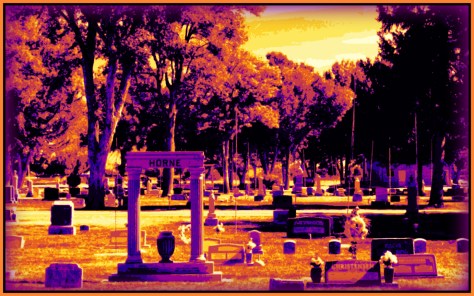
A modded view of Richfield City Cemetery, Utah, October 2015 (c) Vicki Priest
First, a big Thank You to those bloggers who liked my first cross-country road trip post! Second, for those who don’t know, I’ll repeat the series intro here:
Hello from A MUCH BETTER PLACE than where I, and my family, had lived! I wrote earlier about our experience in trying to buy a home from thousands of miles away, but now we’ve arrived (in Michigan from Southern California, if you must know)! I’m not here today to discuss our property or the process in obtaining it, but to relay some photos and comments about our trip as well as a bit about the area we now live in. This is the first post in a series, and I promise, I’ll try not to be long-winded. I simply hope you enjoy the photos and any funny or interesting things that I can share.
Batter my heart, three-person’d God; for, you As yet but knock, breathe, shine, and seek to mend; That I may rise, and stand, o’erthrow me, and bend Your force, to break, blow, burn and make me new. I, like an usurped town, to another due, Labour to admit you, but O, to no end. Reason, your viceroy to me, me should defend, But is captiv’d, and proves weak or untrue. Yet dearly I love you, and would be loved fain, But am beroth’d unto your enemy: Divorce me, untie, or break that knot again, Take me to you, imprison me, for I Except you enthrall me, never shall be free, Nor ever chaste, except you ravish me.
In The Oxford Book of Christian Verse. D. Cecil, ed. (Clarendon Press 1940), p 87.
___________
LOVE II
By George Herbert (1593 – 1633)
Immortal Heat, O let they greater flame Attract the lesser to it: Let those fires, Which shall consume the world, first make it tame, And kindle in our hearts such true desires,
As may consume our lusts, and make thee way. Then shall our hearts pant [for] thee; then shall our brain All her inventions on thine Altar lay, And there in hymns send back thy fire again.
Our eyes shall see thee, which before saw dust; Dust blown by wit, till that they both were blind: Thou shalt recover all they goods in kind, Who wert disseized by usurping lust:
All knees shall bow to thee, all wits shall rise, And praise him who did make and mend our eyes.
In The One Year Book of Poetry. P. Comfort and D Partner, ed.s (Tyndale House Pub.s 1999), Feb. 14.
__________
“BUT ART THOU COME, DEAR SAVIOR?”
By Anonymous
But art Thou come, dear Saviour? hath Thy love Thus made Thee stoop, and leave Thy throne above
Thy lofty heavens, and thus Thyself to dress In dust to visit mortals? Could no less
A condescension serve? and after all The mean reception of a cratch and stall?
Dear Lord, I’ll fetch Thee thence! I have a room (‘Tis poor, but ’tis my best) if Thou wilt come
Within so small a cell, where I would fain Mine and the world’s Redeemer entertain,
I mean, my heart: ’tis sluttish, I confess, And will not mend Thy lodging, Lord, unless
Thou send before Thy harbinger, I mean Thy pure and purging Grace, to make it clean
And sweep its nasty corners; then I’ll try to wash it also with a weeping eye.
And when ’tis swept and wash’d, I then will go And, with Thy leave, I’ll fetch some flowers that grow
In Thine own garden, Faith and Love, to Thee; With these I’ll dress it up, and these shall be
My rosemary and bays. Yet when my best Is done, the room’s not fit for such a guest.
But here’s the cure; Thy presence, Lord, alone Will make a stall a court, a cratch a throne.
In The Oxford Book of Christian Verse. D. Cecil, ed. (Clarendon Press 1940), pp 260-261.
I understand that matter can be changed To energy; that maths can integrate The complex quantum jumps that must relate The fusion of the stars to history’s page. I understand that God in every age Is Lord of all; that matter can’t dictate; That stars and quarks and all things intricate Perform his word—including fool and sage.
But knowing God is not to know like God; And science is a quest in infancy. Still more: transcendence took on flesh and blood— I do not understand how this can be.
The more my mind assesses what it can, The more it learns the finitude of man.
In The Poetic Bible, C Duriez, ed. (Scribner Poetry 1997), 180.
__________
SUPERNATURAL LOVE
By Gjertrud Schnackenberg
My father at the dictionary-stand Touches the page to fully understand The lamplit answer, tilting in his hand
His slowly scanning magnifying lens A blurry, glistening circle he suspends Above the word “Carnation.” Then he bends
So near his eyes are magnified and blurred, One finger on the miniature word, As if he touched a single key and heard
A distant, plucked, infinitesimal string, “The obligation due to every thing That’s smaller than the universe.” I bring
My sewing needle close enough that I Can watch my father through the needle’s eye, As through a lens ground for a butterfly
Who peers down flower-hallways toward a room Shadowed and fathomed as this study’s gloom Where, as a scholar bends above a tomb
To read what’s buried there, he bends to pore Over the Latin blossom. I am four, I spill my pins and needles on the floor
Trying to stitch “Beloved” X by X. My dangerous, bright needle’s point connects Myself illiterate to this perfect text
I cannot read. My father puzzles why It is my habit to identify Carnations as “Christ’s flowers,” knowing I
Can give no explanation but “Because.” Word-roots blossom in speechless messages The way the thread behind my sampler does
Where following each X I awkward move My needle through the word whose root is love. He reads, “A pink variety of Clove,
Carnatio, the Latin, meaning flesh.” As if the bud’s essential oils brush Christ’s fragrance through the room, the iron-fresh
Odor carnations have floats up to me, A drifted, secret, bitter ecstasy, The stems squeak in my scissors, Child, it’s me,
He turns the page to “Clove” and reads aloud: “The clove, a spice, dried from a flower-bud.” Then twice, as if he hasn’t understood,
He reads, “From French, for clou, meaning a nail.” He gazes, motionless. “Meaning a nail.” The incarnation blossoms, flesh and nail,
I twist my threads like stems into a knot And smooth “Beloved,” but my needle caught Within the threads, Thy blood so dearly bought,
The needle strikes my finger to the bone. I lift my hand, it is myself I’ve sewn, The flesh laid bare, the threads of blood my own,
I lift my hand in startled agony And call upon his name, “Daddy daddy”— My father’s hand touches the injury
As lightly as he touched the page before, Where incarnation bloomed from roots that bore The flowers I called Christ’s when I was four.
In The Vintage Book of Contemporary American Poetry, JD McClatchy ed. (Vintage Books 1990), 535-537.
They are small enough to find and care for a tiny stone. To lift it with wobbly concentration from the ground, from the family of stones, up past the pursed mouth—
for this we are thankful—to a place level with her eyes to take a close look, a look into the nature of stone. Like everything, it is for the first time: first stone,
chilly cube of ice, soft rise of warm flesh, hard surface of table leg, first and lasting scent of grass rubbed between the tiny pincer fingers. And there is
the smallest finger poking the air, pointing toward the first heat of the single sun, pointing toward the friendly angels who sent her, letting them know contact’s made.
4. The Soul
Who knows how they get here, beyond the obvious. Who packaged the code
that provided the slate for her eyes, and what about the workmanship that went into the fingers
allowing such intricate movement just months from the other side?— Who placed with such exactness
the minute nails on each of the ten unpainted toes? And what remains
beyond eye and ear, the thing most deeply rooted in her body— the thing that endlessly blossoms
but doesn’t age, in time shows greater vitality? The thing unlike the body that so quickly
reaches its highest moment only to begin, with little hesitation, the long roll back, slowing all the way
until movement is administered by devices other than those devised by divine design? The ageless thing
we call soul, like air, both resident and owner of the body’s estate. But her soul, only partially
unpackaged, sings through the slate that guards it, contacts those of us waiting here
with a splay of its soft, scrutinizing fingers. Her soul is a sapling thing,
something green, dew-damp but resolute, entering this world with an angel’s thumb pressed
to her unformed body at the very last, a template affixed to her body when they decided it was time
to let her go, for her to come to us and their good work was done. An angel’s thumbprint, a signature, her soul.
In The Best American Poetry 1997, J Tate ed. (Scribner Poetry 1997), 91-94.
Love bade me welcome; yet my soul drew back, Guilty of dust and sin. But quick-eyed Love, observing me grow slack From my first entrance in, Drew nearer to me, sweetly questioning, If I lacked anything.
A guest, I answered, worthy to be here. Love said, “You shall be he.” I the unkind, ungrateful? Ah, my dear, I cannot look on thee. Love took my hand, and smiling did reply, “Who made the eyes but I?”
Truth Lord, but I have marred them; let my shame Go where it doth deserve. “And know you not,” says Love, “who bore the blame?” My dear, then I will serve. “You must sit down,” says Love, “and taste my meat.” So I did sit and eat.
.
In A Book of Religious Verse, H Gardner, ed. (Oxford Univ Press 1972), 132.
___________
Simone Weil (1909-1943)
Vicki Priest (This poem is included in the 2014 anthology, The Chorus, compiled and translated into Korean by Aeire Choi. Poems are in both Korean and English. The Chorus is a truly beautiful book of spiritual poetry, and well made [it’s heavy!]. Available through Aladin.)
God is pure beauty. The longing To love the beauty of the world in A human being is essentially The longing for the Incarnation. What we love is perfect joy itself.
It is not in our power to travel In a vertical direction. Christ Himself came down and took possession Of me. I was able to rise above this Wretched flesh, to leave it to suffer by itself.
Something stronger than I was Compelled me to go down on my knees. It is not my business to think about Myself. My business is to think about God. Only obedience is invulnerable for all time.
I always believed that the instant Of death is the center and object of life. Every time I think of the crucifixion Of Christ I commit the sin of envy. The future is still to be feared.
The danger is not in the soul’s doubt that There is bread, but, by a lie, to persuade itself It is not hungry. Christ is our bread. If one Turns aside from him to go toward the truth, One will not go far before falling into his arms.
.
This “poem” consists of quotes by Simone Weil.
___________
IN MEMORIAM
Alfred, Lord Tennyson
Love is and was my lord and king, And in his presence I attend To hear the tidings of my friend, Which every hour his couriers bring.
Love is and was my king and lord, And will be, though as yet I keep Within the court on earth, and sleep Encompassed by his faithful guard,
And hear at times a sentinel Who moves about from place to place, And whispers to the worlds of space, In the deep of night, that all is well.
.
In The One Year Book of Poetry, P Comfort & D Partner, ed.s (Tyndale House Pub.s 1999), “Feb. 11” page.
Peter Kreeft, professor of philosophy at Boston College, has written that C.S. Lewis’s “argument from desire” is, apart from Anselm’s “ontological argument,” “the single most intriguing argument in the history of human thought” (p 249). This is an argument for the existence of God (and heaven). St. Augustine and Goethe also used this argument.
So what is this argument that so many have claimed is actually the best one for God’s existence? Kreeft provides a concise description: “The major premise of the argument is that every natural or innate desire in us bespeaks a corresponding real object that can satisfy the desire. The minor premise is that there exists in us a desire which nothing in time, nothing on earth, no creature, can satisfy. The conclusion is that there exists something outside of time, earth, and creatures which can satisfy this desire” (p 250).
You experience hunger and desire food, and the object of your desire is naturally attainable. The same can be said of sleep, sex, and friendship. But what of pangs from joy and beauty? What of that inexplicable longing at the crashing of ocean waves, or from being immersed in certain music, or desiring a love that a sexual relationship does not fulfill? We experience a thing or person, yet instead of fulfilling desire, they create another – one that is not attainable on earth. In describing Goethe’s thoughts on it, Timothy Keller in The Reason for God wrote, “We not only feel the reality but also the absence of what we long for” (p 134).
The books or the music in which we thought the beauty was located will betray us if we trust to them; it was not in them, it only came through them, and what came through them was longing (Lewis, 29).
While Kreeft addressed the philosophical criticisms of the argument in his 1989 article (see sources below), Keller takes on the more recent science-oriented critiques in his 2008 book. Evolutionary biologists believe all that we are is based on natural selection, and so belief in God and all religious feelings are the consequence of adaptation. How our awe over a beautiful sunset could be explained in these terms is mysterious, but otherwise, there is a serious flaw in this line of evolutionary thinking that some have pointed out.
The flaw is that evolutionary theory says that we cannot trust our own senses or thoughts. Our brains are conditioned for survival (adaptive behavior), and not necessarily for reality or “truth.” Richard Dawkins, Patricia Churchland, and Thomas Nagel have all said the same, as well as Charles Darwin himself. So . . . by their own claims, there is then no reason to trust their thinking on the subject. As Wieseltier wrote in the New York Times,
. . . if reason is a product of natural selection, then how much confidence can we have in a rational argument for natural selection? The power of reason is owed to the independence of reason, and to nothing else . . . . Evolutionary biology cannot invoke the power of reason even as it destroys it.
So what are you going to pay attention to? Your own inner voice and experience, or the assertions of those who claim that our thoughts are guided only by our body’s need for survival – and that “truth” isn’t necessarily beneficial? I’ll leave you with some of CS Lewis’ thoughts on this, from his “Weight of Glory” sermon (1941):
Almost our whole education has been directed to silencing this shy, persistent, inner voice; almost all our modem philosophies have been devised to convince us that the good of man is to be found on this earth. And yet it is a remarkable thing that such philosophies of Progress or Creative Evolution themselves bear reluctant witness to the truth that our real goal is elsewhere. When they want to convince you that earth is your home, notice how they set about it.
They begin by trying to persuade you that earth can be made into heaven, thus giving a sop to your sense of exile in earth as it is. Next, they tell you that this fortunate event is still a good way off in the future, thus giving a sop to your knowledge that the fatherland is not here and now. Finally, lest your longing for the transtemporal should awake and spoil the whole affair, they use any rhetoric that comes to hand to keep out of your mind the recollection that even if all the happiness they promised could come to man on earth, yet still each generation would lose it by death, including the last generation of all, and the whole story would be nothing, not even a story, for ever and ever.
If Lewis could say this in 1941, how much more could he say today, when Naturalism has had one or two more generations to influence the population? So many today don’t even try and pretend that there is an inner voice, an inner knowledge or longing, of a future beyond death. We are evolved,* purposeless, and mortal.
* For a treatment on the lack of evidence for human evolution, see Science & Human Origins (2012).
Sources: Timothy Keller, The Reason for God (Dutton 2008); Peter Kreeft, “C.S. Lewis’s Argument from Desire,” in The Riddle of Joy: G.K. Chesterton and C.S. Lewis (M. Macdonald and A. Tadie, editors; Eerdmans 1989), CS Lewis, The Weight of Glory and Other Addresses (Touchstone 1996).
[A version of this appeared previously in Examiner.com, by the author]
Arranged by Annie Dillard from Mikhail Prishvin, Nature’s Diary, 1925
How wonderfully it was all arranged that each Of us had not too long to live. This is one Of the main snags—the shortness of the day. The whole wood was whispering, “Dash it, dash it . . .”
What joy—to walk along that path! The snow Was so fragrant in the sun! What a fish! Whenever I think of death, the same stupid Question arises: “What’s to be done?”
As for myself, I can only speak of what Made me marvel when I saw it for the first time. I remember my own youth when I was in love. I remember a puddle rippling, the insects aroused.
I remember our own springtime when my lady told me: You have taken my best. And then I remember How many evenings I have waited, how much I have been through for this one evening on earth.
In Mornings Like This: Found Poems. Annie Dillard (Harper Perennial, 1996), 1.
___________
EXILE
Evangeline Paterson
Yes, it is a beautiful country, the streams in the winding valley, the knows and the birches, and beautiful the mountain’s bare shoulder and the calm brows of the hills, but it is not my country, and in my heart there is a hollow place always.
And there is no way to go back— maybe the miles indeed, but the years never.
Winding are the roads that we choose, and inexorable is life, driving us, it seems, like cattle farther and farther away from what we remember.
But when we shall come at last to God, who is our Home and Country, there will be no more road stretching before us and no more need to go back.
In The Poetic Bible, collected by C Duriez (Hendrickson Pub.s 2001), 184).
___________
MY COCOON TIGHTENS, COLORS TEASE
by Emily Dickinson
My cocoon tightens, colors tease, I’m feeling for the air; A dim capacity for wings Demeans the dress I wear.
A power of butterfly must be The aptitude to fly, Meadows of majesty concedes And easy sweeps the sky.
So I must baffle at the hint And cipher at the sign, And make much blunder, if at last I take the clue divine.
In Selected Poems & Letters of Emily Dickinson. RN Linscott, ed (Doubleday 1959), 175.










 With Christian Eyes