Tag Archives: Christianity

Starfield “Religions”, Part 1: The Enlightened and The Promised, and Possible Real-World Influences

[transcript of video] [updated on August 11, 2025]

If you clicked on this video you probably already know something about the video game Starfield, but just in case you don’t, Starfield is a huge open-world (or galaxy) single-player game made by Bethesda Game Studios. It came out in 2023, had various updates, and in 2024 an expansion called Shattered Space was released. This video covers all that material, and if there’s something new to add based on an expected 2025 expansion, then I’m sure to have an update out.

There are three “religions,” of sorts, emphasized in Starfield. One is the atheist group called The Enlightened. Another is the followers of the Great Serpent, The Promised. And lastly is one that the main story is most connected to, the Sanctum Universum. The last one will be the topic of a Part 2 video, so be on the lookout for that. I’ll also get into more of what Bethesda said their intentions were concerning the inclusion of faith questions in this game in that second video.

Now, you need to know at least a tad bit of Starfield’s historical lore to put these belief systems in perspective. Starfield’s story is one of a possible future of Earth and humanity, with your character starting out in the year 2330. At that time only a few of the galaxy’s star systems had been settled to any degree, out of the 120 that currently exist in-game. As a note, even though characters often use the word universe when they seem to mean galaxy, our Milky Way Galaxy contains over 3,900 solar systems, and humanity only explored a very small fraction of these by the time the game takes place.

But traveling back to the past, humans started living on Mars in 2100; the settlement is a company town called Cydonia. An interstellar “grav drive” was developed after this, being successfully used for the first time in 2141. This turned out to not be wonderful, however, as its original design led to the destruction of the Earth’s atmosphere, with Earth becoming uninhabitable by 2203. Besides Cydonia, the larger settlements are New Atlantis from the 2150s, Akila City from the 2160s, Gagarin Landing (from maybe the 2160s, Neon from the 2180s, and Dazra from the 2190s. Important to the religious content of the game is the fact that as the Earth’s demise was approaching, no messiah of any type either came or returned, so it can be guessed that most people gave up on the “old Earth” monotheistic religions. Reference to them in-game is either nonexistent (depending on the religion) or rare; there are no old world scripture books to be found, though other books that people evacuating from Earth brought with them are common. So religion in Starfield starts with a fairly clean slate.

[Now, The Enlightened]

Not surprisingly, though, the basis of the Enlightened is age-old. They are an atheist group, being charitable secular humanists. Personally (and there are philosophers who concur), I think that it takes some faith to believe that something doesn’t exist when no one has proven that to be true. Anyway, there actually isn’t much to the Enlightened in the game. They seem to exist in-game only to have their aspect of the faith arguments represented. There are two sets of texts related to them, Charity in a Godless Universe (parts 1 – 4) and Jake and the Enu (parts 1 and 2). As an aside, don’t you just love these names? They are good, poetic names. Ok. The texts are very simple and do not make any real case for the universe being godless. The Charity books are one young person’s experience with an isolationist sect that she presents as mean-spirited and hypocritical. She may be right, or she may not be telling us the whole story. Either way, a single group of mean people doesn’t warrant a belief in the nonexistence of God.

The Enu books tell us something like a “just-so” story involving early farming people that are strangely too ignorant to know where water comes from (except when it rains, I presume). The two groups are in conflict over a shared water source until they realize it doesn’t come from idols, but from a spring. This realization causes them to reject the idols and resume their neighborliness. So, somehow it’s the idols’ fault that they couldn’t get along. Take away the “gods” (that is, religion) and humans will no longer have conflict. Viola! This idea is commonly promoted by atheists. Interestingly, Bethesda has included conflicting information in regards to these religions or philosophies, either to let you know that things are not all that they seem or as a way out of the game not committing to any belief system. When it comes to the Enlightened, their representative in Akila City is one of those wrenches. When talking with him, he says that people can help each other grow spiritually.

When it comes to real world influences on The Enlightened it seems hardly worth mentioning them, as their claims for not believing in God seem to be common knowledge. But I suppose it could be argued that they represent the New Atheism—or at least modern philosophical thought on the subject, as opposed to post-modern. The New Atheists were activists for the non-belief in God, being openly antagonistic towards Christians. So too, the Enlightened’s book sets are anti-religion. New Atheism is said to be dead now, being a thing for about 20 years, say about 2002 to 2022.

It should be noted that most characters in the game seem to believe in an afterlife, but are unclear on the specifics.

[Now to the believers of The Great Serpent: The Promised of House Va’ruun]

The second group, the people who believe in The Great Serpent, represents an actual in-game religion. And it’s a doozy. Todd Howard, the head Director of Starfield, said that the game was originally inspired by both the Bible and Star Trek II: The Wrath of Khan, the one from 1982.i Well, faith in The Great Serpent is more Khanesque, though really, the stories are very different from one another. Probably the only thing remotely biblical about this religion is that the followers express remorse, like Christians do for sins, and many blame themselves for the calamity that befell them in the added content, Shattered Space.

So what are the basics of this religion, and how did it start? Faith in The Great Serpent did not begin on old Earth or Mars, where the colony ship Archimedes took off from in 2190ii, but is based on the experience of one flight member, Jinan Va’ruun. It seems remarkable that all those on board the colony ship, later renamed The Mourning—as in grieving, not a bright new day—would come to believe Jinan’s story. I surmise, though, that you either drank his Kool Aid or found yourself disappeared, as that is how their theocratic society operates in the game’s present time. This is not to say that his experience didn’t happen. It becomes obvious that he believed it to be real as you navigate your way through the story of Shattered Space.

His experience of meeting what he calls the Great Serpent happened during one of the grav jumps the colony ship made. Because he lost consciousness during the jump and then acted pretty crazy afterwards, people were wary of him. As a note, there are tapes in the vortex-corrupted Scaled Citadel that you can find that seem to give you reason to doubt the authenticity of Jinan’s vision, but his later action of trying to find a physical way to reconnect with the Serpent serves to show his sincerity. Even so, the recordings also give you reason to not fully believe Jinan’s version of things to come.

After the ship landed and the colonists found themselves trying to set up their new lives, they began to listen to him. At least that’s what we find on the recording called “An Admission.” I think there’s good reason to believe that this tape is “made up,” or that at minimum it leaves much out. We also find that there was an original governing council, which would make sense since the ship was a colonizing one. But Jinan ended up taking over this council. He set up the theocracy called House Va’ruun, with four noble houses beneath his own, with these houses providing council members. The houses, by the way, were purposefully made up of diverse people and families, so it can be confusing to the player when encountering house members that look and sound quite different from one another.

So belief in The Great Serpent is required of all people on the planet now called Va’ruun’Kai, with “all must serve” being their maxim. They call themselves The Promised. The location of Va’ruun’Kai is kept secret, even though House Va’ruun signed a treaty with the other colonizing bodies in the past. Since not even their spies know the planets’ coordinates, the implication is that citizens are not permitted to leave. You can also guess that people are not allowed to have outside contact by looking at their literature. Old world books found frequently in the rest of the galaxy are rare here, having been replaced by rewritten versions of the classics. Examples are: A Tale of Two Systems, A Serpent’s Carol, and Nicolai Nicklesea. The vast majority of people live in or very close by to Dazra City, their only deal development. They also have a very large space station, though rendered unusable, which is the location of the start of Shattered Space.
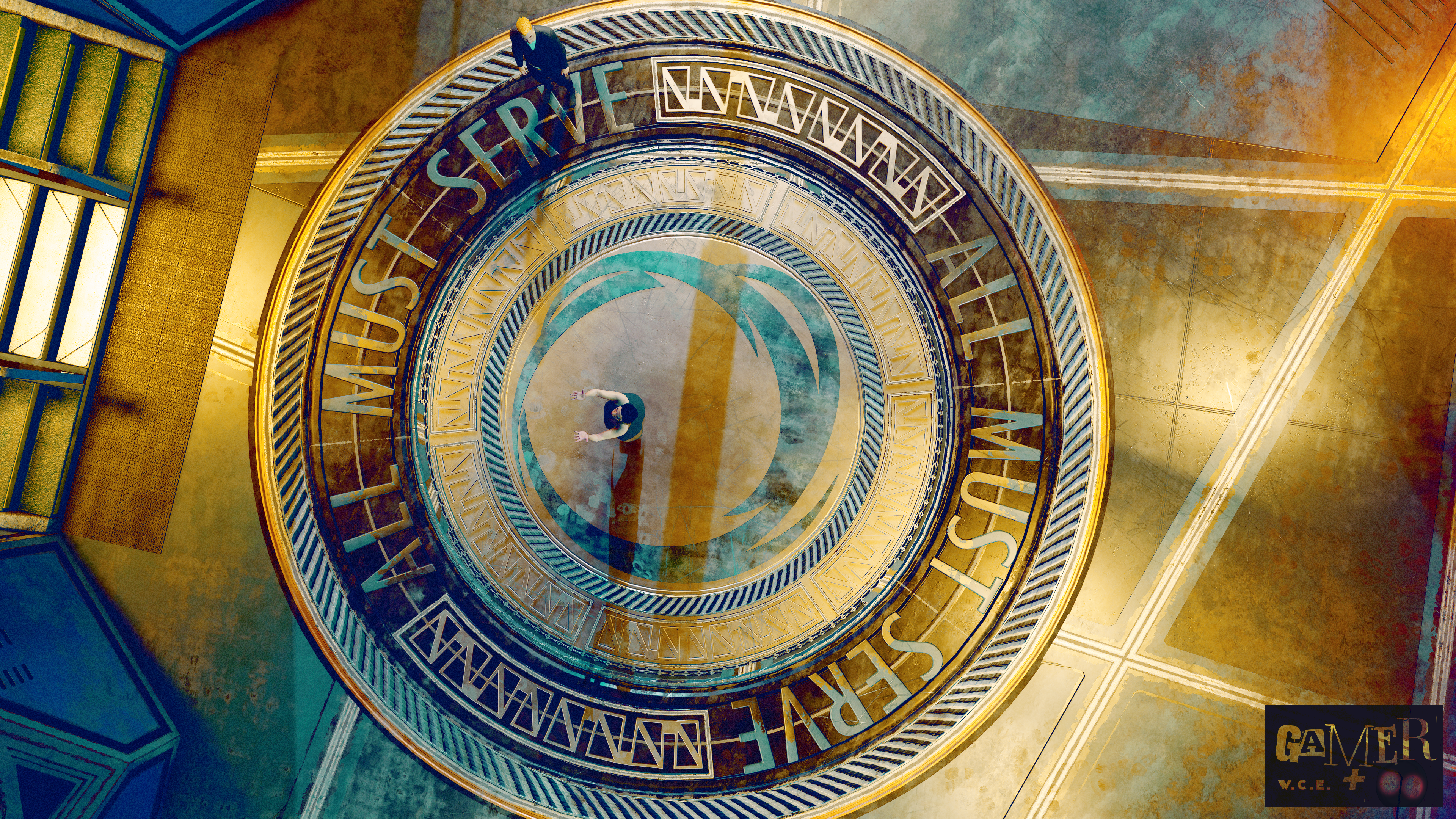
Their theocracy is a strict one. Anyone who is found disrespecting The Great Serpent is apparently not seen again, at least where there are guards. After you finish a certain mission, you can frequently hear citizens talking about how one of the top officials, Viktor Veth’aal, had his own son killed over non-belief. Once in a while you can hear someone warn the person they’re conversing with that they could get into trouble for what they’re saying, while others remark how someone they knew hasn’t been seen since saying something questionable in earshot of a guard. While this is certainly disturbing in itself it seems even more crazy at the present time, seeing as a huge percentage of their population was just wiped out along with half the city.

Being a theocracy, the city is imbued with religious symbols, statues, and shrines. Worship is a constant, although the main center of worship at the Scaled Citadel is destroyed as part of Shattered Space‘s main story line. Let’s talk about that for a minute since you can only see it during the last big battle of the added content. The place of worship inside is very large, as one may imagine, and it is very sleek and modern, very high class looking. It reminded me of a wealthy megachurch. I’m sorry I don’t have a screen shot of this. At the time I did the Citadel battle I wasn’t thinking I’d be doing a video, and experiencing the building is a one-shot event. At any rate, if you pay attention, you can see a smaller place of worship outside, dedicated to The Fang. This area is quite different from the worship hall, having pointy art panels and blood strewn on the altar and floor. Since there isn’t any talk of sacrifices—other than the one children are forced to do at a certain age—I don’t know what the source of blood is. Perhaps the children did the required ritual killing of their pet groats here. . . . my mental images of this are not wonderful. In any case, after the Citadel is destroyed, the bloody floor can still be seen, along with the fangs floating above.

Outside of the city there are very large shrines where people make pilgrimages. You can discover through a guide at one of these shrines that not all of The Promised look fondly at their violent past. They are definitely a divided people in regard to violent vs peaceful worshipfulness; there are even a few Vortex phantoms that are peaceful. At these shrines, you too can gain spiritual strength, which is an interesting take on religion and faith. After all, your character probably doesn’t actually have faith, though you can role play like you do. I didn’t claim to have any real serpent faith in the game, so just being you is enough to gain powers from the shrines. Interesting, too, is a surviving spiritual leader, Inaza Kaisir. She has seen visions which turn out to be accurate,iii proving to her non-believing scientist brother that there’s more to knowledge than what science can provide. So, there are things in the game to indicate spiritual or supernatural realities, even though there are also the opposite indicators of false beliefs, false hopes.

Ok. But who, or what, is the Great Serpent? The Great Serpent is the being that created everything, and it sits coiled around the heart of the universe. According to Jinan, it simultaneously is us and lives in us; it also supposedly loves everyone. (I’m sorry, but I find this really hard to swallow, as snakes just don’t seem to be the loving type. Do they give good hugs? Who cares if a snake loves them, honestly? And if it is us, then what, did it just find a complicated way to love itself?) According to Jinan, in the “From the Scriptures” and the “Serpent’s Crusade” recordings found in the Citadel, the Serpent told him to “prepare the way” for The Shrouding, the coming event where all but The Promised will be destroyed. However, who decided the method of preparation is not known, but Jinan clearly wanted to carry out the blood-letting method. It should be noted that Jinan says that the serpent’s form is “beyond grasp,” so why he says it’s a snake is not known. Beyond this, not much about their beliefs is provided to the player, as the multi-volumed “Va’ruun Scriptures” is not readable.

The Va’ruun’s history is brief, spanning less than three full generations (~140 years) from a single colony ship. In order to prepare the way as the Great Serpent commanded, some of them made contact and lived among others in the settled systems. Jinan claims they behaved as friendly missionaries, but the settled systems claim that they acted friendly only to spy on them, to get important information for their planned attacks. I tend to believe the settled systems’ version, since it would’ve been unnecessary to attack the people you were supposedly trying to convert and who would be destroyed by The Shrouding anyway. The Serpent’s Crusade lasted from 2240 to 2263, when Jinan’s son Jarek sued for peace after Jinan’s death. In any case, how they could fight for that long, with such a limited number of people, is a mystery, shall we say. The Va’ruun officially completely isolated themselves at this time.

The ending of the Serpent’s Crusade led to a split in the Va’ruun. Jarek’s twin brother, Jandar, and one of the noble houses, didn’t agree with ending the “crusade” and thus broke from House Va’ruun. Some say they were pushed out. This violent group of people are known as the Zealots, but they continue to call themselves The Promised. Their powerful and unconversational modified soldiers are called The Redeemed. Zealots are found on Va’ruun’kai and other planets and moons in that region of space and attack anyone on sight. They never try to convert people, just kill them. House Va’ruun does not attempt to convert people either, and when you convert as part of the story’s quest line, it’s a completely unheard of event that shocks people. In fact, the ritual you go through is virtually a forgotten process, with the location being unkept and considered by many council members to be not worth keeping.

Before I move on to the possible real world influences of this religion, I should describe a bit of what the Shattered Space story line is about. This is not a review of Shattered Space,—if it was, I’d have more to say for sure—but some aspects of the dlc’s catastrophe have bearing on both the Va’ruun belief system and real life experiences. Major spoilers here, if you couldn’t guess. The title of this added Starfield gameplay, Shattered Space, refers to the otherworldly vortex unleashed into Va’ruun space by the experiments of Jinan and his grandson and current heir, Anasko. Jinaan began trying to find a means to reach the Great Serpent to converse with him since he hadn’t heard from the Serpent after the fateful grav jump. His research went far but was not completed before his death.

His grandson, who frustradedly admits that neither his father nor himself has heard from the Great Serpent, decides to carry on his grandfather’s quest. He does so and discovers a way to connect with the vortex that exists between universes. The Serpent isn’t to be found in this vortex, though. Interestingly, the game hints at the purgatory-like aspect of the vortex through a character at the dilapidated Abbas Seaweed Farm. He can tell you that he’s had a dream where he’s a ghost, and along with others, he’s forever trapped to roam abandoned halls. In his dream, he also thinks he’ll be forever apart from the Great Serpent. He seems very much to be dreaming about the Vortex phantoms you encounter on Va’ruun’kai. The phantoms themselves will occasionally cry out to the Great Serpent, asking him to release them from their trapped space.
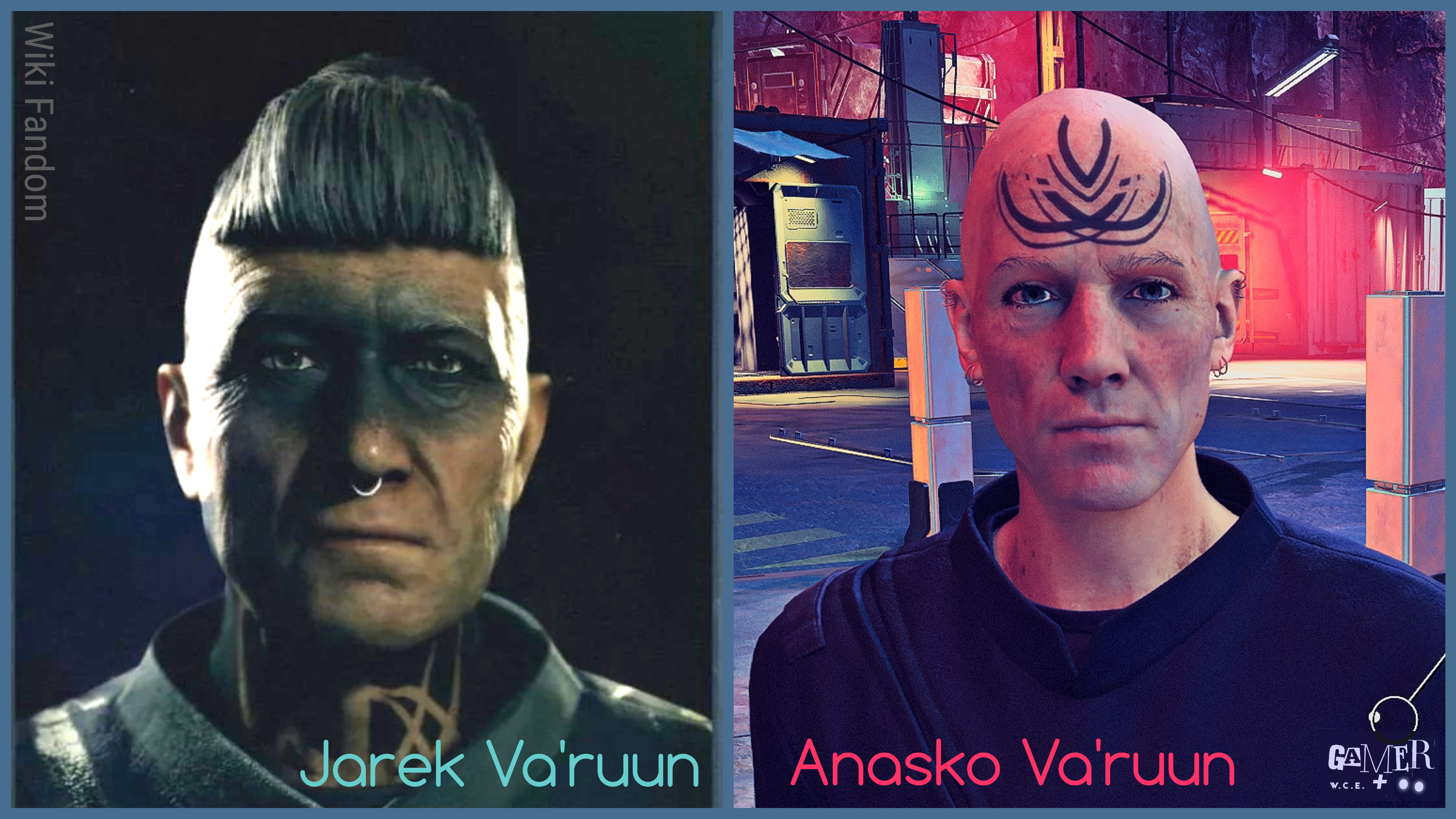
So Anasko, having discovered that people can be made seemingly immortal and empowered by the vortex, decides to begin a new Serpent’s Crusade. His genocidal goal of destroying the people of the settled systems ends up killing a huge number of his own people though, and leaving permanent enemies around Dazra, which itself is half destroyed. You learn this, of course, but you are unable to tell the people that their god wasn’t punishing them since it was not what caused the disaster. Jinan was very controlling and violent, and Anasko continued along those lines, causing massive self-inflicted destruction. Now, let’s move on to possible influences on this religion from the real world.

[Possible Real-World Influences for House Va’ruun]

Early in the game you find that one of your Lodge colleagues, Andreja, is a run-away Va’ruun, so you might naturally think other Va’ruun are like her, being Caucasian with a Eastern European accent [see note VI]. You end up meeting an incarcerated Zealot briefly, and she also seems quite Caucasian; the Va’ruun ambassador in Jemison has a similar accent and blackish hair like Andreja. So, when I landed in Dazra for the first time, I was shocked that the official who met me, Malibor Dul’kehf, looks like an Amazonian Yanomami native! That is, dark hair with bangs and black facial and neck tattoos. He seemed to have walked out of one of my old anthropology texts. It turns out his hair is reddish, but I couldn’t tell in the dark lighting of Dazra. Andreja and the ambassador don’t sport the tattoos (though I had forgotten that the jailed Zealot did), but it seems that all other Dazra citizens and Zealots have them. They may have a black bar across their face, encompassing the eyes, but more often they have elaborate geometric designs. As you meet more people in Dazra, you come to realize that House Va’ruun is the opposite of homogeneous. Even the vocal accents vary widely, which seems pretty absurd for a small isolated population.

Anyway, as you progress through the Va’ruun story, you discover that Jinan Va’ruun and his son Jarek, as well as other random citizens, also look like Yanomami. Is there a reason for this, other than gratuitous diversity? It could be that the game is hinting at two things. One is that the Va’ruun’s violent nature is cultural, since the Yanomami, or Yanomamo, are known to be a very violent people. They became widely known when Napoleon Chagnon, an anthropologist who lived among some of them, published a book about them titled Yanomamo: The Fierce People. This was in 1968 and the book, after a number of editions, is still assigned in anthropology classes. It’s garnered a great deal of controversy over the years, but whatever one may think of the criticisms of Chagnon’s work, it doesn’t change the fact that the Yanomami were, and still are, very violent people. As Encyclopaedia Britannica says, “Yanomami are constantly at war with one another, and much of Yanomami social life centres on forming alliances through trade and sharing food with friendly groups while waging war against hostile villages.” The Va’ruun are worse since they refuse to even form alliances. And, Jinan’s grandson attempts to continue the galaxy-wide slaughter that is the Serpent’s Crusade. (As a note, you can begin to alter their isolationism, or renew the Serpent’s Crusade, by the choice you make at the end of Shattered Space).

The second hint could be in regard to Yanomami cosmology, and how they came up with it. It doesn’t seem far-fetched to think that Jinan’s experience during the grav jump was like a DMT or ayahuasca psychedelic trip that Yanomami and other Amazonian tribes take part in. Seeing snakes while using ayahuasca is extremely common and a snake, or pair of snakes, is common to the cosmology stories of various Amazonian tribes. However, the similarity seems to end there. The cosmology beliefs I read about when researching this unexpected rabbit hole vary quite a bit. In a book entitled The Living Ancestors by Zeljko [Zelko] Jokic [Yo-keech], the Yanomami reported believing in a giant boa that holds the whole of existence—encompassing five cyclical layers—within its abdomen.iv In Jeremy Narby’s book on the Amazonian Ashaninca, The Cosmic Serpent, he shares both his own drug-induced experience of snakes, and another anthropologist’s ayahuasca experience of spirit beings helping him see the reaches of the galaxy. Sound familiar?

Narby also covers how a snake, or two snakes, were creators and/or knowledge keepers in various ancient or primitive cosmologies around the world. In some of these, the snake encircles creation, as Jinan basically conveys in the game. Narby references Joseph Campbell’s books a lot, and who wouldn’t, as Campbell published many in-depth books on mythology and cosmology found around the world. In fact, Campbell’s book entitled The Hero with a Thousand Faces (1949) has been utilized by numerous writers of books, scripts, and game stories. It wouldn’t surprise me if it influenced some of the writers of Starfield.

The most common symbol of the Va’ruun, the ouroborus, is presented in a variety of styles. The ouroborus is a depiction of a snake eating its own tail. That the Va’ruun use the ourborus so much is kind of strange, since in a cosmological sense, it signifies the cyclical nature of death and rebirth. The Va’ruun talk of the destructive Shrouding event and how they will be the only survivors of that, as opposed to a rebirth. They seem to want everything dead but themselves, so what would they even do with a new creation with new people in it? This is very different from the Christian perspective, which is linear, but which does have a one-time destruction and recreation of Earth, when life will be brought back to God’s original non-violent conception. For example, animals and humans do not attack and eat each other.

The Va’ruun have a large variety of snake-like statues, but since the ourborus symbol is used so much by them, let’s talk about it more. First off, when reading about it online you’d think the term itself is old, when it’s not, at least according to the etymologies in the dictionaries I checked. The symbol is ancient, but the word ourborus was first used in 1921, utilizing a combination of Greek words, and apparently wasn’t used much until the 1940s. Looking at the indexes of the four Joseph Campbell books I have, ranging in dates from 1959 to 1986, not one of them lists the word ourborus. I was surprised at this and that’s why I Iooked into its etymology. So apparently it was a word coined or borrowed for its usefulness in referring to a widespread ancient idea and/or symbol. It should be noted that much of what you might read about it online is conjecture, with very little known of its actual meaning from any given ancient culture. One explanation for the snake becoming a symbol of cyclical life has to do with it shedding its skin. It’s as if it regenerates itself, like it is reborn.

The ourborous symbol is found in ancient Egyptian tombs, but not much is known about its Egyptian meaning. It’s conjectured that early on it simply represented daily and seasonal cycles. It could’ve been related to their conceptions of the cosmos and life after death, and one ancient source claims it referred to the world. The Hindu have their own version of a snake involved with creation cycles, Sesha. This 1000-headed snake is coiled around the universe and represents a circular view of time. (If you have the Adoring Fan as a companion, he’ll mention how some religions believe time is circular.) The Norse people also believed in a giant cosmic serpent, called Jormungandr. He kept a hold of his tail while he encircled the world, until the time foretold when he’d release his tail in order to do battle with the gods. The world, most of the gods, and Jormungandr end up being destroyed, but a new world rises. So Jormungandr was an agent of change, as other cultures’s cosmic serpents were.

The Va’ruun ourborus symbol most often seen is very abstract, or stylized, being a circle with some pointed flares. This abstract symbol is actually a set of five linear shapes placed together. Because it was so abstract, I wasn’t at first willing to assume that it was an ourborus, but there are other versions of the symbol that aren’t as abstract. On all Va’ruun computer screens, the background contains a simplified ouroborus, and this same version can be seen on the Va’ruun Scriptures covers. A very interesting version can also be seen on black banners at and near the high elevation Tul’shahk monastery outside of Dazra. Here, the black banners depict an ourborus in a state of destruction. To me, it looks as though it has been shot, and at the opposite side of the circle parts of the snake are either disintegrating or wholly gone. I have no idea what this signifies. Since the serpent looks like it got blasted, it doesn’t seem to depict the disintegration of creation by the creature itself. Zealots are in control of the place and the teacher is preparing people to fight, but the banners may be from the dislocated monks. A statue in the Scaled Citadel may be depicting the destruction of the cosmos, as it shows the ourborous separating and crystal-like formations emerging. But that blast at the lower right side, shown on the banner, is not part of the statue. So who knows. By the way, there’s a travel poster that is oddly like that statue, from the mysterious Trident Luxury Lines.

The elephant in the room so far is that in Christianity (and Judaism, but I don’t want to speak for it here) “the serpent” is a representation of Satan, the being which caused the Fall of Humankind and who was said by God to be THE continual thorn in everyone’s side (I paraphrase). He is understood to be the primary adversary of God and his plans. So it’s interesting to ponder why the being that Jinan saw during a grav jump would appear as a serpent, when the Sanctum Universum—the subject Part II—does not bring up anything like a serpent at all. Your character never encounters anything like that either.

I played through the main part of the game several times and pondered it, and because of that whole experience I did not seriously think that the serpent in-game related to our real-world Christian beliefs. Even though Satan was the first thing that came to mind when encountering information about the Va’ruun faith, I came to believe that the Great Serpent in-game was unrelated to Satan. The reason? There is no Christianity and not much biblical in the Sanctum Universum. There is some stuff that characters have said about God, outside of the Bible, in the Sanctum Universum, which I’ll get to in the second video. So basically, the game is unbiblical, so why would the main adversary of the Judaeo-Christian God be in the game? And, the whole Yanomami angle through me off.

It could be that it’s only a representation of the old creator being of various cultures, represented by a snake, clashing with more modern and more western ideas of who the creator god actually is. As stated earlier, the snake has been viewed as a being who causes transformation. And really, all the old gods are transformers, not actual creators. The Judaeo-Christian God is believed to be the actual creator of everything, however, and all that from nothing. But, as I paid more attention to the words used by the Va’ruun for certain things, I came to believe the Great Serpent likely represents Satan, because the words are used in an opposite sense from their Christian usages; they are a mockery, or even used as a method of giving a false impression of Christianity. What words am I talking about? Crusade, monastery, and the phrases “prepare the way” and being “born anew.”

The word crusade is not religiously neutral as it immediately brings to mind the Catholic crusades of the late 1000s to latter 1200s. Very generally, the purpose of the crusades was to take control of Jerusalem after increasing attacks by Muslims on Christians going on pilgrimage there. While the crusades may be criticized for a number of reasons, the crusaders were never out to kill literally everyone the way the Va’ruun are described as doing. To use the word “crusade” in this context is demeaning. Calling it the Serpent’s Terror would’ve been more applicable since the Va’ruun have indiscriminately killed anyone that’s not a believer. And, the Va’ruun, but more specifically the Zealots, simply want to genocide the settled systems. By the way, the Zealots try to claim in their “Zealot Scriptures Vol. 3” that Jandar “dispensed the gospel of Jinan,” but even if that’s true, the player never experiences a Zealot who is willing to talk to them for the purposes of conversion. To sum up, the word crusade in this context is a mockery, meant to demean the original crusades by suggesting an equivalency.

The Va’ruun also borrow the Catholic word “monastery” to try and force that meaning onto a religious community that did not share the same values. Early orders of monks had different rules, but generally speaking monks were totally devoted to spiritual life and lived according to Jesus’ teachings. Therefore they would not be going around killing people for not believing everything they said, they wouldn’t be remotely thinking like that. So when it comes to the word monastery, the peaceful and perhaps wine-drinking monk is very likely what pops into the minds of most people. Since all Va’ruun know what they’re culture and beliefs are about, the word would not have fooled any of them, so it must be that it was used for mockery.

And who would be most interested in mocking the true creator God and his believers than Satan? Which brings us to the phrase “prepare the way” that Jinan claimed the Serpent told him to do, in order for The Shrouding to take place. I could write a whole article just on this subject, as the phrase relates to God’s plan of salvation, which is peacefully offered to all people. In the New Testament, see Matthew chapter 3, Mark chapter 1, Isaiah 40:3, Malachi 3:1, and John 3:16-17, for example. But here it’s used as an excuse to eliminate all who do not accept the Serpent. How more mocking can you get? The serpent, or at least his messenger, Jinan, tells his followers that they will be the ones saved if they kill all non-believers. Jinan can be viewed as the Anti-John the Baptist, since it was John who told of preparing the way. But by this he meant to repent and cleanse oneself spiritually, for the Messiah was coming. Again, the two meanings of the phrase are very much opposed to one another.

The fourth word or phrase is “reborn”, or to be “born anew.” In Christianity it is a necessity to be born anew by God’s spirit, the Holy Spirit: the person of flesh is birthed again as a person of spirit. In Shattered Space you are required to go through a ritual to become a member of The Promised. Inaza, mentioned earlier, is the person directing you in this. At the end she talks with you and asks, “Do you feel born anew?” And if you have gone through the Unity in the main part of the game, you have the option of replying “There’s more than one way to be born anew, trust me.” Strangely, she responds by saying that “your confidence is impressive.” As a Christian myself, I would never say that there’s more than one way to be born anew, so I found this disturbing. In the context of the game, it is not anything to be disturbed about, but by its own admission Bethesda made the game about religion and big questions, to think about faith in our real world, so I do not take this specific language during an important conversion to be game-related only. So, I was pretty shocked this topic was in the game and I was offended by the possible real-world implication. Since the Va’ruun are so strict about their religion, I found Inaza’s response out of place as well.

I’d like to bring up one more thing, just something interesting to reflect on. The leaders of the Va’ruun, Jinan, Jarek, and Anasko, all lamented not hearing from the Great Serpent after Jinan’s initial and powerful experience. It no doubt made Jarek and Anasko, if not Jinan, question their faith in the snake-like being. They couldn’t admit their concerns to anyone. But Jinan had the audacity to think of forcing his way to the Serpent’s location via science. He seemingly failed, but secretly discovered a Vortex and a way to make humans become a part of it. Anasko continued that endeavor, making a Vortex Va’ruun army, but never finding the Great Serpent. He became a Vortex Phantom himself, just wandering about and disturbed, perhaps destined to be in that state forever. Is it not folly to try and force your way into God’s kingdom? It seems so. It reminded me of a verse in the New Testament, one that many find puzzling; well, translators are puzzled by it too and translate it in different ways. In the New King James Version, Matthew 11:12 Jesus’s words are translated as, “And from the days of John the Baptist until now the kingdom of heaven suffers violence, and the violent take it by force.” Jinan, like the anti-John the Baptist he seems to be, and his descendants are violent and try and take eternity by force.
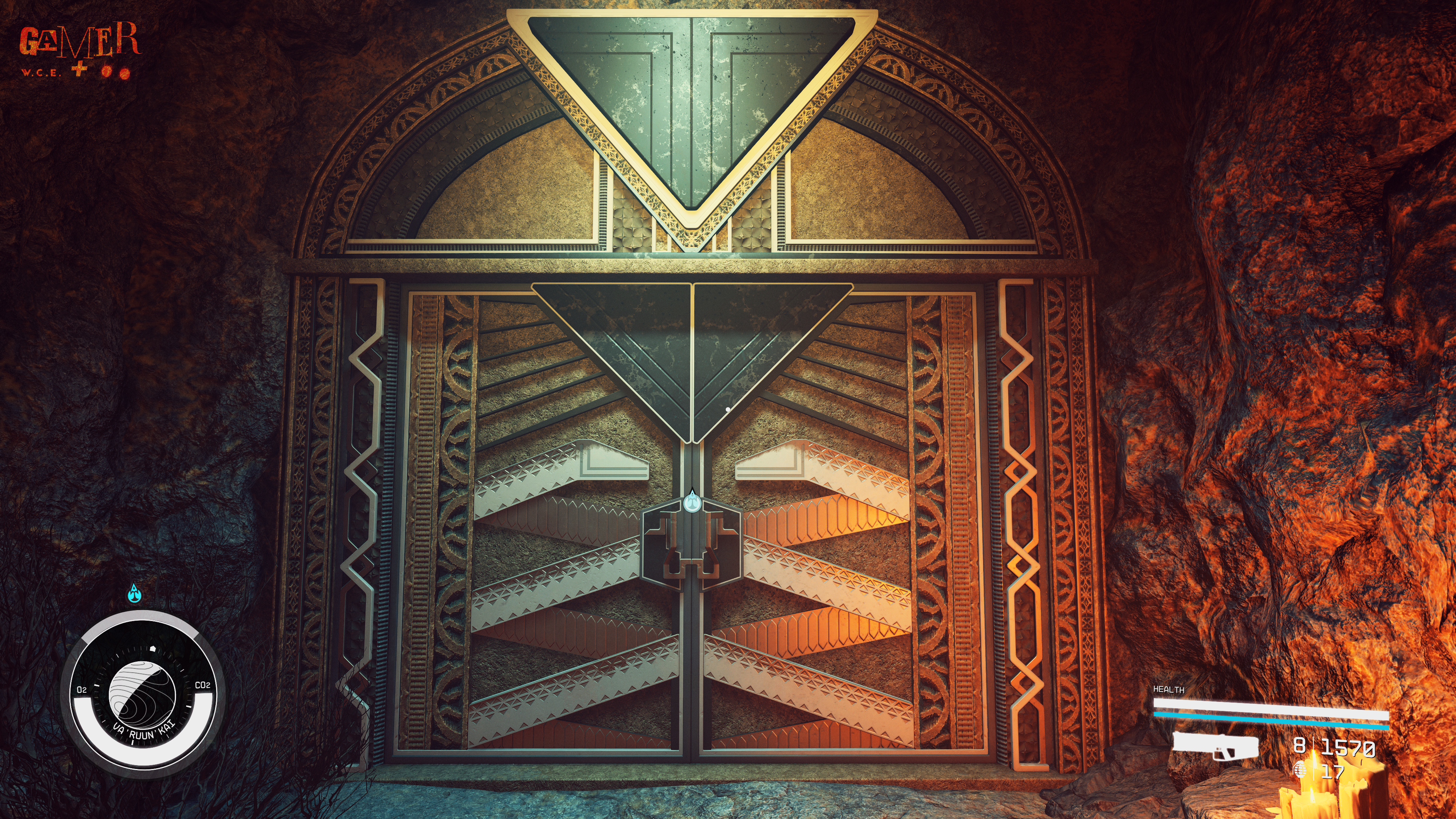
To sum up, The Promised religion: worships a celestial being they liken to a snake, is relatively new, is based on a single experience during a grav jump by a single person, is much more into violence than proselytizing, is forced onto the population, punishes apostasy with death, and is a mockery of Christianity. Who wouldn’t want to join?! If I were in an informal setting I might speculate on how perhaps the original intent was for the Va’ruun to indeed be a less diverse group, descendants of Eastern Europeans, practicing a religion that has similar characteristics to an infamous modern day religious subset, and that maybe, perhaps, the Yanomami were thrown in later to make the flash-point analogy weaker. But I’m not in an informal setting.

However, I will say more about what I realized late in my dive into this subject. Jinan sounds like the words “Jinn” and “Jann,” Arabic or Semitic words for the generally invisible beings we call Genies. When I was in university it was still taught that Muhammad was influenced by a Jinn during his creation of Islam, which is generally otherwise taken from the Bible. That is what was passed down through historical sources by the way, not made up by my public college professor. Jinn are a belief from pre-Islamic Arabians and supposedly their most common form of manifestation is that of a snake. There is also a story about how Muhammad was friends with a giant Jinn snake.v Make what you will of that.

Thanks so much for listening! Please Like and Subscribe. I’ll probably put out a review of Starfield next, less formally without a script, and then in Part 2 I’ll more fully go over what Bethesda’s people had said about the religious aspect of Starfield, survey the Sanctum Universum, and then compare the belief systems to one another. Take care.

i  “Inside Starfield: how Bethesda's 'NASA punk' epic became the biggest Xbox game in a decade,” GQ Magazine, UK, Same White, August 24, 2023.
ii  One source said it departed from Jemison, just FYI.
iii  I'll discuss this more in Part II. Were her visions from The Serpent, and if so, who or what can give us visions?
iv  In Chagnon's 1997 edition of his Yanomamo book, there are four layers, though I'm not sure about the snake.
v  “Jinn Snake Companion and Prophet Muhammad Story,” https://www.youtube.com/watch?v=BMHIkgA7OhI

vi I'm not an expert, but others have said the same about her accent. I want to note, however, that I heard an Israeli soldier speak recently and to me Andreja sounds a lot like him also. So there's the possibility of Middle Eastern accent. I did not add anything about their language, which has marks like a glottal stop. This could simply be Lovecraftian, or could harken to either the Czechoslovakian or Arabic language.

Another Commentary on The Big Lebowski

The Dude and The Stranger at the end of the movie.

By Victoria Priest April 25, 2022 (c) [small changes made on April 29, 2022]

The year is 1998. The Big Lebowski hits theaters, but, I miss it. My son, an infant that I was busy taking care of at the time, in recent times told me I needed to see it as it’s one of his favorite movies. So watching it, I was half-way enjoying it and not knowing what to think of it, really, until the very end when I literally reacted with: “. . . what?!” Why, you ask? Because the movie isn’t just a comedy, but some kind of philosophical religious commentary. I immediately realized that watching the movie once, especially without subtitles on, was only the beginning of the Lebowski experience. I didn’t watch it again right away, but ordered the screenplay and read that. What follows are my own observations and commentary after doing some (but not too much) research and giving it some thought. And I shouldn’t have to say this, but there are spoilers ahead.

A note on a result of waiting so long to comment on an older popular movie: I’m quite aware that the movie has been studied a lot, commented on a lot, and that those studies and commentaries often relate to the background of the Coen Brothers, who wrote and directed the movie. By their name you can guess they’re Jewish, and they are—Coen is Hebrew for priest. They were raised Jewish in America. They have made a number of movies that deal with religion is some way or another, with one in particular—A Serious Man (2016)—being very critical of modern Jewish faith (from what I’ve read). While I have read some reviews and analyses of The Big Lebowski, I’m presenting my own take on the movie here. I plan on delving into the Coen Brothers more and their “religious” films, and will hopefully write the results of that here at a later time.

The Movie

The story starts out by confusing us about when exactly it takes place, in 1990 or 1991? And this seems to be important since the narrator tells us it is: the main character, the Dude, is a man for his time and place, the narrator tells us. In a grocery store, George H. W. Bush is on the news concerning the Gulf War, and the broadcast is from 1990. But the Dude’s check he writes for buying milk is dated September 11, 1991. Eerie, isn’t it? Gulf War and an arguably later effect, the 9/11 attack of 2001, coincidentally predicted in a movie from 1998.i  Despite the movie starting out this way, it doesn’t seem to follow through. There are tiny glimpses relating to The Gulf conflict, but that’s it, with nothing tying it to the end. Interesting, but let’s move on. Continue reading Another Commentary on The Big Lebowski

Where I’ve Been, lately

Welcome all, and the Lord bless you.  For some time I slowed down here while I did some training and “setting up shop” in the grants writing field.  But then I stepped back after becoming discouraged, realizing I needed to rethink my goals and strategy.  That sounds so . . . blah and businessy, doesn’t it?  But it’s actually true.  I wasn’t approaching things the right way and had to calm down about it.  Be still and know the Lord, right?  Yes, be still.  And listen.

In the meantime, during Christmas break time, I decided to go ahead and get going on an idea I’ve had for a long time.  And that is coming up with a clothes design called “Monkwear” (apparently the name has been used before since I couldn’t use that name on Twitter).  I have always had this tug on my heart, this desire that stems from sadness, that Christians should be more united.  Christ prayed for it, yet, we seem so much at odds with each other so often.  So I thought it would be neat if Christians would wear similar and humble clothes all at the same time–to show unity and to be encouraged by seeing siblings in Christ that we don’t personally know.  How much stronger would some of us be if we could only see how many really had faith, and were willing to show it (in what seems a non-confrontational way)?

Elisha prayed, “Open his eyes, Lord, so that he may see.” Then the Lord opened the servant’s eyes, and he looked and saw the hills full of horses and chariots of fire all around Elisha. 2 Kings 6:17

So Monkwear.  Brown simple clothes to wear one day a week or month.  I’m still working on a basic design I want to have on my version of Monkwear; I want to get it “right” and it’s daunting.  In the meantime (again), I’ve been learning GIMP and whatever else I need to know to sell designs on CafePress.  I might do another outlet later, but it’s CafePress for right now.  In case anyone is interested, I have these designs up now; there are even some “With Christian Eyes” things there.  This is not to promote my blog, since the url is not on it, but the sentiment CS Lewis wrote:

“I believe in Christianity as I believe the sun has risen, not only because I see it, but because by it I see everything else.”

The shop at CafePress is Monkwear and The Priest’s Dabblings, and you can connect with me on Twitter if you want at MonkwearCP.   (You can sign up for deals and coupon codes, which provide significant discounts – see CafePress home page.)  Thanks SO much for reading this far, and for visiting my shop if get THAT far!  In this media-saturated age, I know how much your time and attention are worth.

Be one, Jesus prays.   From John 17:23 (V Priest design).
Be one, Jesus prays. From John 17:23 (V Priest design).

Rooted in Love; Ephesians 3:17b-19 (artwork by V. Priest [c])

For Valentine's Day, or any day.  V. Priest (c)
For Valentine’s Day, or any day. V. Priest (c)

With Christian Eyes bumper sticker.

Evidence of Ten Healing Miracles

ten healing miracles.   I was researching miracles and found this page.  The Lord be praised.

Steps to the cross.  Author image.
Steps to the cross. Author image.

Parousia, Shamoosia, Who Needs Christ’s Second Coming?

The Second Coming of Christ window at St. Matt...

Honestly, I never thought it would be so difficult to find a good summary of the various theological views on Christ’s second coming, or what is more technically called parousia.  By this I mean a summary of the liberal view, and who promoted it and why, that proclaimed that Christ’s second coming was a misinterpretation of scripture – that despite the incredible amount and quality of verses to affirm that Christ and Paul and everyone else actually meant what they said – but that really Christ’s parousia is only His presence with us (so they tried to claim).  So, that means, basically, I guess, that there’s no rapture (no glorified bodies, ever . . . .?), no hope that Christ will actually reign amongst humans, that we can build up His kingdom now and that’s about it, etc.

When I look around, when I experience my daily life with other people, when I read history, I suuuurrrre don’t see that Christ’s kingdom is blooming, growing, and all that.  It seems to me that the opposite is true, that the great apostasy is upon us.  “For the time will come when they will not endure sound doctrine, but according to their own desires, because they have itching ears, they will heap up for themselves teachers; and they will turn their ears away from the truth, and be turned aside to fables” (2 Timothy 4:3-4) (kind-of sounds like the liberal theology teachers themselves).  Not to say that Christ isn’t among us doing His work, and we with Him.  The Lord is indeed showing His love and Himself to many in many ways.

So what is my point?  Well, I am doing some research for an extensive blog article that involves (it is not at all the main topic) this liberal, anti-parousia, “we can usher Christ’s kingdom in ourselves since that’s all the New Testament says anyway,” idea, and it’s just sad and difficult dealing with it.  But the main thing is that I wanted to pass on some reading materials to show what is actually in the New Testament, and that our hope is not in man and what he obviously can’t do– that our hope is not misplaced in an elaborate myth (what some “Christian theologians” insist the New Testament is).  The number one source is the Bible itself.  Read the entire New Testament a few times and tell me if you really think it’s basically “made up.”   Here is a good short but information packed essay on Christ’s second coming:  Second Coming of Christ.  This is a short, easy read on it:  What is the Second Coming of Jesus Christ?   And, I don’t necessarily agree with all that is in this article – maybe I just don’t know the right Christians – but it’s contents are worth considering:  The Theology of the End and the End of Theology.

Christ is the suffering servant and the King, as outlined in the Old Testament.  He was the suffering servant during His time on earth, and when He returns it will be in His role as King.  Jesus said, “I will come back and take you to be with me that you also may be where I am” (John 14:3).  “Men of Galilee . . . why do you stand here looking into the sky?  This same Jesus, who has been taken from you into heaven, will come back in the same way you have seen him go into heaven” (Act 1:10-11; see also Matthew 24:29-30).  “And now, dear children, continue in him, so that when he appears we may be confident and unashamed before him at his coming” (1 John 2:28; see also John 3:3).

Is it Rational to be a Christian? (1 of 2)

Good Shepherd fresco from the Catacombs of San...
Good Shepherd fresco from the Catacombs of San Callisto under the care of the Pontifical Commission for Sacred Archeology (Photo credit: Wikipedia)

Below is half of a relatively long (but actually concise) treatment of evidences or evidential steps for the view that the Christian faith is rational, and even desirable, to hold.  Thanks for reading, and may the God of all creation bless you.

______________

For the person who wants to know that there is reason to believe a holy book–that there is evidence to back it up–different areas of apologetics have those answers.  In fact, there is more evidence for the truthfulness of the Bible today than ever before, excepting when the events actually occurred.  This essay assumes that the person searching for a legitimate holy book already believes that there is a deity of some sort; it does not cover arguments for the existence of God.  What this essay does cover, in concise form, are the issues of reliability of the Old and New Testaments, fulfilled prophecies, miracles, and Christ’s resurrection.

Old Testament Reliability

How was the Old Testament written and copied? What we Christians refer to as the Old Testament is the same as the Jewish Septuagint, which is the Greek translation of the Hebrew scriptures, called the Tanakh. The content of the Tanakh and the Septuagint is the same, but the two are formatted differently. The Old Testament follows the same formatting as the Septuagint. The Septuagint was translated from about 250 BC to 150 or 100 BC and was used by the scattered Jews of the diaspora.

The Tanakh itself was written from about 1400-400 BC. Moses and other prophets were believed to possess the word of God because of the signs (miracles) they did, coupled with their openness (“transparency”). Moses was obviously literate, and because of his high upbringing, may have been literate in three languages. He no doubt, along with the people in general, knew the stories of other cultures and had copies of various source documents. Moses’ telling and retelling of events was considered God inspired.

At the time of Christ, the books of the Tanakh were established and accepted as canon. Those who copied the Tanakh beginning AD 70 (after the destruction of the temple) were called Talmudists. They had very specific rules for transmitting the Tanakh. Because damaged copies of the Tanakh were purposefully destroyed, very old copies do not exist. The Massoretes (or Masoretes) were the copyists for the Tanakh from AD 500 – 900. They, too, had very specific rules for copying, and any imperfect copies were destroyed. They are noted for adding marks to the text that represent vowels, as Hebrew did not have vowels and concern was growing over the continued pronunciation of the language. Whoever the copyists were through time, they all took God’s command in Deuteronomy 12:32 very seriously: “See that you do all I command you; do not add to it or take away from it.”

There have been archaeological finds in recent centuries to confirm the historicity of the Old Testament, and the Dead Sea scrolls additionally confirm accurate copy transmission.   With the 200+ scrolls that date from approximately 250 BC to AD 125, we have the oldest copies of scripture, and these tell us that the accuracy of transmission is nearly 100%. A Qumran copy of Isaiah 53 has only three truly variant letters from the more recent Massoretic text, and these three letters do not change the text meaning in any real way.

There are many archaeological finds that corroborate the OT, with these representing only a sample:

  • The Moabite Stone. Mentions “Yahweh” and events in 2 Kings 3.
  • The Taylor Prism. From Nineveh, it describes the siege of Jerusalem by Sennacherib an corresponds to 2 Kings 18-19, 2 Chronicles 37, and Isaiah 36-37.
  • The Cyrus Cylinder. After Cyrus began ruling Babylon (539 BC), he ordered that Babylonian captives could return home. This is told of in Ezra 1:1-3 and 6:3 (see also 2 Chronicles 36:23 and Isaiah 44:28).
  • The Tel Dan Stele. This is an Aramaic inscription found in Israel. It is about Hazael’s victory over Ramoth Gilead, as in 2 Kings 8:28-29, and conveys that David’s dynasty ruled in Jerusalem.
  • The Gilgamesh Epic. Found in the great library of Nineveh, it in part describes a flood not unlike that in Genesis 7-8.

New Testament Reliability

There has been a plethora of interest in “lost gospels,” which leads some to doubt the manner in which the New Testament (NT) was put together.  Then there are those who also question the accurate transmission of the words in the NT, saying that parts were added or taken away at later times.  All these issues are really non-issues, promulgated by detractors of the faith and sometimes believed by neutral parties who simply don’t take the time to look into these matters further.  Concerning when the books of the NT were written and how they became canon, providing a chronological order seems like it would be clearest, and that is provided below.  As for the accuracy of textual transmission, however, here is a good summary:

“A simple comparison of the text of the Bible with the text of other religious, historical, and philosophical documents from the ancient past proves the vast superiority of the biblical record.  Less than one tenth of one percent of the biblical text is in question, whereas no such accuracy of transmission exists for the Qur’an, the Mahabharata, or the Iliad.  Some ancient records such as Caesar’s Gallic Wars of Tactitus’ Annals, exist in less than ten copies, and these copies date from 1,000 years after their originals.  By contrast, over 5,000 copies of the New Testament exist, the vast majority of them dating less than 200 years after the original text and some fragments less than 50 years after the original text.  No book from ancient history has been transmitted over the centuries with greater clarity and accuracy than the Bible” (Geisler and Hindson p 100).

So when was the New Testament written?  The books that were considered canon and that make up the New Testament were written not all that long after Christ’s death and resurrection, by those who were Christ’s disciples/apostles or associates of the apostles.   In other words, by close eye witnesses of Jesus, or persons who learned directly from those eye witnesses.  Jesus lived from about 4 BC to AD 33.  The book considered earliest in the NT is James, written around AD 45-48, and the most recent book is Revelation, written by AD 100.  In light of the prior quote regarding biblical transmission, it is known that the copies that now exist reflect the originals very reliably.  That is, what is used for our bible translations today can very confidently be considered “original.”

But how do we know that the books of the NT are the ones that the early church read and thought reliable (had divine inspiration), and that important books weren’t left out?  The books of the NT had been circulated and read amongst the widespread churches (in Europe and the greater Middle East of today), and certainly not in the region of Rome only!  Books considered scripture had apostolic authority, which was important very early on because of the rapid development of false teachings.  So, we know that the books were all written by AD 100, and that they were widely circulated (and copied); there are codices of the gospels and of the letters of Paul from the early 2nd century.

Partly as a result of some influential persons (such as Marcion) trying to redefine and delete parts of scripture, “lists of canon” began to be written down.   The first generally accepted one dates to the late 2nd century and is known as the Muratorian Canon; it had excluded Hebrews, James, 1&2 Peter, and 3 John.  The early church father Tertullian (c. 150 – c. 229) had quoted 23 of the 27 books that became the NT.  Those excluded or disputed on some lists were done so for various reasons, but not because some churches thought they were inauthentic; often it was because a heretical group happened to like the book, so then some questioned it.  The Eastern and Western churches differed early on and this is reflected in the books supported or unsupported at different times (examples are Hebrews and Revelation).  Later, most believers accepted James, 2 Peter, 2 and 3 John, and Jude, yet some did not want to accept these.  However, the Eastern church accepted an official list in 367 which includes all the books of the present NT.  In 393 and 397, councils of the western church also accepted the NT canon as it is today.

What of some books that weren’t included in canon?  From the church father Eusebius, who had investigated possible canonical books, we know of some old “spurious” books.  The Didache had instruction in it and was used by the early church, but it faded from use and its authorship was in severe doubt.  The Acts of Paul had been written by an overzealous admirer, not Paul.  The Epistle of Barnabas was read and admired, but it was not written by Paul’s partner Barnabas.  The Shepherd of Hermas was widely read and may be all true, but it was written in the early 2nd century by someone other than an apostle or an apostle’s associate.  The Apocalypse of Peter was written in the first half of the 2nd century, so Peter the Apostle was not the author.  Other books that some critics like to bring up, like the Gospel of Thomas, were written far later and were never considered apostolic whatsoever; they are simply made up, forgeries, etc.

Now, are there historical or archaeological evidences that corroborate the NT?  While not everything can be corroborated, there are outside sources that confirm aspects of NT writings.  These help to show that the texts are indeed historical and not made up later.  Written sources for Jesus and Christians are (1) the Roman historian Tacitus (55-117) in his Annals (15.44); (2) Pliny the Younger, a Roman Governor, in a letter to the Emperor in about 112; (3) Josephus, a 1st century Jewish historian (some of his writing or copies of it are questioned, but others are not; there is definite reference to Jesus in Josephus’ writings); (4) Jewish Rabbinical writings called the Babylonian Talmud; and (5), the 2nd century Greek satirist Lucian.

Archaeological finds also corroborate the NT, and they continue to grow in number.  Here is a small sample:

  • The ossuary of Caiaphas (Luke 3:2 and others), discovered in 1990.
  • The Pilate Stone, discovered in 1961, has Pontius Pilate’s name on it and where he governed.
  • The Gallio (or Delphi) inscription (dated to about 52) speaks of Gallio, the same being mentioned in Acts 18:12; discovered in 1905.
  • Sergius Paulus inscriptions (there is more than one inscription bearing that name) confirm the proconsul of Cypress, as is mentioned in Acts 13:7.
  • The Pool of Siloam, excavated in 2004. As recorded in John 9:1-11, Jesus did a miracle there.

Fulfilled Prophecies

When considering the Old Testament prophecies fulfilled by Christ, it is exciting to simply read over an annotated list of them. There are different lists, however, with the highest number of fulfilled prophecies going up to 400. The listed number of “major” fulfilled prophecies varies as well, ranging from about 61 to 121.   In MacDonald’s list of chronologically ordered fulfilled prophecies, he presents 44 (he does not say that these are the only ones he considers “major,” however) (MacDonald 1995). Here is one list just for your quick online reference: Prophecies that Jesus Christ Fulfilled.

One of my favorite lists is by D. James Kennedy – not because of the list itself, but because of the story around it. He had spoken to a highly educated man, a writer, who thought that the bible was simply written by man; he had no knowledge of the evidences for the validity of the scriptures. So Kennedy asked the man to tell him who it was he had read about, after reciting many verses to him.  The man said that the verses clearly referred to Jesus Christ. But the man was completely surprised when Kennedy told him that all the verses he read were from the OT, the last book of which was written 400 years before Christ. He went on to tell him, “No critic, no atheist, no agnostic has ever once claimed that any one of those writings was written after His birth. In fact, they were translated from Hebrew into Greek in Alexandria some 150 years before He was born.”

So it is that verses such as (1) Micah 5:2, “But you, Bethlehem, Ephrathah, though you are little among the thousands of Judah, yet out of you shall come forth to Me the One to be ruler in Israel, whose goings forth have been from of old, from everlasting,” (2) Isaiah 53:3, “He is despised and rejected by men, a man of sorrows and acquainted with grief. And we hid, as it were, our faces from Him. He was despised, and we did not esteem Him,” (3) Psalm 22:16, “They pierced my hands and my feet,” (4) Psalm 22:18, “They divided my garments among themselves, and they cast lots for my clothing,” and (5) Psalm 34:20, “He protects all his bones; not one of them is broken,” refer to Jesus though written centuries before His birth.

One of the most fascinating prophecies of the Messiah is found in Daniel 9:24-27, and it concerns the timing of His coming. It is not in some of the basic lists, no doubt because it is not easily deciphered or shown in a few words. To put it very briefly, this prophecy provides a window of time as to when the Messiah would be around. When the Hebraic terms are taken into account, and then taking into account which possible scripture(s) is meant by the rebuilding of Jerusalem, and then also taking into account the different calendars (ancient calendars kept 360-day years), a time frame emerges that encompasses the time that Jesus lived (and was crucified) (Powell 2006).

There is so much more that can be known concerning the fulfilled prophecies of Christ that cannot be easily shown in a list, such as Christ in the meanings and symbols of things, like the lamb and shepherd, and symbols and events related to the feast days of Israel. Unique among religious faiths is the fulfillment of prophecies found in the Old and New Testaments.  “You will find no predictive prophecies whatsoever in the writings of Buddha, Confucius, Mohammed, Lao-Tse, or Hinduism. Yet in the Scripture there are well over two thousand prophecies, most of which have already been fulfilled” (Kennedy xxix).

Please also see Is it Rational to be a Christian? (2 of 2)

© Vicki Priest 2012 (this is a modified and edited version of a series of articles published by the author at Examiner.com, 2011)

________________

Bibliography and Recommended Reading (for both article parts)

Anonymous. “Why should I believe in Christ’s Resurrection?” GotQuestions.org. http://www.gotquestions.org/why-believe-resurrection.html (accessed March 2012).

Arlandson, James. “Do Miracles Happen Today?” American Thinker. January 13, 2007. http://www.americanthinker.com/2007/01/do_miracles_happen_today.html (accessed March 2012).

Chong, Timothy. “Bible, Canonicity.” In The Popular Encycolopedia of Apologetics, by Ergun Caner Ed Hinson, 101-102. Eugene: Harvest House Publishers, 2008.

Copan, Paul. Is God a Moral Monster? Making Sense of the Old Testament God. Grand Rapids: Baker Books, 2011.

Dowley, Tim, Editor. Eerdman’s Handbook to The History of Christianity. Grand Rapids: Wm. B. Eerdmans Publishing Co., 1977.

Garrett, Duane A, General Editor. NIV Archaeological Study Bible. Grand Rapids: Zondervan, 2005.

Geisler, Norman, and Ed Hindson. “Bible, Alleged Errors.” In The Popular Encyclopedia of Apologetics, by Ergun Caner Ed Hindson, 97-100. Eugene: Harvest House Publishers, 2008.

Gleghorn, Michael. “Ancient Evidence for Jesus from Non-Christian Sources.” bethinking.org. 2001. http://www.bethinking.org/bible-jesus/intermediate/ancient-evidence-for-jesus-from-non-christian.htm (accessed March 2012).

Hart, David Bentley. Atheist Delusions: The Christian Revolution and Its Fashionable Enemies. New Haven & London: Yale University Press, 2009.

Keller, Timothy. The Reason for God: Belief in an Age of Skepticism. New York: Dutton, 2008.

Kennedy, D. James. “Christ: The Fulfillment of Prophecy.” In The Apologetics Study Bible, by Ted, General Editor Cabal, xxviii-xxix. Nashville: Holman, 2007.

MacDonald, William. “Prophecies of the Messiah Fulfilled in Jesus Christ.” In Believer’s Bible Commentary, by William MacDonald, xviii-xxiii. Nashville: Thomas Nelson Publishers, 1995 (1989).

Nappa, Mike. True Stories of Answered Prayer. Carol Stream: Tyndale House, 1999.

Powell, Doug. Holman QuickSource Guide to Christian Apologetics. Nashville: Holman Reference, 2006.

Ricci, Carla. Mary Magdalene and Many Others: Women Who Followed Jesus . Minneapolis: Augsburg Fortress Publishers, 1994.

Sailhamer, John H. Biblical Prophecy. Grand Rapids: ZondervanPublishingHouse, 1998.

Yates, Gary E. “Bible, Transmission of.” In The Popular Encycolopedia of Apologetics, by Ed, and Ergun Caner Hindson, 107-110. Eugene: Harvest House Publishers, 2008.

Couldn’t have said it Better: Christians persecuted throughout the world

Western media generally ignores Christian persecution (photo by baikahl, http://www.sxc.hu/photo/250630).

There is now a high risk that the Churches will all but vanish from their biblical heartlands in the Middle East.

Wow.  I just wanted to share this article (below, in part) because I certainly couldn’t have said all that better myself.  I’ve been bad about not posting persecution updates, and it is partly due to the fact that the persecution is just so persistent and depressing.  The killing, maiming, threatening, imprisoning, etc., of Christians goes on everyday in just so many places, that I pray generally for my persecuted brothers and sisters.  It’s a tough one.  Jesus told us we’d be persecuted, so it’s natural to the faith; we are told to take joy in it, since the persecutors are really persecuting Jesus – it’s an acknowledgment of the truth of our faith and of the truth about God.  Still, it’s sad and horrible on an emotional level, and we are to pray without ceasing . . .

Here is the first part of the article by Rupert Shortt, as published in The Telegraph yesterday.  Please click on the link that follows it to read the rest of the article.

Imagine the unspeakable fury that would erupt across the Islamic world if a Christian-led government in Khartoum had been responsible for the deaths of hundreds of thousands of Sudanese Muslims over the past 30 years. Or if Christian gunmen were firebombing mosques in Iraq during Friday prayers. Or if Muslim girls in Indonesia had been abducted and beheaded on their way to school, because of their faith.

Such horrors are barely thinkable, of course. But they have all occurred in reverse, with Christians falling victim to Islamist aggression. Only two days ago, a suicide bomber crashed a jeep laden with explosives into a packed Catholic church in Kaduna, northern Nigeria, killing at least eight people and injuring more than 100. The tragedy bore the imprint of numerous similar attacks by Boko Haram (which roughly translates as “Western education is sinful”), an exceptionally bloodthirsty militant group.

Other notable trouble spots include Egypt, where 600,000 Copts – more than the entire population of Manchester – have emigrated since the 1980s in the face of harassment or outright oppression.

Why is such a huge scourge chronically under-reported in the West? One result of this oversight is that the often inflated sense of victimhood felt by many Muslims has festered unchallenged. Take the fallout of last month’s protests around the world against the American film about the Prophet Mohammed. While most of the debate centred on the rule of law and the limits of free speech, almost nothing was said about how much more routinely Islamists insult Christians, almost always getting away with their provocations scot-free.

Female Hajj Pilgrims to Saudi Arabia Sent Back Home

This is from a very short article in Bloomberg online, and there are other articles to be found by googling:

Nigeria has protested to Saudi Arabia’s authorities over the detention of more than 1,000 female pilgrims who arrived in the kingdom for the annual Hajj pilgrimage without male guardians, state-run Radio Nigeria said. . . . Saudi Arabia enforces restrictions that are interpreted from the Wahhabi version of Sunni Islam. Women can’t travel or get an education without male approval or mix with unrelated men in public places.

As a Christian, I am at a loss as to why anyone would voluntarily become a Muslim in the first place, but when I see stuff like this, I am out-and-out flummoxed.  So, women must be controlled and herded like lesser beings, AND, they can’t even be in public with other men because . . . why???  Oh, men can’t control themselves.  They’ll just start doing some Mardi Gras moves in the street.  Really??  Belong to a religion that is so controlling, that seems to acknowledge and even promote the idea that human males are as good as randy rabbits, and that seems to not control its tyrannical and extremely violent members no matter what it does?  (And I won’t even get into all the persecution that goes on in the world against Christians at the hands of Muslims.)

Wow.  Sorry, but there is simply no comparison between Christianity and Islam.  And don’t go whining (atheists) about ancient pockets of “Christian” history (a lot of actual Christians died in trying to get false and violent actions to stop).  Sure, there have been wolves in sheep clothing that have done bad things in the name of Christianity.  It happens everyday in every area of life – I mean, charlatans seeking power and all of that, using whatever thing people have positive feelings about.   What you do is look at the founder of the faith.  Is s/he like that (false, after power, money, etc.)?  I won’t get into Muhammad here and the history of Islam, but I think it worth looking at Christ and the history of those who actually follow Him and his teachings.

Christ was sin-free and was not married; he didn’t go after multiple wives or even minor wives; he didn’t leave any heirs for everyone to argue about or over.  He lifted women UP from their low status at the time He visited us here on earth.  Women could follow Him and learn from Him.  In fact, He said it was better for a woman to learn from Him, to take the time and do that – as it was more important – than to serve Him or other men!!!  Wow!!  Why would any woman NOT want to follow Jesus?  If you want to know more and discover some pretty cool information that you just don’t hear about all that often, see New Testament Views of Women.   You may want to read about the woman at the well whom Christ talked with too.

In the future, I’ll try and post an article about the good in the history of Christ’s true followers, like those who founded hospitals (hospitals that were free) and universities.  People seem to have forgotten the parts of Christian history, too, when Christians died in order to stop those who did violence in Christ’s name.   In the meantime, if any Muslims come here, don’t go hatin’ on me.  Actions are actions, and the action reported on in the press was done and promoted by a whole country, and a whole section of Islam.  It’s no secret.  If you want to explain how your own sect of Islam is not like that in the comments, go ahead, but know that WordPress comments are always moderated.

The 9/11 Attacks and Protests in Libya and Cairo

Very briefly, since I’m leaving for work soon, the current US administration’s immediate response to the violent protests in Libya and Cairo was not only extremely lame, but anti-US law.  In an article I read last night, which I can’t yet locate this morning, administration officials said that such a film that sparked the violent events should not have been made and that American freedom does not extend to criticizing other religions too much.

Whaaa . . . . ?!?!?!  They didn’t use the words “too much,” but it was the diplomatic way of saying the same thing.  If this is so, then why, of why, have I had to experience militant atheists condemning Christianity and Christians – often in very vile and childish ways – for a number of years now.  Not long enough for the fascist government to locate them?

In a newer article this morning I see that the administration is doing some back-up and corrections.  Former President Clinton is saying that there is no excuse for the violent acts that happened yesterday.  Finally!!!  Our government needs to defend us, not militant Muslims.  We have freedom here.  We have freedom to investigate something and say what we think about it.  We even have the freedom here to make fun of that thing.  American government – please start defending us and stop making yourself out to be mega wimps to these people!

This wasn’t just about the film!  Has no one noted that these events took place on 9/11, yet the film has been out a while (the film being the Innocence of Muslims)?  People, please wake up.  These were not spontaneous acts, but planned acts.  And I bet the governments, or at least factions in the governments, knew about them.

Anyway, I simply couldn’t believe what I read last night.  If I find those quotes from US officials later today or tomorrow, I will publish them.  If America implemented what they said, we’d all be in trouble, and they also show the bizarrely weak and misguided spine of our government.  Thanks for reading.

Is God ever the author of evil? Does God cause evil acts?

The light shines through the darkness. By Mattox at stock.xchng (http://www.sxc.hu/photo/1134104).

As a Christian, I believe John’s statement:  This is the message we have heard from him and declare to you: God is light; in him there is no darkness at all (John 1:5).  Yet, there are verses in the Bible—mostly in the Old Testament—where God says He causes calamity, the hardening of hearts, even sinful behavior.  Critics and skeptics ask about these, and in light of the evil and suffering in the world, wonder at the goodness or even existence of God.

So which verses are we talking about?  Here are some of them:

Exodus 9:12:  But the Lord hardened Pharaoh’s heart and he did not listen to them, as the Lord had told Moses.

1 Kings 22:23:  You see, the Lord has put a lying spirit into the mouth of all these prophets of yours, and the Lord has pronounced disaster against you.

Isaiah 45:7:  I form light and create darkness, I make success and create disaster; I, the Lord, do all these things.

Mark 4:11-12 (verse 12 is from Isaiah 6:9-10):  He answered them, “The secret of the kingdom of God has been granted to you, but to those outside, everything comes in parables so that ‘they may look and look, yet not perceive; they may listen and listen, yet not understand; otherwise, they might turn back—and be forgiven.”

So does God really, purposefully, harden people’s hearts to that they won’t listen to Him or come to Him, tell people or spirits to go and lie for Him so that they (or others) do the wrong thing, and/or simply cause disasters?

The basic answer to all of these is that since God is sovereign and He made everything, He is ultimately responsible for everything that happens.  That’s how the Hebrews saw it and that’s how they wrote, though to us today it seems odd or unsatisfactory.  The Hebrews knew that persons and spirits were responsible, yet they emphasized God’s role.  As is stated in Hard Sayings of the Bible, “What is reflected here is the lack of precise distinction in Hebraic thought between primary and secondary causes.  Since God is sovereign, human will and freedom to decide for or against God were often subsumed under divine sovereignty” (Kaiser et al, 620).

Let’s look at each of the above verses separately, while keeping in mind the general explanation already stated by Kaiser et al.  Regarding Exodus 9:12, MacDonald briefly writes:  “The more Pharaoh hardened his heart, the more it became judicially hardened by God” (96).  The concern is recognized in Kaiser et al.:  “. . . it appears God authors evil and then holds someone else responsible.  Did God make it impossible for Pharaoh to respond and then find Pharaoh guilty for this behavior?” (142).  No, since Pharaoh hardened his own heart  during the first five plagues (Ex 7:13, 14, 22; 8:15, 19, 32; 9:7, 34, 35; 13:15).  After this, as MacDonald so concisely stated, God helped the process along since it was already what Pharaoh had decided himself.

1 Kings 22:23.  In considering this verse and its context, the Hebrew habit of ignoring secondary causes is significant.  There are other verses in the Bible where a command is given, but it is an affirmation of permission – as is the case when Jesus tells the demons to enter a herd of pigs (Matt 8:31), or when he tells Judas to get going with his plans (John 13:27).  In the case of 1 Kings 22, King Ahab was listening to false prophets and the false prophets were responsible for their own lies; God allowed it and used it for His plans, and God even warned Ahab.

. . . the passage in question is a vision that Micaiah reveals to Ahab.  God is telling Ahab, “Wise up.  I am allowing your prophets to lie to you.”  In a sense, God is revealing further truth to Ahab rather than lying to him.  If God were truly trying to entrap Ahab into a life-threatening situation, he would not have revealed the plan to him!  Even so, Ahab refuses to heed God’s truth, and he follows his prophets’ advice (Kaiser et al, 231).

In conclusion, “Without saying that God does evil that good may come, we can say that God overrules the full tendencies of preexisting evil so that the evil promotes God’s eternal plan, contrary to its own tendency and goals” (Kaiser et al, 230).

Isaiah 45:7.  Much has been written on Isaiah 45:7, since part of the problem is that the King James Bible incorrectly used the word “evil” instead of disaster or some like word.  The verse refers to natural “evil” (destructive forces) and not moral evil.  God permits these things, and in fact natural destructive forces are a normal and necessary part of the earth’s balance and being.  The verse is a strong declaration, however, that God is THE creator and that He is ultimately in control of all things, and not some other being.

Mark 4:11-12 (Isaiah 6:9-10).  After having reviewed the other verses/passages, the meaning of this passage can almost be inferred.  It may sound mean and controlling of God, but it is a reality that there are those people who go after and accept views and actions that are contrary to God.  For those like this, God lets them continue; they have chosen their way, their path, and God does not force anyone to follow Him and accept Him as savior and Lord.  (Interestingly, the author of the section on this verse in Kaiser et al. [417-419] does not agree, providing a minority interpretation that is something of a 180˚ turn.)  MacDonald provides a generally accepted interpretation:

Verses 11 and 12 explain why this truth was presented in parables.  God reveals His family secrets to those whose hearts are open, receptive and obedient, while deliberately hiding truth from those who reject the light given to them. . . . we must remember the tremendous privilege which these people had enjoyed.  The Son of God had taught in their midst and performed many mighty miracles before them.  Instead of acknowledging Him as the true Messiah, they were even now rejecting Him.  Because they had spurned the Light of the world, they would be denied the light of His teachings (1330).

God is light; in him there is no darkness at all (John 1:5b).  God is not evil and does not do evil, but He does “work around” the evil in this world to further His plans for human redemption.  God loves us, and sent His son for us, so that we may have new life in Him (to not be controlled by the evil in the world).  If you want that, you will find it.  You will find God and He will know you.  “For the Son of Man came to seek and to save what was lost” (Luke 19:10); “Ask and it will be given to you; seek and you will find; knock and the door will be opened to you” (Matt 7:7); “Now we see but a poor reflection as in a mirror; then we shall see face to face.  Now I know in part; then I shall know fully, even as I am fully known” (1 Cor 13:12); “But the man who loves God is known by God” (1 Cor 8:3).

____

Sources:  James Dunn and John Rogerson, ed.s, Eerdmans Commentary on the Bible (Grand Rapids: William B. Eerdman’s Pub Co 2003); Tim Jackson, Did God Create Evil?; Kaiser, Walter et al, Hard Sayings of the Bible (Downers Grove: InterVarsity Press 1996); MacDonald, William, Believer’s Bible Commentary (Nashville: Thomas Nelson Pub.s 1995).