Category Archives: Religion

The Anti-Semitic, Anti-Israel Nation of Sweden

I didn’t know Sweden had gotten so anti-Semitic.  Did you?  Isn’t this an example of hypocrisy to support violence against people, against a minority in your country, even?  I don’t keep up with European affairs too much, so I was very shocked and very sickened after reading the article linked below.  It’s so astonishingly tiring, too, to think violence perpetrated against Israel is Israel’s fault.

There is a lot of false “history” out there regarding the formation of Israel and the tensions and wars that followed (I guess even the educated in Sweden don’t want to know, but would rather spread hate).  Israel was not perfect – nobody is or was – but the Palestinians (and the Arab immigrant fighters brought in at that time) are not at all innocent.  Why do you think Israel received the land for their state after WWII, but then the Palestinians did not (nor have they ever since)?  Please read some real history if you don’t know and you think it’s all Israel’s fault (see the second link)!

LINK:  “Sweden. Violence dominates and a Jew today feels like a Jew in Berlin in the ’20s”

For a detailed history of Israel and Palestine, and all that has transpired in that region until the present day, go to this page to start, and then read on (links continue the narrative and provide other side links for more specifics):

LINK:  “Israel and Palestine: A Brief History – Part I” [it is not brief, it’s just not in book form . . .]

You will read that Israel had accepted the UN lines of partitions for their respective countries, even though it wasn’t great for Israel.  And then the Arab League declared war on Israel.  And, the Arabs were stabbing each other in the back over these lands (read the bottom of the “Partition” section).  Regarding the 1948 war:

The conflict created about as many Jewish refugees from Arab countries [as there were Arabs from Israel], many of whom were stripped of their property, rights and nationality, but Israel has not pursued claims on behalf of these refugees . . .

So who has moved on, left the past and revenge behind, and simply tried to make a good living?  Israel.  Israel defends itself, as anyone one would; it doesn’t terrorize and go out and kill innocents in buses, at restaurants, etc.  The hate toward them is mind-bogglingly unfounded.

“Science & Human Origins” Informational Review

Science & Human Origins cover0001Science & Human Origins, a Discovery Institute Press book (2012) by Ann Gauger, Douglas Axe, and Casey Luskin, is a much needed summary of the difficult to understand sciences that are used in the study of human origins and evolution.  The scientific methods used may not be the primary problem in understanding, however, but instead, the politics and emotionalism involved.  For the person who wants to find anything beyond the “party line” in regards to the science, and what we actually know of the hominin (previously “hominid”) fossil record, a source like this may be your best hope.  Popular textbooks, museum displays, and magazines fail to present pertinent facts, and quotes found in this book by the highest of academics in the field can leave you assured of the authors’ assessment.

This small book is not perfect, in my view.  I found chapter two, on one explanation of how there is not enough time to account for the amount of evolution that has taken place, difficult to understand.  Maybe you will not have this difficulty.  It just seems like there is something missing to me.  The way the book is put together seems disjointed to me as well, and while this may be in big part due to the different scientific fields involved, I think that adding a chapter, and dividing the chapters into two related groups, would have made the book more beneficial to readers.

Chapter one combines the lack-of-time problem with the paucity of fossil evidence for ape-like creature-to-human evolution problem.  Chapter three – the longest in the book – provides a detailed account of the deception (willful or not) by some scientists regarding the fossil line of evidence for human evolution, the data we have for that supposed line of evidence, and scientific criticisms of that data from top scientists in paleontology and related fields.  Chapter five is related to these in discussing “The Science of Adam and Eve,” while chapter four provides us information on junk DNA and chromosomal fusion.  For those who want to know more about this subject before reading the book, I present below concise information and quotes from chapters one (II) by Ann Gauger, three (I) by Casey Luskin, and five (III) by Ann Gauger.

I.  Hominin Phylogeny

If you try and talk to an ardent evolutionist, you are very likely going to come across this belief and attitude that the theory of evolution is written in stone, everything that one reads about it in textbooks and in mainstream media is true, that of course humans evolved from an ape-like ancestor, etc. etc.   But as is made abundantly clear in this book, many scientists publish studies in Nature and similar professional journals, who go against this “we know all” flow.  Human evolution is not at all clear-cut and the fossil record is severely lacking.  Many fossils that had been considered within the line of ancestral humans are now held in serious doubt.  Yet, these “negative” findings don’t make the news.  These study results don’t make it on the cover of Time.

I think a significant reason for the publication of this book stem from the false statements made by Professor Ronald Wetherington in 2009 to the Texas State Board of Education.  Either this guy is a liar or he is woefully uninformed of his own line of study.  He just couldn’t say enough about how the fossil record showing human evolution was a complete sequence, how it showed gradualistic change just like Darwin predicted, and how there are no gaps in the record – and those scientists who say otherwise are not telling the truth.  Well!  Sorry to say, but Professor Wetherington is the one not telling the truth, and persons such as these influence what gets taught in our schools and their words are parroted frequently and mindlessly.

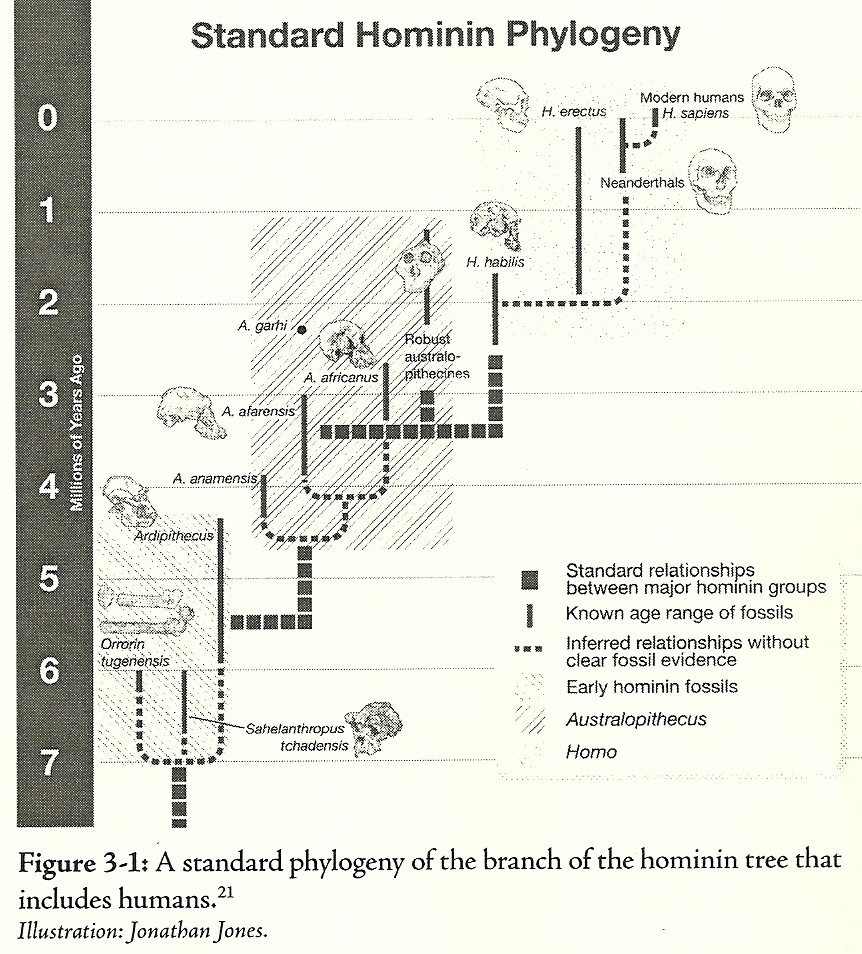
Below are synopses of the fossils believed to be within the ancestral line to humans; many of these are actually not considered in line anymore by mainstream scientists in paleoanthropology or primate studies.  A chart showing the traditional, party-line view of human evolution is also shown below (from page 49).

Toumai Skull (Sahelanthropus tchadensis):  This species is represented by one skull with jaw fragments.  ~6.5 million years old.  Reported on in 2002, it is now considered by many to be a gorilla or ape or at least not in the human line.  If this skull is ancestral to humans, then australopithecines can’t be (pp 50-51).

Orrorin (Orrorin tugenensis):  Only a few bones are known of this species, and they do not include a skull or jaw.  ~ 6 million years old.  Even though little can be determined about this species’ way of moving, the conjecture by some that it may have walked upright was enough to put it in the human line.  Human evolutionary thinking had made bipedal walking a necessary condition for a fossil to be included in the human line.  However, we now know that this can no longer be a litmus test.  Why?  Because an ancient bipedal ape was discovered, Oreopithecus bambolii.  This creature is clearly an ape, it walked bipedally, and it lived ten million years ago.  We now know that some human-like physical features, that scientists considered unique to our line, developed in other species in parallel.  Nevertheless,if this species is found to be ancestral to humans, then australopithecines can’t be (pp 51-54).

Ardi (Ardipithecus ramidus):  Extremely reconstructed from very crushed and very friable and chalky bone fragments (skull and other parts).  ~4.4 million years old.  Even though the reconstruction of this fossil should have raised big doubts about any interpretations regarding it, it was in the news big time.  Even Science magazine joined in in the hype:

Science magazine named Ardi the “breakthrough of the year” for 2009, and officially introduced her with an article titled “A New Kind of Ancestor . . . (p 55).

After other scientists finally got to look at these fossil remains–which took over 15 years to “reconstruct”–claims of its bipedality were not affirmed.  Not only that, but some scientists hinted, and others said out-right, that Ardi was not a hominid, was not bipedal, and was closer to being an ape or orangutan (pp 54-57).

Australopithecines:  Because there are more Australopithecine fossils than any other, and because one in particular had become so popular–Lucy–it’s a bit hard to say only a little about this group of species.  In 2006 there was much hype over two canine teeth found of the species called Austropithecus anamensis.  I will say it again and allow the information to sink in:  there was much hype over only two canine teeth.  In any case, the author of the A. anamensis technical paper is worth quoting since he confirms Luskin’s contention:

Until recently, the origins of Australopithecus were obscured by a sparse fossil record . . . . The origin of Australopithecus, the genus widely interpreted as ancestral to Homo, is a central problem in human evolutionary studies.  Australopithecus species differ markedly from [both] extant African apes and candidate ancestral hominids . . . (p 58).

Let’s look at Lucy, an Australopithecus afarensis with purportedly 40% of it’s bones found.   First off, it’s not clear that all the bones of Lucy are actually hers.  The bones were highly spread out over a gully and one of its hillsides.  Many scientists no longer think Lucy walked upright like we do, or even at all, basically.  She very clearly has knuckle-walking hands, which no one denies but some try to excuse.  It is unlikely, from an evolution theory point of view, that she would retain these characteristics if she didn’t use them.  But to make a further argument about her mode of moving, the supposedly evolved form of Homo habilis retains some of these features 2 million years later.  Unused characteristics will not hang around that long in an evolved species.

Also, a whole slew of bodily features show that Lucy was ape- or chimp-like and was not at all adapted to running.  Australopithecine ear canals (for balance and locomotion) are not like humans but similar to apes.  They have grasping toes.  Professional studies and papers from 1975 and 2007 suggest that Australopithecines should no longer be considered part of the human line (pp 57-65).

Homo habilis:  ~1.9 million years ago.  The well regarded anthropologist Ian Tattersall of the American Museum of Natural History said this species is “a wastebasket taxon, little more than a convenient recipient for a motley assortment of hominin fossils.”  Besides this suggestive statement (suggestive of the quality of analyses that had gone on), Spoor et al. in Nature (1994) reported that the ear canal of this species was closer that of a baboon, and another study from 1991 “found that the skeleton of habilis was more similar to living apes than were other australopithecines like Lucy” (p 66).  Another scientist stated that habilis “‘displays much stronger similarities to African ape limb proportions’ than even Lucy” (p 67).  This species is therefore not considered to be in the human line (pp 65-67).

Standard Hominin chart Wells0001

[GAP]:  There are no transitional fossils between Australopithecus and Homo.  About 2 million years ago cranial capacity of the human line suddenly about doubled.

Homo and Australopithecus differ significantly in brain size, dental function, increased cranial buttressing, expanded body height, visual, and respiratory changes” and, the authors of the paper said “We, like many others, interpret the anatomical evidence to show that early H. sapiens was significantly and dramatically different from . . .  australopithecines in virtually every element of its skeleton and every remnant of its behavior (pp 67-68). . . .  The anatomy of the earliest H. sapiens sample indicates significant modifications of the ancestral genome and is not simply an extension of evolutionary trends in an earlier australopithecine lineage throughout the Pliocene.  In fact, its combination of features never appears earlier” (p 68; from Journal of Molecular Biology and Evolution 2000, emphasis mine).

The earliest fossils of Homo, Homo rudolfensis and Homo erectus, are separated from Australopithecus by a large, unbridged gap.  How can we explain this seeming saltation?  Not having any fossils that can serve as missing links, we have to fall back on the time-honored method of historical science, the construction of a historical narrative (pp 69-70; Ernst Mayr 2004, emphasis mine).

Homo erectus:  Extremely similar to modern humans – probably only a subspecies (so it was actually human). ~ 2 million years ago.  Cranial capacity is on average smaller, but still within the overall range of modern humans (which is incredibly varied).

Neanderthals (Homo neanderthalensis):  Very similar to modern humans and now known to be something like a subspecies of modern humans.  In fact, DNA studies show that many modern humans have Neanderthal DNA in them.  ~ .75 million years ago.  Cranial capacity on average was larger than modern humans.

II.  Evolution Time

There are no transitional fossils between Australopithecus and Homo (and some scientists, at least, no longer think Australopithecus should even  be in the homo line).  Ok.  But what time frame is there between these two species of Hominin?  About 1.5 to 2.o million years.  And how many traits arose or need to have changed?  About 16, at least, and many of these have to have occurred together – they won’t work apart from one another, or on their own they could even be harmful to the creature(s).

Based on experiments that test the rate of change at the molecular level, this number of changes within the known time frame would have been impossible.  Considering how slowly, relatively speaking, these hominins would reproduce, evolving even one homo feature from australopithecine would be basically impossible in the time frame we know exists between these species.  Gauger states:

You don’t have to take my word for it.  In 2007, Durrett and Schmidt estimated in the journal Genetics that for a single mutation to occur in a nucleotide-binding site and be fixed in a primate lineage would require a waiting time of six million years.  The same authors later [2008] estimated it would take 216 million years for the binding site to acquire two mutations, if the first mutation was neutral in its effect (pp 24-25).

III.  Are Only Two Human Parents Possible?

In Ann Gauger’s “The Science of Adam and Eve” (chapter five), she presents the history of research into the diversity of certain immune defense genes.  She does this since persons in the past used these genes, which have tremendous variety in our genomes and the genomes of our “cousin” species, to prove that humans could not have come from only two parents (like Adam and Eve).  The science involved is of course specific and complicated and I will not attempt to give am in-depth summary of it here.  What I will say is that an original study (published in 1995) found that chimps and humans shared 32 alleles of this gene (HLA-DRB1), and later study cut that down to seven and showed a whole new complication that was a mystery (different portions of the same gene yielded wildly different results).

The results were mysterious because it turns out that even though the gene has 100s of allele variations (there are a number of HLA genes, and each has hundreds of alleles), most are not recombined and therefore are known as haplotypes.  These haplotypes are inherited in blocks, and there are very few of these in humans – five, in fact.  Three are very ancient and two are, well, not as ancient (~30 mya or more, and ~ 5 mya, based on current evolutionary assumptions), and one is not shared with chimps.  Each person can carry two different alleles of the HLA gene studied.  So it is now known to be in the realm of possibility that we all came from two parents only, each carrying two different HLA alleles.

The later study, and others, provided data that may also force a change in neo-Darwinian thinking.  This newer data show that we share genes with other species that are not common ancestors.  We have some gene sequences that are more closely related to gorillas than chimps, and we have sequences resembling those from macaques – animals that are not in our hominid group.  What does this data do to the whole concept of common descent?  (pp 103 – 121).

*      *      *

So what we end up with is a hominin family tree that, if a number of scientific studies and their conclusions are to be followed (the papers being in the major journals in their fields), would be gutted.  Continuous, gradual, evolutionary change in the hominin line?  No, not at all.  We also have the science of nucleotide-binding mutations indicating that there is no possibility, given the relatively short time frame, that any fossil currently thought to represent an ancestor in the human line could have evolved into a human.  Please read the book for more detailed information, but for checking out the references as well.

Who are terrorists? Hint: Not American “conservatives”

Great article, and one that shouldn’t have to be written and published.  But get this:

CNN and MSNBC immediately speculated about “right-wing nutcases” and tea partyers. As of 2013, the number of terrorist attacks involving members of the tea party is precisely zero. The last major terrorist attack that had even the slightest link to anything on the political right was Oklahoma City bomber Timothy McVeigh in 1995. Described as a devout Christian and Republican, he was neither.

Many people in the media or who have voices that the media likes to chime, are those who promote lies and hypocrisy against those they simply disagree with.  When you’re young, well, at least when I was young, I assumed people told the truth and did things that were in the best interest of others and the community.  People that weren’t criminals just didn’t do the things that are basically a common part of our media and leadership today.   In any case, the article that is linked below is great, and apparently a good portion of our population needs to read it, stop ignoring reality, and stop pointing fingers and spreading hate against regular people (who are often more informed than they are).

Link:  Boston Marathon terrorism: The toxic brew of Islam and politics

A murderous, cancerous ideology known as radical Islam has metastasized globally. It needs to be stopped, and admitting the problem exists is the first step to recovery for deniaholics.

Churches and the Bible; Faith, Actions, and Witness

Random peaceful scene: Badachro Bay in Scotland  (ColinBroug at stock.xchng).
Random peaceful scene: Badachro Bay in Scotland (ColinBroug at stock.xchng).

If you go to church, are you happy with it?  I don’t mean happy with what the church does for you only, but are you happy with what it does and how it follows Christ?  Unfortunately, actually, I’ve attended many churches.  It would have been great to have gone to one church from the beginning and stayed with, and developed, life-long relations within that body, just like it’s a real (and wonderful!) family.  But eventually with my original church, the leadership there fell apart.  After that, I went to different churches for different reasons – scriptural and spiritual (these can be reasons to stay or to leave), or strange difficulties with people, or simply  moving too far away.  So, my point is, I’ve experienced different Christian leadership groups, how they do things, what they emphasize, etc.

I’m bringing this up in a post because we’ve been searching for a home church since we moved to this city.  We went to one for a while that has a lot of good going for it, it seems, yet after a while we just saw too many things that we didn’t think were scriptural or spiritual or healing . . . so we began looking again.  We’ve been going to one that we like a lot, though it has an extroverted “culture” (and we’re more introverted).  There are a lot of great people there, they emphasize Christ’s church in the world and being an active Christian (this is good and necessary, but that doesn’t mean one has to be an extrovert), and they seem spiritual.  Besides the emphasis on extroversion, there’s a major thing that is bothering me, and my family, about this church, but for privacy reasons I’m not going to get into it.

The thing is, why is it so hard to find a church where the body simply follows Christ?  Not the laws and regulations of Israel, but the radical message of Christ?  Why are so many into money?  Being a poor person for a while now (we’re not in complete poverty, but if we didn’t have some savings to live off of right now, we would be), I notice a number of things I didn’t notice before.  It just is a real turn-off when wealthy leadership talks about what blessings they have and how God is good, when you don’t have those things . . . at all . . . yet they ask for money from you.

Sacrificial giving is good, for sure, but it still seems wrong when wealthy people ask for poor peoples’ money . . .  Christ came to help the poor, and in the Old Testament God talks much of helping the poor and not cheating them.  This issue is why I mentioned “witness” in the title.  Christianity seems like such a money-grabbing faith so often – at least nonbelievers pick up on this from stories in the media.  Yet the New Testament teaches that people should give out of love and desire, with a happy heart, not out of compulsion, and the church is not just for the wealthy and should not favor the wealthy (in fact, many of Christ’s words emphasize the opposite).  And instead of demanding more funds from people to have a bigger building, say, perhaps the fellowship should divide into smaller related churches.  In any case . . .

Getting back to a previous issue: extrovertism.  Does anyone wish they could worship and fellowship with a more introverted crowd, in a more introverted way?  Does anyone think living more like a monk, in a monkish community – one that is also doing Christ’s work in the world around them – would be great (but I don’t know, maybe your fellowship is already like this*)?  I wish I could have that, do that.  I wish I could invest in buildings on a large property that would be a community of Christians.  A thankful, contemplative, prayerful, creative, and safe community committed to Christ and what He said and copying what He did (hey, sure, that might include upsetting someone’s cheating “money cart” once in a while . . . or often).   This would be a happy place.  But is it possible today?  I don’t know.  It seems impossible today.  Far too many people today seem to latch on to something, some belief, that is not necessary for salvation and hold it up higher than Christ.  It’s weird, and the church is weirdly divided.

Thanks for reading what is essentially a vent (though I DO wonder if people think the same) . . . and God bless you!

* We live in a very busy, urban, and expensive cultural area.

The Wonderful, the Why, and the Fulfilled Prophecies of Christ at Easter

Happy Easter everyone!  Or, if you don’t like to call it that, Blessed Resurrection Day!  Thank you Lord for all that you did and are doing!  Here is a link to a very informative and I’d say concise treatment of the meaning of, and verses relating to, Christ’s crucifixion and resurrection.  The web site it’s on is distractingly and annoyingly messy (to me, anyway), but hey . . . it’s meant as a basically informational site for pastors, I guess.

Link: The Crucifixion, Death and Resurrection of Jesus

Madonna, Don’t Bully the Boy Scouts

I’m very tired of people in the media, or anyone else for that matter, telling people that they can’t have a private organization based on certain beliefs.  As Madonna did recently.  Madonna dresses as Boy Scout, rips organization’s gay ban  The Boy Scouts is a private organization – let them be.  If ANYONE else wants to start a new organization similar to the Boy Scouts but with different values – guess what, they can!  This is nothing more than trying to take control of a large, influential, and traditional organization.  It’s appalling. Our country is a free one.  That organization can have it’s own values, based on the Bible, and anyone else is free to start their own organization based on secularism or humanism or whatever.  It’s amazing they don’t see their own hypocrisy.

Is Madonna for worker’s rights?  Hey Madonna, why don’t you join underpaid and underworked Walmart workers?  What’s on YOUR mind?  Only the rich would be concerned so much about sex, when so many people can’t even make enough money to pay rent or buy food . . . so many cannot afford to have families.  But the rich can, like Madonnna, and then go around trying to control others’ convictions about what God says.   People, we need to loudly defend our freedoms in these kinds of matters here or we will go the way of European countries, where in places it is against the law to publicly convey the word of God or homeschool your children.

Christian Poems XI: Eliot, and a prayer from Kierkegaard

ASH WEDNESDAY (FROM CANTO I)

By T.S. Eliot

Because I do not hope to turn again
Because I do not hope
Because I do not hope to turn
Desiring this man’s gift and that man’s scope
I no longer strive to strive toward such things
(Why should the aged eagle stretch its wings?)
Why should I mourn
The vanished power of the usual reign?

Because I do not hope to know again
The infirm glory of the positive hour
Because I do not think
Because I know I shall not know
The one veritable transitory power
Because I cannot drink
There, where trees flower, and springs flow, for there is nothing again

Because I know that time is always time
And place is always and only place
And what is actual is actual only for one time
And only for one place
I rejoice that things are as they are and
I renounce the blessed face
And renounce the voice
Because I cannot hope to turn again
Consequently I rejoice, having to construct something
Upon which to rejoice

And pray to God to have mercy upon us
And I pray that I may forget
These matters that with myself I too much discuss
Too much explain
Because I do not hope to turn again
Let these words answer
For what is done, not to be done again
May the judgement not be too heavy upon us

Because these wings are no longer wings to fly
But merely vans to beat the air
The air which is now thoroughly small and dry
Teach us to care and not to care
Teach us to sit still.

Pray for us sinners now and at the hour of our death
Pray for us now and at the hour of our death.

In A Sacrifice of Praise (2nd ed), James H. Trott, editor (Cumberland House 2006), 714-715.

heart2-1

___________

AT THE LORD’S TABLE

(One of seven entries in the source cited)

By Soren Kierkegaard

O Lord Jesus Christ, who didst first love us, who until the end didst love them whom Thou didst love from the beginning, who unto the end of days dost continue to love him who would belong to Thee; Thy faithfulness cannot deny itself–oh, only when a man denies Thee can he compel Thee as it were to deny him also, Thou loving One.  So be this our comfort when we must accuse ourselves of the offences we have committed and of the things we have left undone, of our weakness in temptation, unfaithfulness to Thee, to whom once in early youth and ofttimes again we promised faithfulness–this be our comfort, that even if we are unfaithful, Thou dost remain faithful, Thou canst not deny Thyself.

In The Prayers of Kierkegaard, P.D. LeFevre, editor and author (Univ of Chicago Press 1956), 120.

“Humanism for Children”: Wm Lane Craig via The Washington Post.

Humanism for children – Guest Voices – The Washington Post.

I need to “get out” more on the internet, as I hadn’t seen this until today.  Nice little article.  It’s funny how some defenders of humanism, in the comments, complain that he didn’t mention the guys on their side.  Why should he, specifically?  He did mention them in passing, as having weak arguments.  It can be viewed as being more polite and academic to not attack everyone, but to primarily present one’s argument instead.  And the high rhetoric of some of humanism’s defenders is very funny too – it’s exactly the point.  Without a basis for claiming their moral authority, they end up looking like self-promoters of humanity, which often leads to despotism.  And around the web, there are no shortage of little bully despots running around daily, blindly insulting anyone who doesn’t agree with him.  What a wonderful, happy, and moral world the humanists are creating!

Here is an example from the academic realm of how humanists or naturalists (I can’t say for sure based on the info provided) equate belief in God with stupidity, and that somehow their views are superior.  They can’t even see how their opinions show that they think their views are obviously superior, instead of letting people have faith, and, actually talking about their differing views as equals.  They said that the man in question, Ben Carson,  claimed that evolutionists could not have the same level of ethics as theists (basically).  This is a philosophical argument, if it’s true what they said, and they need to address it seriously instead of whining about it. 

Dr. Ben Carson’s Beliefs On Evolution Stir Controversy At Emory University

As it turns out, Dr. Carson delivered the Presidential Prayer Breakfast speech shortly after I had made this post:

See the Prayer Breakfast Speech That’s Grabbing Headlines: Doctor Attacks Political Correctness, National Debt in Front of Obama

“Against Calvinism,” a counterpoint book by Roger E. Olson

Against CalvinismI believe someone needs finally to stand up and in love firmly say “No!” to egregious statements about God’s sovereignty often made by Calvinists.  Taken to their logical conclusion, that even hell and all who will suffer there eternally are foreordained by God, God is thereby rendered morally ambiguous at best and a moral monster at worst.  I have gone so far as to say that this kind of Calvinism, which attributes everything to God’s will and control, makes it difficult (at least for me) to see the difference between God and the devil” (p 23).

I’m not one to go out of my way to either belittle or cause a fight between Christians, but the fact that I bought and read this book is a testament to the harsh treatment I’ve received from (at least some) Calvinists.  From my understanding of God and scripture, the “new Calvinist” belittling of other Christians and fighting with them publicly is not of Christ.  The author of Against Calvinism is like minded, but has had even worse unChrist-like jewels thrown at him than I have, presumably because he is a professor.  He had students, anonymously and not, tell him he wasn’t a Christian and that he was going to hell – simply for not believing their interpretation of scripture.  Whenever I come across this behavior – insulting people personally instead of addressing the parts of scripture they point to for consideration – it raises a big . . . red . . . flag.  (And, of course, it’s a very bad witness for Christ.)

I’ve encountered this with the proponents of post-tribulation rapture as well, and after looking into the scriptural arguments for pre- mid- and post-tribulation raptures, the post-tribs seem to have the least going for them in my view.  And so they make personal attacks, saying that those who don’t go along with them are just wimps who can’t stomach the idea of going through the tribulation.   Me: “rolls eyes and is reminded of cults.”  But “new Calvinists” do the same thing.  Instead of making an effort to understand where non-Calvinists are coming from, they make incredibly insulting claims towards them that are very far from the truth.   They even have the audacity to call everyone who doesn’t agree with them Arminians (and the name calling has had the impact of turning that theology into a bad label), even though it’s obvious that they don’t understand that theology, and the additional audacity to make it seem that if you are Reformed, you are Calvinist.   This whole scenario should make anyone wonder how (or how well) they assimilate their own theology.

I have no interest in man-centered theology; I am intensely interested in worshiping a God who is truly good and above reproach for the Holocaust  and all other evils too numerous to mention.  Too many Calvinist authors misrepresent non-Calvinist theologies as if they are all man-centered, humanistic, less-than-God-honoring, and even unbiblical without ever acknowledging the problems of their own theology.  Too many young, impressionable followers have not yet figured out what those problems are.  I write this to help them (p 24).

I will argue throughout this book that high Calvinism is not the only or the best way of interpreting Scripture.  It is one possible interpretation of isolated texts, but in light of the whole witness of Scripture it is not viable.  Furthermore, I will argue that high Calvinism stands in tension with the ancient faith of the Christian church and much of the heritage of evangelical faith.  Some of its crucial tenets cannot be found before the church father Augustine in the fifth century, and others cannot be found before a heretic named Gottschalk (d. circa 867) or from him until Calvin’s successor, Theodore Beza (p 24).

As a note, it’s good to keep in mind that both Calvinism and Arminianism are theologies that do not fully reflect their namesakes – they both were altered some after Calvin and Arminius died.  Olson doesn’t cover all the aspects of this in his book, as they are not all necessary, but he does show clear evidence that Calvin did not write about, believe in, or adhere to “limited atonement.”  This is the “L” in “TULIP,” the acrostic for the five points of modern high Calvinism:  Total depravity, Unconditional election, Limited Atonement, Irresistible grace, and Perseverance.  “Four point” Calvinists do not adhere to limited atonement, but as limited atonement logically follows from the other four points and would be needed for the whole theological scheme to work, four point Calvinists are criticized both by high Calvinists and non-Calvinists alike for being inconsistent.

As I’ve seen in other written works, Olson points out that many persons who call themselves Calvinists are not actually Calvinists; in particular, many Baptists churches maintain traditional orthodox doctrine that is not Calvinist, yet they still seem to want to call themselves that.  There aren’t even any Baptist churches represented in the international organization, World Communion of Reformed Churches (WCRC).  It’s good, then, to see that another book I have here, which I’ll write about later (God willing), is written by a Baptist (C. Gordon Olson):  Getting the Gospel Right: A Balanced View of Salvation Truth (the cover shows a balanced scale with Arminianism on one side and Calvinism on the other).  A small book published by the Calvary Church group also presents a middle-ground approach, which that semi-denomination adheres to:  The Five Points of Calvinism: “Weighed and Found Wanting” (George L. Bryson).  Many of the books that Roger Olson uses and recommends are listed at the end of this post.  Three links for further reading now are also provided.

In the title of this post I wrote that Against Calvinism is a counterpoint book.  I used that term because Zondervan published For Calvinism first, and this book is the good or evil twin of that one – but Zondervan doesn’t appear to have a name for these related books (like a counterpoint series or something along those lines).  Olson calls his book little, but it’s not, really.  It has fairly small print and lots of details, though it is smaller compared with the other Olson book mentioned above (Getting the Gospel Right appears to cover more verses, passages, and various interpretations more specifically).

The point is, it has a lot in it, and it’s been hard to decide what to include in this post.   First, I’ll do the obvious thing and briefly outline the main points of high Calvinism, together with counterpoints.   Second, I’ll provide statements and/or questions that typical “new Calvinists” make, with Olson’s responses (some truncated).   And lastly, I’ll include Olson’s mini instructive scenarios that illustrate the different views of salvation grace as they are found in Semi-Pelagianism (it’s a person’s choice), Monergism (Calvinism – it’s all God’s choice), and Evangelical Synergism (Protestant Arminianism – it’s both a person’s choice and God’s choice).  Of course, for the detailed information with all the technical terms, read Olson’s book.

Main Points of High Calvinism with Counterpoints, Briefly Stated

T = Total Depravity.  This refers to humans’ total spiritual depravity, or their spiritual deadness.  Since we are spiritually dead, God needs to intervene in order for us to be regenerated.  Non-Calvinists don’t have much argument with this in general – it is the method and timing of regeneration that is at issue (see the other letters in the TULIP).

U = Unconditional Election.  This refers to being elected by God to salvation, and the believer being predestined.  All Christians believe in election, but not all believe that God chooses people and passes over other people only because God decided specifically.  Calvinists believe people have nothing at all to do with it – they don’t respond to the Gospel themselves – and that it is only God’s choice.  This logically leads to the doctrine of double predestination: there are people chosen by God to go to heaven and the others are chosen to go to hell.  This abrogates human responsibility and so is deemed immoral by non-Calvinists.

L = Limited Atonement (or particular redemption).  Non-Calvinists and some Calvinists (four-pointers) reject the idea of limited atonement outright as being unbiblical.  It denies the plain and supported meanings of  verses like 1 John 2:2, 1 Timothy 4:10, and others, that convey that Christ’s blood was and is enough for all (if the whole world accepted Christ’s work and God’s gift, Christ’s sacrifice would be enough to cover everyone).  Calvinists of course use other verses to support their theology, and try to explain away verses that say that Christ died for all.  They claim that God intended Christ’s blood for the elect only; as such, they cannot preach to an open crowd that “Christ died for your sins.”  Olson goes into detail about this (in chapter six).  As Olson wrote, “To paraphrase John Wesley, this seems to be such a love and compassion as makes the blood run cold” (p 49).

I = Irresistible Grace (or effectual or efficacious grace, or Monergism).  This seems to be the most flagrantly or glaringly contradictory claim of the lot.  While Calvinists say that God draws the elect – only – and they cannot resist it (it’s irresistible), they also claim (somehow) that it’s not forced on those chosen.  Huh?  Well yes, in Calvinism it is forced on them.  God changes their hearts without their permission; it’s only after God does this that they respond to him, in fact.   Since people are dead spiritually and can’t respond in any case, in Calvinism, it is all God’s doing.  In non-Calvinistic theologies, God has provided a type of grace that draws all people first – some accept this draw and some reject it.  “The ordinary message of the gospel for most evangelical Christians is ‘believe and be saved,’ based on Scripture passages such as John 3:1-21, in which Jesus tells Nicodemus that he must be born again and that belief in him will accomplish that (v. 14).  There is really no way to reconcile this passage with belief that regeneration precedes faith” (p 52).

P = Perseverance.  This doctrine is the least controversial and is not really discussed much by Olson.  He points out that Lutherans and Free Will Baptists reject it, but that Arminius hadn’t made up his mind about it.

Excerpts from “Responses to Calvinist Claims” (pp 188 – 192)

“1.  Any other view of God’s sovereignty than Calvinism diminishes the glory of God; only ‘the doctrines of grace’ fully honor and uphold God’s glory.  It all depends on what “God’s glory” means.  If it means power, then perhaps this is correct.  But power isn’t glorious except when guided by goodness and love.  Hitler was powerful but obviously not glorious.  Jesus Christ revealed God as ‘our Father’ and therefore as good and loving.  In fact, high Calvinism (TULIP), wrongly labeled ‘the doctrines of grace’ by Calvinists, diminishes God’s glory by depicting him as malicious and arbitrary.  Furthermore, if Calvinism is correct, nothing can ‘diminish the glory of God’ [including real or perceived views of him] because God foreordained everything for his glory.”

“2.  Non-Calvinist theologies of salvation, such as Arminianism, make salvation dependent on good works because the sinner’s decision to accept Christ is made the decisive factor in his or her salvation.  It seems more the case that Calvinism makes salvation dependent on good works or something good about person elected to salvation, or else how does God choose them out of the mass of people destined for hell?  It’s either something God sees in them, or else God’s choice of them is arbitrary and capricious.  Furthermore, Arminian theology does not make salvation dependent on good works; all the ‘work’ of salvation is God’s.  The sinner is enabled to repent and believe by God’s prevenient grace and the bare decision to accept God’s salvation is not a good work; it is simply accepting the gift of grace. . . . ”

“5. Only Calvinism can account for God’s sovereignty over nature and history; unless God foreordains and controls every event, down to the smallest puff of existence and down to every thought and intention of the mind and heart, God cannot be sovereign.  This is not what ‘sovereignty’ means in any human context.  A human sovereign is in charge but not in control of what goes on in his or her realm.  God can steer the course of nature and history toward his intended goal and assure that they reach it without controlling everything.  God is like the master chess player who knows how to respond to every move his opponent makes.  There is no danger of God’s ultimate will not being done.  In fact, Calvinism cannot explain the Lord’s Prayer that teaches us to pray, ‘Your will be done on earth as it is in heaven,’ which implies that God’s will is not already being done on earth.  According to Calvinism, it is!”

“7. Reformed theology, Calvinism, is the only solid foundation for conservative, biblical Christian theology.  All other approaches, such as Arminianism, a man-centered theology, inevitably lead to liberal theology.  Arminianism is not a ‘man-centered theology’ but a God-centered theology.  It is driven entirely and exclusively by a vision of God’s unconditional goodness and love.  The one main reason Arminians and other non-Calvinists believe in free will is to preserve and protect Cod’s goodness so as not to make him the author of sin and evil.  Calvinism makes it difficult to recognize the difference between God and the devil except that the devil wants everyone go to hell and God wants many to go to hell.  Arminian theology does not lead into liberal theology.  If anything, Calvinism does that.  Friedrich Schleiermacher, the father of modern liberal theology, was a Calvinist!  He never even considered Arminianism; he moved right from conservative, high Calvinism to universalism while holding onto God’s meticulous providence even over evil.  Most of the nineteenth-century liberal theologians were former Calvinists who came to abhor its vision of God and developed liberal theology without any help from classical Arminianism. . . . ”

8. God has a right to do whatever he wants to with his creatures and especially with sinners who all deserve damnation.  His goodness is shown in his merciful rescue of some sinners; he owes nothing to anyone.  Those he passes over deserve hell.  While it may be true that everyone deserves hell, although even many Calvinists hesitate to say that about children, God is a God of love who genuinely desires all people to be saved, as the New Testament clearly testifies in 1 Timothy 2:4 ‘who wants all people to be saved and to come to a knowledge of the truth.’  There is no way to get around the fact that ‘all people’ means every single person without exception.  The issue is not fairness but love.  A God who could save everyone because he always saves unconditionally but chooses only some would  not be a good or loving God.  He would certainly not be the God of 1 Timothy 2:4 and similar passages.’

“11. Non-Calvinist theologies such as Arminianism believe in something that is impossible: libertarian free will–belief that free decisions and actions simply come from nowhere.  Calvinism and some other theologies, as well as many philosophers, know that ‘free will’ simply means doing what you want to do and people are always controlled by their strongest motives, so being able to do otherwise–libertarian free will-is an illusion.” [Apparently, these people never make tough decisions based on multiple choices, like over which house or car or whatever to buy, where to go to college, which job to take, etc. etc.]   “If ‘free will’ only means doing what you want to do even though you couldn’t do otherwise, how is anyone responsible for what they do?  If a murderer, for example, could not have done otherwise than murder, then a judge or jury should find him not guilty–perhaps by reason of insanity.  Moral responsibility, accountability, and guilt depend on ability to do otherwise–libertarian freedom.  The Calvinist view of ‘free will’ isn’t really free will at all. . . .”

Mini Scenarios that Illustrate Different Views of Saving Grace (pp 172 -173)

First, imagine a deep pit with steep, slippery sides.  Several people are lying broken and wounded, utterly helpless [reflecting our fallen and depraved nature], at the bottom of the pit.

  • Semi-Pelagianism says that God comes along and throws a rope down to the bottom of the pit and waits for a person to start pulling on it.  Once he does, God responds by yelling, “Grab it tight and wrap it around yourself.  Together we’ll get you out.”  The problem is, the person is too hurt to do that, the rope is too weak, and God is too good to wait for the person to initiate the process.
  • Monergism says God comes along, throws a rope down into the pit, and climbs down it, wrapping it around some of the people and then goes back out of the pit and pulls them to safety without any cooperation.  The problem is that the God of Jesus Christ is too good and loving to rescue only some of the helpless people.
  • Evangelical synergism says that God comes along and throws a rope down and yells, “Grab onto it and pull and together we’ll get you out!”  Nobody moves.  They are too wounded.  In fact, for all practical purposes they are “dead” because they are utterly helpless.  So God pours water into the pit and yells, “Relax and let the water lift you out!”  In other words, “Float!”  All a person in the pit has to do to be rescued is let the water lift him or her out of the pit.  It takes a decision, but not an effort.  The water, of course, is prevenient grace.

*       *       *

Thanks for reading, and let me leave you with some verses worth considering.

“My brothers, some from Chloe’s household have informed me that there are quarrels among you. What I mean is this: One of you says, “I follow Paul”; another, “I follow Apollos”; another, “I follow Cephas”; still another, “I follow Christ.” Is Christ divided?  Was Paul crucified for you?  Were you baptized into the name of Paul?” (1 Corinthians 1:11-13).

““My [Jesus’] prayer is not for them alone [those living at that time]. I pray also for those who will believe in me through their message, that all of them may be one, Father, just as you are in me and I am in you. May they also be in us so that the world may believe that you have sent me. I have given them the glory that you gave me, that they may be one as we are one: I in them and you in me.  May they be brought to complete unity to let the world know that you sent me and have loved them even as you have loved me” (John 17:20-23, emphasis added).

With how divisive and divided Christ’s church is today, how can those looking in from the outside see that God sent Christ?  Can our lack of unity, and sometimes vicious acts toward one another, actually imply that God cannot accomplish what Jesus prayed for (so they are basically false)?  I don’t know the answer for sure, since it’s all too obvious that Christians have chosen men to be leaders in the faith over Christ as the head; I don’t know how that can change in actual application.  And, considering what Paul had said (in the quote above), it seems it may be true that the great apostasy already had started in the early church.  Pray for more unity as well as guidance from the Holy Spirit for all.

*       *       *

For further reading on this subject right now, go to Molinism vs Calvinism, at Reasonable Faith (if you read this to the end then know, too, that some Calvinists have altered Molinism to fit into Calvinism more, and Olson has a small section on this in his book),  Confessions of an Arminian Evangelical, and Calvin’s Comeback? The Irresistible Reformer (in The Christian Century – you need to register to read it).

*       *       *

Recommended readings from “Against Calvinism” (in alphabetical order by title, excluding The and A):

Arminian Theology: Myths and Realities (Roger Olson, InterVarsity Press 2006).

The Doors of the Sea: Where was God in the Tsunami? (David Bentley Hart, Eerdmans 2005).

The Freedom of God: A Study of Election and Pulpit (James Daane, Eerdmans 1973).

God’s Universal Salvific Grace (Vernon C Grounds, Bethany 1975).

The Great Debate: Calvinism, Arminianism, and Salvation (Alan PF Sell, Baker 1982).

Is God to Blame? (Gregory A Boyd, InterVarsity Press 2003).

A Scandalous Providence: The Jesus Story of the Compassion of God (E Frank Tupper, Mercer Univ. Press 1995).

The Transforming Power of Grace (Thomas Oden, Abingdon Press 1993).

What the Bible says about God the Ruler (Jack Cottrell, Eerdmans 1991).

Whosoever Will: A Biblical-Theological Critique of Five-Point Calvinism (DL Allen and SW Lemke, editors, Broadman & Holman 2010).

Why I Am Not a Calvinist (J Walls and J Dongell, InterVarsity Press 2004).

Evidence of Ten Healing Miracles

ten healing miracles.   I was researching miracles and found this page.  The Lord be praised.

Steps to the cross.  Author image.
Steps to the cross. Author image.