Category Archives: review

Breaking Bad season 5: Did anyone else want to throw the TV out?

Update:  At the time that I wrote this I wasn’t aware that “Season 5” was broken up into two parts and that the next “season” wasn’t going to be “6.”  So the post below is about the first half of Season 5.  I did end up watching the second half, late again, on Netflix.  Those episodes were hard to watch, but I wanted to see if Walter would redeem himself in any way.  After much beyond believable behavior on his part, he finally did admit to himself – and to his wife before he died – that he didn’t do all the nasty stuff he did for the family (it really took him a long time to admit the obvious), but because he liked the power.  I may watch it again so that I can write a fuller post on sin and how people handle it, or don’t, in this popular show and how it reflects Christian belief on these subjects, but for now, enjoy the original essay (and thanks for dropping by!).

I wonder how many Christians watched “Breaking Bad,” the show about a high school chemistry teacher turned evil meth mastermind.  I hadn’t wanted to watch it until recently, but that was because I had a mistaken view of what the original story was; we also because don’t watch much TV.   My son wanted to see what it was all  about, however, since it’s so popular, and we ended up watching up to season 5 recently on Netflix.  (This is an adult show, so yeah, we fast forwarded over a few parts – something my son was very glad to do!)

If you’ve watched it, you know that the teacher, Walt, gets lung cancer and his family, even with insurance, can’t pay for all the treatments and surgery (that alone, if I recall correctly, was $120,000).  He originally thought of just letting himself die, but his family didn’t want that, of course.  So, since he knew chemistry, he decided to make money at making meth.  He wanted to make enough to pay for the family’s bills and put enough in savings for his kids to go to college – before he died.  He had good intentions, at least during the first season (and what he’s doing is not any different than what the tobacco industry gets away with legally, when it comes down to it).  However, the treatments went unusually well and Walt’s cancer went into remission.  Things went downhill from there.

I very much like the message of the first season.  It’s something like this comic:

522f5029aa919But after season 1, Walt gets more and more prideful until by the end of season 5, he murders a man easy as pie, where there is no reason to (and this man was a trusted associate).  At this point in the show Walt is 51 yeas old, and only about a year and a half has taken place since the beginning of season 1.  He is no longer the same person he was, by any stretch of the imagination.  People can and do become corrupt, but the only way that it can happen at that speed and level, is by becoming demon possessed.  So what I’m saying is that, *gasp*, the show is just bad.

The bad writing and weird decision-making by the characters started in season 2, so it makes me think the makers of this show didn’t have a good long-term vision for it.  To try and make us believe that all the violence and stupidity in the show is due to Walt not being able to get proper health care is just silly.  I do think they could’ve stayed on track with that original idea and come up with a more realistic, quirkier, and interesting show than what “Breaking Bad” became.

After season 1, it simply became a gangster soap opera.  There are tidbits in it about the possibility of God, and how people change and become bad, but that’s all they are – tidbits.  Besides that, Hank, Walt’s DEA brother-in-law (the good guys, right?), is an extremely obsessive legalist type who is about as equally disturbing as Walt!  In any case, I kept watching the show because I was invested in it and I simply wanted to see what happened next, but, after season 5, I truly don’t care what happens to Walt anymore.  I wish he hadn’t left a trail of bodies (or . . . barrels of acid) everywhere and made the lives of  those who happen to be still alive so miserable.

Thoughts and Counter Thoughts on “30-Second Philosophies”

30-Second Philosophies

For a well-organized and concise presentation of 50 philosophical ideas, 30-Second Philosophies: The 50 most Though-provoking philosophies, each explained in half a minute is worth reading and having around for a quick review and a handy reference (for Christians too).  The title is more of a catchy, rather than an accurate, description of the book.  The “30-second explanations” can take more than that time to read, of course–if you’re thinking about what you read–and there are side notes to expand on the explanations.  In addition, for each section in the book there is both a glossary and a profile of the chosen exemplary philosopher.   There is some introductory material and a resources section in the back as well.

It is very nice indeed that the book is divided into subject sections, instead of the philosophies being presented in either a chronological or alphabetical list.  The sections are:  “Language & Logic,” “Science & Epistemology,” “Mind & Metaphysics,” “Ethics & Political Philosophy,” “Religion,” “Grand Moments,” and “Continental philosophy.”

Seeing as this blog is to view things from a Christian perspective, I will opine on the “Religion” section.  “30-Second Philosophies” may be a good book for a Christian to have as a basic learning tool and reference, but it is not friendly to Christian beliefs.  This is no surprise, since most philosophers today are materialistic* in their beliefs and thinking (Hasker 2006).  In this section Thomas Aquinas is profiled and the following philosophies are presented:  “Aquinas’ five ways,” “Anselm’s ontological argument,” “Epicurus’ riddle,” “Paley’s watchmaker,” “Pascal’s wager,” and “Hume against miracles.”

As might be assumed, ending the religion section with an (old) argument against a major theology isn’t a good sign toward a positive view of Christian philosophy and thought.  Each of the sections negatively criticizes Christian philosophers and theological ideas; for example, the author(s) makes a flat-out claim that the ontological argument is false, and elsewhere implies that God is false or silly since He didn’t make us all simply virtuous.  The “obvious solution” of making us only virtuous would have meant no problem of evil would have sprung up.  Here the author ignores the concept of actual free-willed beings, since in materialism there can be no true free will.

Regarding the Ontological Argument, please see the Sennett/Plantinga source below, which contains a chapter on the argument.  In that chapter (which is basically reproduced here), Plantinga goes through the history of the argument and provides a final and valid restatement of it (Plantinga is a professor of philosophy emeritus at The University of Notre Dame).  Secondly, regarding the problem of evil, the reader might like to view the William Lane Craig article provided in the Sources and Recommendations section.  There is no shortage of Christian writings on this subject, since, as Craig wrote,

“The problem of evil is certainly the greatest obstacle to belief in the existence of God. When I ponder both the extent and depth of suffering in the world, whether due to man’s inhumanity to man or to natural disasters, then I must confess that I find it hard to believe that God exists. No doubt many of you have felt the same way.”

I did not write of all the criticisms the authors had for Christian philosophy in “30-Second Philosophies,” but you are encouraged to check them out and seek the answers.  If you can imagine someone picking up this book and only reading the summary explanations and criticisms, then you will get an idea of what the average person or student thinks.  You can find this level of knowledge and thinking all over the internet (and no doubt in our more physical interactions), and it would behoove us to know more and have legitimate and current counter arguments and answers.

* This link will lead you to a subscriber view only article.  To see the whole article without being a subscriber, do a browser search and click on the link for “What is Materialism?” by Michael Philips.

Sources and Recommendations

Beilby, James K., editor, For Faith and Clarity: Philosophical Contributions to Christian Theology  (BakerAcademic 2006).

Craig, William Lane.  “The Problem of Evil,” at Reasonable Faith.

Evangelical Philosophical Society (and Philosophia Christi).

Evolution News & Views

Hasker, William.  “Philosophical Contributions to Theological Anthropology,” in For Faith and Clarity (Beilby 243-260).

Kreeft, Peter J.  “C.S. Lewis’s Argument from Desire,” in G.K. Chesterton and C.S. Lewis: The Riddle of Joy (William B. Eerdmans Pub. Co. 1989, 249-272).

Sennett, James F., editor, The Analytic Theist: an Alvin Plantinga reader (William B. Eerdmans Pub. Co. 1998).

Why, Oh WHY, do Asian noodles have so many calories?

Chow Mein pack with hand to show scale (it's not a big pack).
Chow Mein pack with hand to show scale. It’s not a large pack, but bigger than the Indo Mie brand.
This article was updated on May 14, 2014.

One thing I love (one of the only things I love) about living in Southern California is that there are many Asian stores around (restaurants, too, of course).  They are the best places for buying fresh fish, and usually for fresh produce, too (by “best” I mean they have both good selections and good prices).  I recently made a clear broth-based soup with fresh salmon in it after visiting a new Asian market, and it was awesome; good nutritionally and inexpensive (the store I had visited sold bags of salmon “scraps” that yielded a whole plate of salmon after I deboned and skinned it).

IndoMie brand noodle, this one Mi Goreng (there are other yummy flavors, too).

Besides all the fresh produce, the Asian stores also sell a great array of sauces and cooking aids, teas, and instant foods – like instant noodles – and these can be purchased by the box (if desired).  I don’t mean the cheap cup-o-noodles that can be found anywhere, but more substantial fare.  Some of these instant noodles can be quite expensive, too, but I just leave those on the shelf.  One of my favorites, and my family’s favorites, is Sapporo Ichiban Chow Mein noodles.  They’re not expensive (usually $.68 – $.98 each), but they’re good!  IndoMei varieties, like Goreng, are excellent (and pretty cheap).  Maruchan (and Nissin) instant Yakisoba’s are easily found now in many stores and are pretty good too, and since they don’t require a pan to prepare them they are tempting to us instant-fix sort of people (they range in price a lot, from $.78 [interestingly, at Target] – to twice that much, depending on the store).

Instant (microwavable) Yakisoba.

So now to the point.  My son and I are looking to lose some weight and so started investigating calorie counts and all that, and what I’ve discovered surprised even me (I used to do all that diet stuff a lot when I was younger).  The surprising thing I found was that there are fewer calories in many Hungry Man frozen meals than in many instant noodle packs.  Eating a Hungry Man frozen meal also provides more variety of food types, so more nutrients (but, on the down side, more cholesterol, too).  And what’s actually quite annoying is that the manufacturers of the the noodle packs will not admit that one pack is one serving.  The Sapporo Chow Mein, for instance, actually claims to have three servings in it!  When it is cooked it fits in a small bowl . . . yet when you go to an Asian restaurant, you will be served far more than that with an individual order of chow mein.

So why, really, do instant noodles have so many calories?  Well, because they’re FRIED into that brick or cup shape.  They don’t look like they’re fried, to me, so all the more shocking to find that that is where many of the calories come from.  Nippon actually has a page on the process – how it’s done and why.  Nongshim, a Korean manufacturer, claims to produce healthier, non-fried instant noodles.

I hope the table below—providing a comparison of noodle meals with some Hungry Man frozen entrees—helps you out.

Instant Noodles vs Hungry Man.  Chart by author.
Instant Noodles vs Hungry Man. Chart by author.

dinner_bourbon_steak_strips

If you’re into noodles . . . and seasonings, check out this blog (if you haven’t already):  How I Eat My Noodles.  If you would like more information on real ramen, see Kobi’s Kitchen: Types of Ramen, Styles of Ramen.

Fallout New Vegas: Comments from a Christian

Update:  If you’re interested in the newest Fallout game, I have a detailed (two-part) review here, Fallout 4. Sometimes Bigger Isn’t Better (Overview) and Fallout 4. Sometimes Bigger Isn’t Better (Story)Note:  Here’s another FNV related article, a detailed look at the Honest Hearts DLC and its By the Waters of Babylon theme.  Thanks for checking them out!

Having played Skyrim so much, and liking it (for the most part), I finally ventured to play some other Bethesda games.  I played Fallout 3 for a while, then started Fallout New Vegas.  I was initially not going to get the game at all, simply because of its name.  I have no desire to go to Las Vegas, and deplore the “please sin in our city and enjoy committing adultery” TV ads put out from that place.  I was concerned that the game might glorify sin, although I was a bit confident that Bethesda as a company – while trying to appeal to the widest possible audience for its games – was still not into the glorification of bad behavior.

I like role playing games (RPGs), which Skyrim and the Fallout series are (my son plays Borderlands and tells me it’s an RPG, but it seems to have less freedom about it and simply more shooting – I just don’t think of it as an RPG).  Skyrim is more free however (and beautiful), it seems to me, with more rewards for exploration, than the Fallout games I’ve played so far.  These games let you fulfill your desires for adventure, for completing difficult tasks, and for mystery-solving.  So while these games are gory, crude (some sections of the games, and some game add-ons, have very crude language), and even sexual to a more or less degree, their verbal and moral choices contents are not much different than the real world.  The gore in the Fallout series is pretty nasty though, and there’s no way to turn it down.

And if you didn’t know, the Fallout series takes place in the somewhat distant future, after a major nuclear war.  The look is not futuristic, but more like retro 1950s (apparently evoking the falsehood of post-WWII optimism).

If you’re wondering if your teens should be allowed to play Fallout 3 or New Vegas, I think I would be criticized by many for saying “it depends.”  Fallout 3 does not have the sexual content that New Vegas does, that I’m aware of (Fallout New Vegas has at least two females that you can “sleep” with, and they aren’t spouses), though it does have some pretty crude language in parts.  The reason why I may seem wishy-washy about this is that, while I homeschool my son now, he had been to a small Baptist private school for two years, and what he heard and learned while there was nothing at all different than what is in the Fallout games.  What kids are exposed to these days is horrible, not just that they learn bad words or sexual things, but that so many kids are very selfish and promote actions that hurt others a great deal (and these often involve sex).  Truly, we live in a fallen world.

But to be more specific, Fallout New Vegas is not a game for older teens unless they’re very mature and have experienced the crudities of real life already (or read books with similar content).  One can play Fallout New Vegas for the adventure and play a good character.  Since it is an RPG, one can make all the best choices and do a lot of good in this fallen and war-torn part of the world, and basically ignore people and quests that are unethical.  That’s part of what a role playing game is, after all.  Whether you choose to let your older teen play it may depend, too, on your weighing of the game choices available for older teens.  Do you choose games that are simply all shooting constantly, like Black Ops II, or Borderlands II–which is inbetween an RPG and first person shooter, in my view–, or games that are non-violent . . . well, you might be wishing for too much there . . . though there is Minecraft (which both my husband and son like to play) and sports games (which they don’t).  And, of course, it would depend on your teen’s attitude – does s/he simply want to play a challenging game that is basically realistic, or are they out to experience a sinful fantasy?  If the latter, then no matter the person’s age, there’s a problem there if one calls themselves a Christian.

Basically, these games are like living in a fantasy book, where you make the moral choices while battling for your life.  And while dealing with gore.  If the gore takes too much effort to deal with, don’t play the Fallout series.  Skyrim has very little gore compared to these.

Some other comments.  If you buy the Ultimate Edition of Fallout New Vegas, it comes with all the additional content.  “Old World Blues” is good to play as early as possible since it has your own home in it with all the work stations, and talking appliances.  It has quirky juvenile humor.  “Dead Money” is very unpleasant and there isn’t much reason to play it, except for additional game play time (it is very gory and my husband even thought it was just stupid and low of Bethesda).

"Old World Blues" image drifting around the internet.
“Old World Blues” image drifting around the internet.

“Honest Hearts” is pretty, well, the scenery is quite a bit prettier than the main game’s map; it is in Mormon territory and this added content astonishingly quotes the Bible.  This is pretty cool, actually, but the buzz I got from that dissipated upon hearing the outcome of the quest’s story.  Main quests in the games have a visual story that plays when you complete them, showing different outcomes based on the decisions you made in the game.   Because I helped the tribes defend themselves against the violent, slave-taking invaders, Bethesda chose to say that the tribes became militarized instead of just going back to their way of life.  Wow, Bethesda, no on can defend themselves without becoming militarized . . . (pretty bizarre attitude for a violent video developer).

Another religious aspect of the game, though subtle and apparently confusing, is the inclusion of the Followers of the Apocalypse.  This group has a very nice cross as its symbol and this is not hidden.  They reside outside of the Vegas Strip in an old Mormon fort, while giving medical and educational aid to the area residents.  If you visit the wiki site and read up on The Followers, you will read that they are a “secular humanist” organization.  I’d like to know what secular humanist organization will use a cross as their symbol?  Part of their reasoning comes from something the founder of the group said in an earlier game, about not worshiping so much as helping people.  So, at least to a degree, one can’t blame atheists or anyone else for being confused about them.

What I don’t like about this aspect of the game is that while these people appear to be Christians, with their traditional cross flag and their type of aid that is traditionally Christian, they are in a Mormon fort.  An uninformed player could easily get the impression that “Christian” and “Mormon” are the same, though they are not at all the same.  Of course, Mormons have been pushing the Christian claim hard for some time now, but any real look into their main doctrines will show that many are diametrically opposed to basic Christian belief.

If you want an overall rating of the game, I’d say it’s OK.  There are problems with it, like the multiple quest-arrow system that you can’t adjust or turn off, it not having a compelling enough main quest storyline, and – this is a biggy – when the main quest is completed the game is over.  That is, you can’t play anymore unless you go back to a previous save.  It’s very odd.  Originally, I had finished the main quest before doing all the added content.  I was shocked to find that the whole thing ended, so went back (the game does give you this choice before it shuts down).  Frankly, I have no desire to play the game again, though the thought came to mind because of the additional “Old World Blues” content.  It’s upsetting that it wasn’t a part of the original game; it doesn’t do anyone any good to get a fantastic and helpful home when the game is just about over . . .

“Science & Human Origins” Informational Review

Science & Human Origins cover0001Science & Human Origins, a Discovery Institute Press book (2012) by Ann Gauger, Douglas Axe, and Casey Luskin, is a much needed summary of the difficult to understand sciences that are used in the study of human origins and evolution.  The scientific methods used may not be the primary problem in understanding, however, but instead, the politics and emotionalism involved.  For the person who wants to find anything beyond the “party line” in regards to the science, and what we actually know of the hominin (previously “hominid”) fossil record, a source like this may be your best hope.  Popular textbooks, museum displays, and magazines fail to present pertinent facts, and quotes found in this book by the highest of academics in the field can leave you assured of the authors’ assessment.

This small book is not perfect, in my view.  I found chapter two, on one explanation of how there is not enough time to account for the amount of evolution that has taken place, difficult to understand.  Maybe you will not have this difficulty.  It just seems like there is something missing to me.  The way the book is put together seems disjointed to me as well, and while this may be in big part due to the different scientific fields involved, I think that adding a chapter, and dividing the chapters into two related groups, would have made the book more beneficial to readers.

Chapter one combines the lack-of-time problem with the paucity of fossil evidence for ape-like creature-to-human evolution problem.  Chapter three – the longest in the book – provides a detailed account of the deception (willful or not) by some scientists regarding the fossil line of evidence for human evolution, the data we have for that supposed line of evidence, and scientific criticisms of that data from top scientists in paleontology and related fields.  Chapter five is related to these in discussing “The Science of Adam and Eve,” while chapter four provides us information on junk DNA and chromosomal fusion.  For those who want to know more about this subject before reading the book, I present below concise information and quotes from chapters one (II) by Ann Gauger, three (I) by Casey Luskin, and five (III) by Ann Gauger.

I.  Hominin Phylogeny

If you try and talk to an ardent evolutionist, you are very likely going to come across this belief and attitude that the theory of evolution is written in stone, everything that one reads about it in textbooks and in mainstream media is true, that of course humans evolved from an ape-like ancestor, etc. etc.   But as is made abundantly clear in this book, many scientists publish studies in Nature and similar professional journals, who go against this “we know all” flow.  Human evolution is not at all clear-cut and the fossil record is severely lacking.  Many fossils that had been considered within the line of ancestral humans are now held in serious doubt.  Yet, these “negative” findings don’t make the news.  These study results don’t make it on the cover of Time.

I think a significant reason for the publication of this book stem from the false statements made by Professor Ronald Wetherington in 2009 to the Texas State Board of Education.  Either this guy is a liar or he is woefully uninformed of his own line of study.  He just couldn’t say enough about how the fossil record showing human evolution was a complete sequence, how it showed gradualistic change just like Darwin predicted, and how there are no gaps in the record – and those scientists who say otherwise are not telling the truth.  Well!  Sorry to say, but Professor Wetherington is the one not telling the truth, and persons such as these influence what gets taught in our schools and their words are parroted frequently and mindlessly.

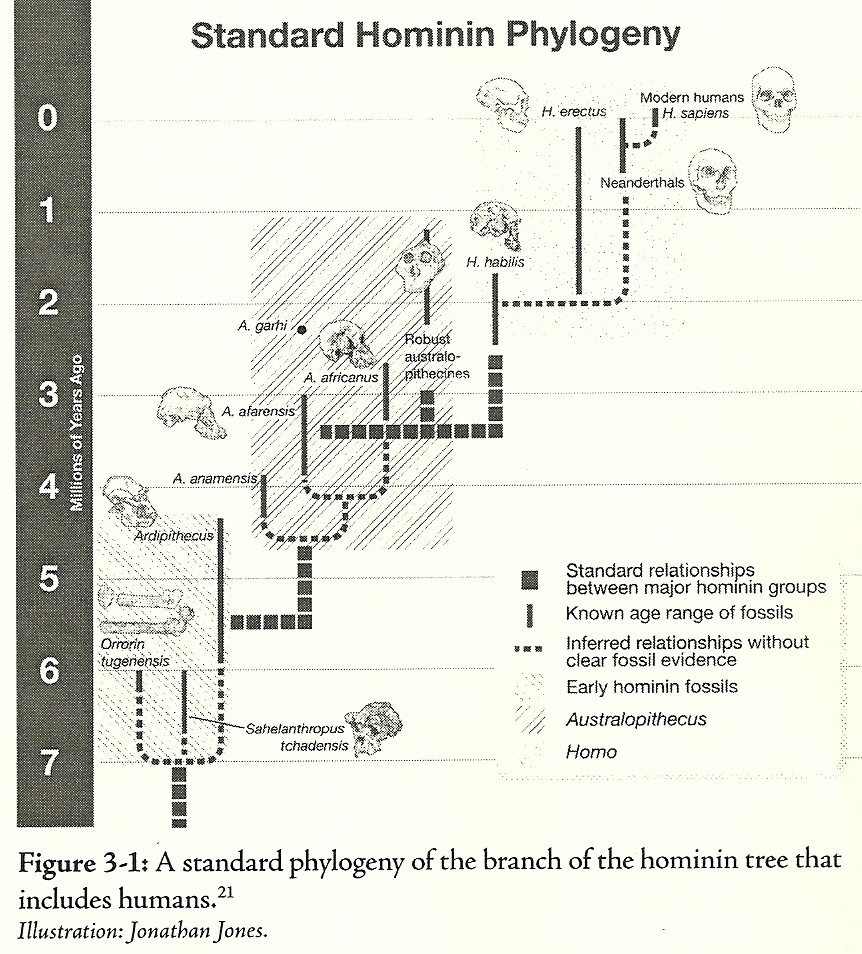
Below are synopses of the fossils believed to be within the ancestral line to humans; many of these are actually not considered in line anymore by mainstream scientists in paleoanthropology or primate studies.  A chart showing the traditional, party-line view of human evolution is also shown below (from page 49).

Toumai Skull (Sahelanthropus tchadensis):  This species is represented by one skull with jaw fragments.  ~6.5 million years old.  Reported on in 2002, it is now considered by many to be a gorilla or ape or at least not in the human line.  If this skull is ancestral to humans, then australopithecines can’t be (pp 50-51).

Orrorin (Orrorin tugenensis):  Only a few bones are known of this species, and they do not include a skull or jaw.  ~ 6 million years old.  Even though little can be determined about this species’ way of moving, the conjecture by some that it may have walked upright was enough to put it in the human line.  Human evolutionary thinking had made bipedal walking a necessary condition for a fossil to be included in the human line.  However, we now know that this can no longer be a litmus test.  Why?  Because an ancient bipedal ape was discovered, Oreopithecus bambolii.  This creature is clearly an ape, it walked bipedally, and it lived ten million years ago.  We now know that some human-like physical features, that scientists considered unique to our line, developed in other species in parallel.  Nevertheless,if this species is found to be ancestral to humans, then australopithecines can’t be (pp 51-54).

Ardi (Ardipithecus ramidus):  Extremely reconstructed from very crushed and very friable and chalky bone fragments (skull and other parts).  ~4.4 million years old.  Even though the reconstruction of this fossil should have raised big doubts about any interpretations regarding it, it was in the news big time.  Even Science magazine joined in in the hype:

Science magazine named Ardi the “breakthrough of the year” for 2009, and officially introduced her with an article titled “A New Kind of Ancestor . . . (p 55).

After other scientists finally got to look at these fossil remains–which took over 15 years to “reconstruct”–claims of its bipedality were not affirmed.  Not only that, but some scientists hinted, and others said out-right, that Ardi was not a hominid, was not bipedal, and was closer to being an ape or orangutan (pp 54-57).

Australopithecines:  Because there are more Australopithecine fossils than any other, and because one in particular had become so popular–Lucy–it’s a bit hard to say only a little about this group of species.  In 2006 there was much hype over two canine teeth found of the species called Austropithecus anamensis.  I will say it again and allow the information to sink in:  there was much hype over only two canine teeth.  In any case, the author of the A. anamensis technical paper is worth quoting since he confirms Luskin’s contention:

Until recently, the origins of Australopithecus were obscured by a sparse fossil record . . . . The origin of Australopithecus, the genus widely interpreted as ancestral to Homo, is a central problem in human evolutionary studies.  Australopithecus species differ markedly from [both] extant African apes and candidate ancestral hominids . . . (p 58).

Let’s look at Lucy, an Australopithecus afarensis with purportedly 40% of it’s bones found.   First off, it’s not clear that all the bones of Lucy are actually hers.  The bones were highly spread out over a gully and one of its hillsides.  Many scientists no longer think Lucy walked upright like we do, or even at all, basically.  She very clearly has knuckle-walking hands, which no one denies but some try to excuse.  It is unlikely, from an evolution theory point of view, that she would retain these characteristics if she didn’t use them.  But to make a further argument about her mode of moving, the supposedly evolved form of Homo habilis retains some of these features 2 million years later.  Unused characteristics will not hang around that long in an evolved species.

Also, a whole slew of bodily features show that Lucy was ape- or chimp-like and was not at all adapted to running.  Australopithecine ear canals (for balance and locomotion) are not like humans but similar to apes.  They have grasping toes.  Professional studies and papers from 1975 and 2007 suggest that Australopithecines should no longer be considered part of the human line (pp 57-65).

Homo habilis:  ~1.9 million years ago.  The well regarded anthropologist Ian Tattersall of the American Museum of Natural History said this species is “a wastebasket taxon, little more than a convenient recipient for a motley assortment of hominin fossils.”  Besides this suggestive statement (suggestive of the quality of analyses that had gone on), Spoor et al. in Nature (1994) reported that the ear canal of this species was closer that of a baboon, and another study from 1991 “found that the skeleton of habilis was more similar to living apes than were other australopithecines like Lucy” (p 66).  Another scientist stated that habilis “‘displays much stronger similarities to African ape limb proportions’ than even Lucy” (p 67).  This species is therefore not considered to be in the human line (pp 65-67).

Standard Hominin chart Wells0001

[GAP]:  There are no transitional fossils between Australopithecus and Homo.  About 2 million years ago cranial capacity of the human line suddenly about doubled.

Homo and Australopithecus differ significantly in brain size, dental function, increased cranial buttressing, expanded body height, visual, and respiratory changes” and, the authors of the paper said “We, like many others, interpret the anatomical evidence to show that early H. sapiens was significantly and dramatically different from . . .  australopithecines in virtually every element of its skeleton and every remnant of its behavior (pp 67-68). . . .  The anatomy of the earliest H. sapiens sample indicates significant modifications of the ancestral genome and is not simply an extension of evolutionary trends in an earlier australopithecine lineage throughout the Pliocene.  In fact, its combination of features never appears earlier” (p 68; from Journal of Molecular Biology and Evolution 2000, emphasis mine).

The earliest fossils of Homo, Homo rudolfensis and Homo erectus, are separated from Australopithecus by a large, unbridged gap.  How can we explain this seeming saltation?  Not having any fossils that can serve as missing links, we have to fall back on the time-honored method of historical science, the construction of a historical narrative (pp 69-70; Ernst Mayr 2004, emphasis mine).

Homo erectus:  Extremely similar to modern humans – probably only a subspecies (so it was actually human). ~ 2 million years ago.  Cranial capacity is on average smaller, but still within the overall range of modern humans (which is incredibly varied).

Neanderthals (Homo neanderthalensis):  Very similar to modern humans and now known to be something like a subspecies of modern humans.  In fact, DNA studies show that many modern humans have Neanderthal DNA in them.  ~ .75 million years ago.  Cranial capacity on average was larger than modern humans.

II.  Evolution Time

There are no transitional fossils between Australopithecus and Homo (and some scientists, at least, no longer think Australopithecus should even  be in the homo line).  Ok.  But what time frame is there between these two species of Hominin?  About 1.5 to 2.o million years.  And how many traits arose or need to have changed?  About 16, at least, and many of these have to have occurred together – they won’t work apart from one another, or on their own they could even be harmful to the creature(s).

Based on experiments that test the rate of change at the molecular level, this number of changes within the known time frame would have been impossible.  Considering how slowly, relatively speaking, these hominins would reproduce, evolving even one homo feature from australopithecine would be basically impossible in the time frame we know exists between these species.  Gauger states:

You don’t have to take my word for it.  In 2007, Durrett and Schmidt estimated in the journal Genetics that for a single mutation to occur in a nucleotide-binding site and be fixed in a primate lineage would require a waiting time of six million years.  The same authors later [2008] estimated it would take 216 million years for the binding site to acquire two mutations, if the first mutation was neutral in its effect (pp 24-25).

III.  Are Only Two Human Parents Possible?

In Ann Gauger’s “The Science of Adam and Eve” (chapter five), she presents the history of research into the diversity of certain immune defense genes.  She does this since persons in the past used these genes, which have tremendous variety in our genomes and the genomes of our “cousin” species, to prove that humans could not have come from only two parents (like Adam and Eve).  The science involved is of course specific and complicated and I will not attempt to give am in-depth summary of it here.  What I will say is that an original study (published in 1995) found that chimps and humans shared 32 alleles of this gene (HLA-DRB1), and later study cut that down to seven and showed a whole new complication that was a mystery (different portions of the same gene yielded wildly different results).

The results were mysterious because it turns out that even though the gene has 100s of allele variations (there are a number of HLA genes, and each has hundreds of alleles), most are not recombined and therefore are known as haplotypes.  These haplotypes are inherited in blocks, and there are very few of these in humans – five, in fact.  Three are very ancient and two are, well, not as ancient (~30 mya or more, and ~ 5 mya, based on current evolutionary assumptions), and one is not shared with chimps.  Each person can carry two different alleles of the HLA gene studied.  So it is now known to be in the realm of possibility that we all came from two parents only, each carrying two different HLA alleles.

The later study, and others, provided data that may also force a change in neo-Darwinian thinking.  This newer data show that we share genes with other species that are not common ancestors.  We have some gene sequences that are more closely related to gorillas than chimps, and we have sequences resembling those from macaques – animals that are not in our hominid group.  What does this data do to the whole concept of common descent?  (pp 103 – 121).

*      *      *

So what we end up with is a hominin family tree that, if a number of scientific studies and their conclusions are to be followed (the papers being in the major journals in their fields), would be gutted.  Continuous, gradual, evolutionary change in the hominin line?  No, not at all.  We also have the science of nucleotide-binding mutations indicating that there is no possibility, given the relatively short time frame, that any fossil currently thought to represent an ancestor in the human line could have evolved into a human.  Please read the book for more detailed information, but for checking out the references as well.

“Against Calvinism,” a counterpoint book by Roger E. Olson

Against CalvinismI believe someone needs finally to stand up and in love firmly say “No!” to egregious statements about God’s sovereignty often made by Calvinists.  Taken to their logical conclusion, that even hell and all who will suffer there eternally are foreordained by God, God is thereby rendered morally ambiguous at best and a moral monster at worst.  I have gone so far as to say that this kind of Calvinism, which attributes everything to God’s will and control, makes it difficult (at least for me) to see the difference between God and the devil” (p 23).

I’m not one to go out of my way to either belittle or cause a fight between Christians, but the fact that I bought and read this book is a testament to the harsh treatment I’ve received from (at least some) Calvinists.  From my understanding of God and scripture, the “new Calvinist” belittling of other Christians and fighting with them publicly is not of Christ.  The author of Against Calvinism is like minded, but has had even worse unChrist-like jewels thrown at him than I have, presumably because he is a professor.  He had students, anonymously and not, tell him he wasn’t a Christian and that he was going to hell – simply for not believing their interpretation of scripture.  Whenever I come across this behavior – insulting people personally instead of addressing the parts of scripture they point to for consideration – it raises a big . . . red . . . flag.  (And, of course, it’s a very bad witness for Christ.)

I’ve encountered this with the proponents of post-tribulation rapture as well, and after looking into the scriptural arguments for pre- mid- and post-tribulation raptures, the post-tribs seem to have the least going for them in my view.  And so they make personal attacks, saying that those who don’t go along with them are just wimps who can’t stomach the idea of going through the tribulation.   Me: “rolls eyes and is reminded of cults.”  But “new Calvinists” do the same thing.  Instead of making an effort to understand where non-Calvinists are coming from, they make incredibly insulting claims towards them that are very far from the truth.   They even have the audacity to call everyone who doesn’t agree with them Arminians (and the name calling has had the impact of turning that theology into a bad label), even though it’s obvious that they don’t understand that theology, and the additional audacity to make it seem that if you are Reformed, you are Calvinist.   This whole scenario should make anyone wonder how (or how well) they assimilate their own theology.

I have no interest in man-centered theology; I am intensely interested in worshiping a God who is truly good and above reproach for the Holocaust  and all other evils too numerous to mention.  Too many Calvinist authors misrepresent non-Calvinist theologies as if they are all man-centered, humanistic, less-than-God-honoring, and even unbiblical without ever acknowledging the problems of their own theology.  Too many young, impressionable followers have not yet figured out what those problems are.  I write this to help them (p 24).

I will argue throughout this book that high Calvinism is not the only or the best way of interpreting Scripture.  It is one possible interpretation of isolated texts, but in light of the whole witness of Scripture it is not viable.  Furthermore, I will argue that high Calvinism stands in tension with the ancient faith of the Christian church and much of the heritage of evangelical faith.  Some of its crucial tenets cannot be found before the church father Augustine in the fifth century, and others cannot be found before a heretic named Gottschalk (d. circa 867) or from him until Calvin’s successor, Theodore Beza (p 24).

As a note, it’s good to keep in mind that both Calvinism and Arminianism are theologies that do not fully reflect their namesakes – they both were altered some after Calvin and Arminius died.  Olson doesn’t cover all the aspects of this in his book, as they are not all necessary, but he does show clear evidence that Calvin did not write about, believe in, or adhere to “limited atonement.”  This is the “L” in “TULIP,” the acrostic for the five points of modern high Calvinism:  Total depravity, Unconditional election, Limited Atonement, Irresistible grace, and Perseverance.  “Four point” Calvinists do not adhere to limited atonement, but as limited atonement logically follows from the other four points and would be needed for the whole theological scheme to work, four point Calvinists are criticized both by high Calvinists and non-Calvinists alike for being inconsistent.

As I’ve seen in other written works, Olson points out that many persons who call themselves Calvinists are not actually Calvinists; in particular, many Baptists churches maintain traditional orthodox doctrine that is not Calvinist, yet they still seem to want to call themselves that.  There aren’t even any Baptist churches represented in the international organization, World Communion of Reformed Churches (WCRC).  It’s good, then, to see that another book I have here, which I’ll write about later (God willing), is written by a Baptist (C. Gordon Olson):  Getting the Gospel Right: A Balanced View of Salvation Truth (the cover shows a balanced scale with Arminianism on one side and Calvinism on the other).  A small book published by the Calvary Church group also presents a middle-ground approach, which that semi-denomination adheres to:  The Five Points of Calvinism: “Weighed and Found Wanting” (George L. Bryson).  Many of the books that Roger Olson uses and recommends are listed at the end of this post.  Three links for further reading now are also provided.

In the title of this post I wrote that Against Calvinism is a counterpoint book.  I used that term because Zondervan published For Calvinism first, and this book is the good or evil twin of that one – but Zondervan doesn’t appear to have a name for these related books (like a counterpoint series or something along those lines).  Olson calls his book little, but it’s not, really.  It has fairly small print and lots of details, though it is smaller compared with the other Olson book mentioned above (Getting the Gospel Right appears to cover more verses, passages, and various interpretations more specifically).

The point is, it has a lot in it, and it’s been hard to decide what to include in this post.   First, I’ll do the obvious thing and briefly outline the main points of high Calvinism, together with counterpoints.   Second, I’ll provide statements and/or questions that typical “new Calvinists” make, with Olson’s responses (some truncated).   And lastly, I’ll include Olson’s mini instructive scenarios that illustrate the different views of salvation grace as they are found in Semi-Pelagianism (it’s a person’s choice), Monergism (Calvinism – it’s all God’s choice), and Evangelical Synergism (Protestant Arminianism – it’s both a person’s choice and God’s choice).  Of course, for the detailed information with all the technical terms, read Olson’s book.

Main Points of High Calvinism with Counterpoints, Briefly Stated

T = Total Depravity.  This refers to humans’ total spiritual depravity, or their spiritual deadness.  Since we are spiritually dead, God needs to intervene in order for us to be regenerated.  Non-Calvinists don’t have much argument with this in general – it is the method and timing of regeneration that is at issue (see the other letters in the TULIP).

U = Unconditional Election.  This refers to being elected by God to salvation, and the believer being predestined.  All Christians believe in election, but not all believe that God chooses people and passes over other people only because God decided specifically.  Calvinists believe people have nothing at all to do with it – they don’t respond to the Gospel themselves – and that it is only God’s choice.  This logically leads to the doctrine of double predestination: there are people chosen by God to go to heaven and the others are chosen to go to hell.  This abrogates human responsibility and so is deemed immoral by non-Calvinists.

L = Limited Atonement (or particular redemption).  Non-Calvinists and some Calvinists (four-pointers) reject the idea of limited atonement outright as being unbiblical.  It denies the plain and supported meanings of  verses like 1 John 2:2, 1 Timothy 4:10, and others, that convey that Christ’s blood was and is enough for all (if the whole world accepted Christ’s work and God’s gift, Christ’s sacrifice would be enough to cover everyone).  Calvinists of course use other verses to support their theology, and try to explain away verses that say that Christ died for all.  They claim that God intended Christ’s blood for the elect only; as such, they cannot preach to an open crowd that “Christ died for your sins.”  Olson goes into detail about this (in chapter six).  As Olson wrote, “To paraphrase John Wesley, this seems to be such a love and compassion as makes the blood run cold” (p 49).

I = Irresistible Grace (or effectual or efficacious grace, or Monergism).  This seems to be the most flagrantly or glaringly contradictory claim of the lot.  While Calvinists say that God draws the elect – only – and they cannot resist it (it’s irresistible), they also claim (somehow) that it’s not forced on those chosen.  Huh?  Well yes, in Calvinism it is forced on them.  God changes their hearts without their permission; it’s only after God does this that they respond to him, in fact.   Since people are dead spiritually and can’t respond in any case, in Calvinism, it is all God’s doing.  In non-Calvinistic theologies, God has provided a type of grace that draws all people first – some accept this draw and some reject it.  “The ordinary message of the gospel for most evangelical Christians is ‘believe and be saved,’ based on Scripture passages such as John 3:1-21, in which Jesus tells Nicodemus that he must be born again and that belief in him will accomplish that (v. 14).  There is really no way to reconcile this passage with belief that regeneration precedes faith” (p 52).

P = Perseverance.  This doctrine is the least controversial and is not really discussed much by Olson.  He points out that Lutherans and Free Will Baptists reject it, but that Arminius hadn’t made up his mind about it.

Excerpts from “Responses to Calvinist Claims” (pp 188 – 192)

“1.  Any other view of God’s sovereignty than Calvinism diminishes the glory of God; only ‘the doctrines of grace’ fully honor and uphold God’s glory.  It all depends on what “God’s glory” means.  If it means power, then perhaps this is correct.  But power isn’t glorious except when guided by goodness and love.  Hitler was powerful but obviously not glorious.  Jesus Christ revealed God as ‘our Father’ and therefore as good and loving.  In fact, high Calvinism (TULIP), wrongly labeled ‘the doctrines of grace’ by Calvinists, diminishes God’s glory by depicting him as malicious and arbitrary.  Furthermore, if Calvinism is correct, nothing can ‘diminish the glory of God’ [including real or perceived views of him] because God foreordained everything for his glory.”

“2.  Non-Calvinist theologies of salvation, such as Arminianism, make salvation dependent on good works because the sinner’s decision to accept Christ is made the decisive factor in his or her salvation.  It seems more the case that Calvinism makes salvation dependent on good works or something good about person elected to salvation, or else how does God choose them out of the mass of people destined for hell?  It’s either something God sees in them, or else God’s choice of them is arbitrary and capricious.  Furthermore, Arminian theology does not make salvation dependent on good works; all the ‘work’ of salvation is God’s.  The sinner is enabled to repent and believe by God’s prevenient grace and the bare decision to accept God’s salvation is not a good work; it is simply accepting the gift of grace. . . . ”

“5. Only Calvinism can account for God’s sovereignty over nature and history; unless God foreordains and controls every event, down to the smallest puff of existence and down to every thought and intention of the mind and heart, God cannot be sovereign.  This is not what ‘sovereignty’ means in any human context.  A human sovereign is in charge but not in control of what goes on in his or her realm.  God can steer the course of nature and history toward his intended goal and assure that they reach it without controlling everything.  God is like the master chess player who knows how to respond to every move his opponent makes.  There is no danger of God’s ultimate will not being done.  In fact, Calvinism cannot explain the Lord’s Prayer that teaches us to pray, ‘Your will be done on earth as it is in heaven,’ which implies that God’s will is not already being done on earth.  According to Calvinism, it is!”

“7. Reformed theology, Calvinism, is the only solid foundation for conservative, biblical Christian theology.  All other approaches, such as Arminianism, a man-centered theology, inevitably lead to liberal theology.  Arminianism is not a ‘man-centered theology’ but a God-centered theology.  It is driven entirely and exclusively by a vision of God’s unconditional goodness and love.  The one main reason Arminians and other non-Calvinists believe in free will is to preserve and protect Cod’s goodness so as not to make him the author of sin and evil.  Calvinism makes it difficult to recognize the difference between God and the devil except that the devil wants everyone go to hell and God wants many to go to hell.  Arminian theology does not lead into liberal theology.  If anything, Calvinism does that.  Friedrich Schleiermacher, the father of modern liberal theology, was a Calvinist!  He never even considered Arminianism; he moved right from conservative, high Calvinism to universalism while holding onto God’s meticulous providence even over evil.  Most of the nineteenth-century liberal theologians were former Calvinists who came to abhor its vision of God and developed liberal theology without any help from classical Arminianism. . . . ”

8. God has a right to do whatever he wants to with his creatures and especially with sinners who all deserve damnation.  His goodness is shown in his merciful rescue of some sinners; he owes nothing to anyone.  Those he passes over deserve hell.  While it may be true that everyone deserves hell, although even many Calvinists hesitate to say that about children, God is a God of love who genuinely desires all people to be saved, as the New Testament clearly testifies in 1 Timothy 2:4 ‘who wants all people to be saved and to come to a knowledge of the truth.’  There is no way to get around the fact that ‘all people’ means every single person without exception.  The issue is not fairness but love.  A God who could save everyone because he always saves unconditionally but chooses only some would  not be a good or loving God.  He would certainly not be the God of 1 Timothy 2:4 and similar passages.’

“11. Non-Calvinist theologies such as Arminianism believe in something that is impossible: libertarian free will–belief that free decisions and actions simply come from nowhere.  Calvinism and some other theologies, as well as many philosophers, know that ‘free will’ simply means doing what you want to do and people are always controlled by their strongest motives, so being able to do otherwise–libertarian free will-is an illusion.” [Apparently, these people never make tough decisions based on multiple choices, like over which house or car or whatever to buy, where to go to college, which job to take, etc. etc.]   “If ‘free will’ only means doing what you want to do even though you couldn’t do otherwise, how is anyone responsible for what they do?  If a murderer, for example, could not have done otherwise than murder, then a judge or jury should find him not guilty–perhaps by reason of insanity.  Moral responsibility, accountability, and guilt depend on ability to do otherwise–libertarian freedom.  The Calvinist view of ‘free will’ isn’t really free will at all. . . .”

Mini Scenarios that Illustrate Different Views of Saving Grace (pp 172 -173)

First, imagine a deep pit with steep, slippery sides.  Several people are lying broken and wounded, utterly helpless [reflecting our fallen and depraved nature], at the bottom of the pit.

  • Semi-Pelagianism says that God comes along and throws a rope down to the bottom of the pit and waits for a person to start pulling on it.  Once he does, God responds by yelling, “Grab it tight and wrap it around yourself.  Together we’ll get you out.”  The problem is, the person is too hurt to do that, the rope is too weak, and God is too good to wait for the person to initiate the process.
  • Monergism says God comes along, throws a rope down into the pit, and climbs down it, wrapping it around some of the people and then goes back out of the pit and pulls them to safety without any cooperation.  The problem is that the God of Jesus Christ is too good and loving to rescue only some of the helpless people.
  • Evangelical synergism says that God comes along and throws a rope down and yells, “Grab onto it and pull and together we’ll get you out!”  Nobody moves.  They are too wounded.  In fact, for all practical purposes they are “dead” because they are utterly helpless.  So God pours water into the pit and yells, “Relax and let the water lift you out!”  In other words, “Float!”  All a person in the pit has to do to be rescued is let the water lift him or her out of the pit.  It takes a decision, but not an effort.  The water, of course, is prevenient grace.

*       *       *

Thanks for reading, and let me leave you with some verses worth considering.

“My brothers, some from Chloe’s household have informed me that there are quarrels among you. What I mean is this: One of you says, “I follow Paul”; another, “I follow Apollos”; another, “I follow Cephas”; still another, “I follow Christ.” Is Christ divided?  Was Paul crucified for you?  Were you baptized into the name of Paul?” (1 Corinthians 1:11-13).

““My [Jesus’] prayer is not for them alone [those living at that time]. I pray also for those who will believe in me through their message, that all of them may be one, Father, just as you are in me and I am in you. May they also be in us so that the world may believe that you have sent me. I have given them the glory that you gave me, that they may be one as we are one: I in them and you in me.  May they be brought to complete unity to let the world know that you sent me and have loved them even as you have loved me” (John 17:20-23, emphasis added).

With how divisive and divided Christ’s church is today, how can those looking in from the outside see that God sent Christ?  Can our lack of unity, and sometimes vicious acts toward one another, actually imply that God cannot accomplish what Jesus prayed for (so they are basically false)?  I don’t know the answer for sure, since it’s all too obvious that Christians have chosen men to be leaders in the faith over Christ as the head; I don’t know how that can change in actual application.  And, considering what Paul had said (in the quote above), it seems it may be true that the great apostasy already had started in the early church.  Pray for more unity as well as guidance from the Holy Spirit for all.

*       *       *

For further reading on this subject right now, go to Molinism vs Calvinism, at Reasonable Faith (if you read this to the end then know, too, that some Calvinists have altered Molinism to fit into Calvinism more, and Olson has a small section on this in his book),  Confessions of an Arminian Evangelical, and Calvin’s Comeback? The Irresistible Reformer (in The Christian Century – you need to register to read it).

*       *       *

Recommended readings from “Against Calvinism” (in alphabetical order by title, excluding The and A):

Arminian Theology: Myths and Realities (Roger Olson, InterVarsity Press 2006).

The Doors of the Sea: Where was God in the Tsunami? (David Bentley Hart, Eerdmans 2005).

The Freedom of God: A Study of Election and Pulpit (James Daane, Eerdmans 1973).

God’s Universal Salvific Grace (Vernon C Grounds, Bethany 1975).

The Great Debate: Calvinism, Arminianism, and Salvation (Alan PF Sell, Baker 1982).

Is God to Blame? (Gregory A Boyd, InterVarsity Press 2003).

A Scandalous Providence: The Jesus Story of the Compassion of God (E Frank Tupper, Mercer Univ. Press 1995).

The Transforming Power of Grace (Thomas Oden, Abingdon Press 1993).

What the Bible says about God the Ruler (Jack Cottrell, Eerdmans 1991).

Whosoever Will: A Biblical-Theological Critique of Five-Point Calvinism (DL Allen and SW Lemke, editors, Broadman & Holman 2010).

Why I Am Not a Calvinist (J Walls and J Dongell, InterVarsity Press 2004).

On Skyrim: A Vent from a Christian Parent (a mom who plays)

Fighting a dragon in Skyrim.  From http://www.industrygamers.com/news/ps3-skyrim-its-not-nearly-as-bad-as-it-seems/
Fighting a dragon in Skyrim. From http://www.industrygamers.com/news/ps3-skyrim-its-not-nearly-as-bad-as-it-seems/

Maybe you’ve come here before and read one or more of my posts on Skyrim.  If you haven’t, and you’re a parent interested in knowing more about the game, please also read my earlier review for parents.  It would probably be better if you read that one first, actually, since it presents the positive aspects of the game.  And just by way of warning, there are all kinds of spoilers in both posts.

I decided to write this not because I didn’t know about some unpleasant things about Skyrim before (though I know more now) – from a Christian perspective – but out of frustration over the questions presented on a major website.  A great percentage of these questions show that a lot of young people like to play all of the bad aspects of the game, and miss the complexities.  If you are a Christian and let your teen play without watching and knowing what they’re doing, maybe you’ll want to.  My son hasn’t played lately, but when he did, he liked to play bad characters once to see what they were about.  I didn’t like that he played some of the roles he had, but I talked with him about it.  It gave me an opportunity to find out what he thought of things presented in the game, and if he did something bad in the game, how that might or might not reflect on his real-life actions and attitudes.

There are certain things that I really didn’t want him doing, and he didn’t – like selecting the perk where your character will be able to cut people’s heads off.  This is bad enough in quick game play, but in Skyrim slow-motion, close-up cut-scenes happen randomly and they would include the slicing off of heads.  If a parent is concerned about what their child can select as perks, they can easily see all available perks from the perk trees, viewable after selecting the Skills menu.

The problem with Skyrim is that it is made by a corporation seeking the largest possible market (the Elder Scrolls series did not start out this way, and previous games were more specifically moral).  While the Dovahkiin – your character, the Dragonborn – is SUPPOSED to be a good SAVIOR type of figure, the player can choose to do all kinds of evil things.  Not only that, but there is quite a bit more to do in the game if the player decides to do these bad things.  Please watch the video below to hear the theme song, which is awesome, and read the words of the song.  They talk of the character of the Dovahkiin and of the main quest of the game (though there is a secondary main quest too).

As a parent, you may want to know more specifically about what I’m talking of in order to decide if you want to limit your kid’s game play in these areas.

1)  The Thieves Guild.  In past Elder Scrolls games, the Thieves Guild was more like a Robin Hood sort of organization.  In Skyrim it is not, and it is controlled by Mavin Blackbriar, a super evil, powerful, business woman who has a whole heck of a lot people fooled.  The most disturbing thing about Skyrim, when I first started playing, was finding out that you cannot get rid of Mavin and stop her murders and mafia-like activities in Riften – even though it seems like the game-makers intended to let you do something.  By the way the characters in Riften talk, and by the notes you find, it seems as though bringing Mavin to justice will be a quest . . . but in the end you can’t do anything about her.  In any case, there are lots of quests to do with the Thieves Guild and lots of items unique to the guild to be had, so it would be tempting to a lot of people to be in this guild.

2)  The Dark Brotherhood.  These are assassins for hire.  Mavin is in with them too.  You get the picture.  Again, quests and loot . . . so it’s tempting to play as a bad guy.

3)  Vampires.  The Dawnguard expansion allows the player to be a vampire, but the main idea is to be a part of the Dawnguard – vampire slayers.  The castle with the vampires is pretty disgusting and I think the game makers did an OK job of making vampires a negative thing, while still providing a mass-market expansion.  Vampires of course feed on humans.

4)  Werewolves and the Companions.  Being a werewolf in Skyrim can be only a matter of being stronger once a day, but there is the option to feed off of a human (cannibalism) in order to maintain the form a bit longer. With the Dawngaurd expansion, however,  it can get nastier.  Dawnguar adds a werewolf perk tree, and unlike the other perk trees, perks can only be ge gained by eating human hearts.  Yeah, gross.   There is a non-Companions quest in Skyrim that conveys the evilness of lycanthropy.  I not only included the Companions here because it is the group where you acquire lycanthropy, but I wanted to mention the less than charitable intentions of the Companions.   They only do good works if they’re paid, and one gets the impression that the more they are paid, the more likely they will be to go out and actually do the job.   A good thing about the Companions is that you get the opportunity to cure the leader of his werewolfism, which he very much desires.

As discussed in my original review, Skyrim is a complex game if played the way it was meant to be played.  One quest that I found to be bad, that seems like a good thing to do at first, is the Gildergreen quest.  In this quest, you are to recover an evil blade (hey, a clue there), which is needed in order to collect the sap of a certain tree.  The reason you need this sap is to revive the Gildergreen tree in Whiterun.  Before you revive it, it looks dead; afterwards it looks alive and vibrant, with purple flowers.  So WHY would that be a bad thing?  Well, you wouldn’t really know at first.

The first hint is the evil blade, but then, a lot of things in Skyrim are just things and don’t necessarily live up to their names.  But there is another hint.  When you go to where the mother tree is, which is in a very large, beautiful, and tranquil lit cavern, you encounter some people there enjoying the sanctuary.  When you talk with the lady there, you can ask her about the tree and the blade, and she responds very negatively to you.  Ok.  So . . . what do you do?  It doesn’t seem that bad or anything – you just want to revive the tree in Whiterun.  But what happens, no matter how hard you try to control the situation, is that the persons in the sanctuary get killed by the guardian Spriggons when you cut the mother tree for its sap.  Is reviving an old tree in Whiterun worth the lives of those people?  Not in my book.  The Whiterun folks can get a new tree!

I think the Gildergreen quest is actually a good lesson in deciphering information and choosing to do the better thing.  Skyrim is full of mental and moral exercises such as the Gildergreen quest.  A problem with this, however, as with the evil groups and quests in Skyrim generally, is that the player must choose not to do a lot of available game play.  As an adult I’m not very tempted to join the evil groups and do evil things, but for a lot of young people these might be tempting (especially in the presence of peer pressure).  I do think Skyrim has A LOT going for it compared to other games: visual and musical beauty, complexity (good luck trying to decipher all the purposefully conflicting books and dialogue regarding the history and religion of not only Skyrim, but that of the continent it’s on, Tamriel), historical and mythological aspects, etc.  As a Christian parent, I think it’s OK for older kids to play as long as the parent(s) knows about the game and is at least somewhat involved with their kid’s gameplay.

[Section on lycanthropy updated on Jan. 23, 2013]

“Screw Calm and Get Angry” Quotes

Ebury PressScrew Calm and Get Angry is a little chunky hardcover published by Andrews McMeel Publishing, LLC (Kansas City 2010).  Little chunky books are just so hard not to look into, to savor,  to roll in one’s hands like a lollipop in the mouth.  So yeah, I enjoyed it.

Even though this book isn’t new, I just saw it for the first time last month.  Here are some fun quotes from it, and don’t worry if you are offended by one, since you’ll find another you agree with (the quotes are from a whole range of political, religious, and philosophical views):

How fortunate for leaders that men do not think.  Adolf Hitler

We hang the petty thieves and appoint the great ones to public office.  Aesop

The world is a dangerous place, not because of those who do evil but because of those who look on and do nothing.  Albert Einstein

There may be times when we are powerless to prevent injustice, but there must never be a time when we fail to protest.  Elie Wiesel

Start off every day with a smile and get it over with.  W.C. Fields

The modern conservative is engaged in one of man’s oldest exercises in moral philosophy, that is, the search for a superior moral justification for selfishness.  J.K. Galbraith

Let us be grateful to the mirror for revealing to us our appearance only.  Samuel Butler

Nobody really cares if you’re miserable, so you might as well be happy.  Cynthia Nelms

In our civilization, and under our republican form of government, intelligence is so highly honored that it is rewarded by exemption from the cares of office.  Ambrose Bierce.

You can’t say civilization don’t advance . . . for in every war they kill you in a new way.  Will Rogers

I know God will not give me anything I can’t handle.  I just wish that he didn’t trust me so much.  Mother Teresa

If you wake up and you’re not in pain, you know you’re dead.  Russian proverb

Life is not so bad if you have plenty of luck, a good physique, and not too much imagination.  Christopher Isherwood

It is only by not paying one’s bills that one can hope to live in the memory of the commercial classes.  Oscar Wilde

The modern banking system manufactures money out of nothing.  Perhaps the most astounding piece of sleight-of-hand that was ever invented.  Banking was conceived in inequity and born in sin . . .  But if you want to continue to be slaves of the bankers and pay the cost of your own slavery, then let the bankers continue to create money and control credit.  Josiah Charles Stamp

Advertising may be described as the science of arresting the human intelligence long enough to get money from it.  Stephen Leacock

Criminal:  A person with predatory instincts who has not sufficient capital to form a corporation.  Howard Scott

Money:  There’s nothing in the world so demoralizing as money.  Sophocles

It is better to keep your mouth closed and let people think you are a fool than to open it and remove all doubt.  Mark Twain

That men do not learn very much from the lessons of history is the most important of all the lessons that history has to teach.  Aldous Huxley

A life spent in constant labor is a life wasted, save a  man be such a fool as to regard a fulsome obituary notice as ample reward.  Georgy Jean Nathan

I like work; it fascinates me.  I can sit and look at it for hours.  Jerome K. Jerome

Apparently, a democracy is a place where numerous elections are held at great cost without issues and with interchangeable candidates.  Gore Vidal

Politics is supposed to be the second-oldest profession.  I have come to realize that it bears a very close resemblance to the first.  Ronald Reagan

Politics, N[oun].  Strife of interests masquerading as a contest of principles.  The conduct of public affairs for private advantage.  Ambrose Bierce.

Only two things are infinite, the universe and human stupidity, and I’m not sure about the former.  Albert Einstein

Skyrim: Dragonborn DLC, a Christian’s View

Seeker from Bethesda
A Seeker in Apocrypha. Copyright, Bethesda.

The “Dragonborn” addition to the Skyrim video game, which came out earlier this month (December 2012) for XBOX, has – I think – the most “Christian” oriented content overall (in Skyrim, not the other Elder Scroll games).  I wish I had written down certain dialog as I played it with my high-level character, but I simply wasn’t expecting anything out of the ordinary to takes notes on!  (If I start a new game, it will be some time before I can get to those dialogs again – for now, this commentary without quotes will have to do.)

This latest DLC adds additional land mass via a large island known in the Elder Scroll series as Solstheim.  (Update of Dec. 24:  it appears to be playable from the beginning of a new game, as I went to Soltstheim at level 6, after I fought my first dragon and made my way to Windhelm).  It is no doubt loved by Elder Scroll fans since it brings in elements from Morrowind (the home of the Dunmer, or Dark Elves), and indeed, the flavor of the place is quite a bit different from Skyrim (the home of the Nords).  There are various quests to be found and accomplished, but the main quest involves the defeat of the first dragonborn, Miraak, who still exists after ages because of his service to Hermeus Mora, the powerful spirit being of knowledge and fate.  Miraak desired power and thus made a “pact with the devil” – a safe allusion to Mora and his top minion.   The DLC takes place when Miraak has used his powers to enslave the sleeping minds and bodies of the denizens of Solstheim, whom he is using to build a temple to himself.  Miraak has only a small amount of dialog, but that small amount sounds an awful lot like satanic desires and promises.  In addition, he has his hypnotized followers say things that are a copy, and thus a sick mockery, of true spiritual expression.

What’s interesting, from a Christian-in-the-current-world point of view, is that Hermeus Mora’s realm is called Apocrypha.  (“Apocrypha” are extra-biblical writings of various qualities some are legitimate but have some textual or factual issues, while others are outright forgeries with false “witness”).  It is dark and hazy and is made up of books (literally – the walls are made of books), and all underneath and around walkable areas is a very black sea.  This “sea” has black slithery arms coming out of it all of the time, and they will whip you and hurt you if they can.  The most dangerous creatures that stalk the place look very much akin to the old “creature from the black lagoon.”  The other dangerous creatures are “seekers,” whose hideous appearance includes a lamprey-like mouth where their stomach is.  These seekers of “knowledge” are never satisfied, but devour what their gut desires and not what their heart and mind discerns as true.  This is my take on them, anyway, which I see as the problem with seeking and using secret – usually false – knowledge, and which is the point of this dark and eery place.

When it comes to Christianity, God chose to communicate with man and it was His desire to be known and understood.  Those who purport to have “secret” knowledge of Him in order to steer someone away from God’s revelation, are not working within God’s desires for mankind.

On the other side of the coin are the Skaal of Solstheim.  They are Nords of the ancient way and claim to have been given Solstheim by the All-Maker.  They believe in one creator God, and the way they talk about creation and how we are to be in it, generally fits in with the Judeo-Christian biblical message.  You can have an interesting conversation with Wulf Wild-Blood of the Skaal, who asks you if you can find his run-away brother whom he believes turned into a werebear (like a werewolf, only a bear).  His brother could go down that path only be rejecting the call of the All-Maker.  While the Skaal have beliefs that mesh with scriptures, they have others that do not – they believe in reincarnation.  Conversations with fellow Skyrim players  about how reincarnation doesn’t at all mesh with a loving creator God, and how it is wholly incompatible with Christ’s message and work, is a possible real-world benefit of playing this game.*

If, as a Christian, you will only play games that have pure Christian messages and signs, then Skyrim and Dragonborn aren’t for you.  But if you want to play a game that actually gives a nod to God and certain Judeo-Christian beliefs and virtues in today’s world, then Skyrim is an OK game for that.  I wrote about Skyrim earlier, here.  That review by no means covers all the aspects of Skyrim.  There are things about the game I don’t like and scratch my head at, wondering about the game maker (Bethesda) every time I think of them (there are aspects of the game you can only play if you decide to do bad and dishonorable things).

Hopefully I’ll be able to flush this review out in the future, with quotes and such.  In the meantime, enjoy the Dragonborn and listen to the new leader of the Skaal:  do not follow Hermeus Mora, but follow the path laid out for you (and to the Skaal, this would be by the All-Maker).

* These last two sentences were edited in after the initial posting of this review (12-20-12).

A post that updates, or adds to, this post can be found at Dragonborn DLC Playability and the Skaal Religion.   Thanks!

I lost the men in my family to DayZ

DayZ Official Site banner.

In line with encouraging circumstantial thinking, like “When life gives you lemons, make lemonade,” I’m making the most of the video game DayZ by sharing with you its addictive qualities.  The men in my family team-it-up in this multi-player online game, and the survival aspect is so intense it’s like they’re literally out in a gorilla warfare battlefield.  Consider yourself forewarned if you haven’t played DayZ yet, and I’m assuming that’s the case since if you had, you’d be playing it right now instead of reading this.

DayZ is actually a mod made for the military simulation game, ARMA 2.  This mod places the player in an apocalyptic zombie world of survival, but it’s the other online players that are more often the real danger.  This game is not anything like shooter zombie games such as Left4Dead.  Sure, you shoot zombies if you want to, and no doubt you’ll have to, but they are often slow or relatively easy to deal with.  Well, during the day, anyway.  Most online players, however, are just really horrible individuals.  I say that so generally because as far as I and the men can tell, the vast majority are snipers, bandits, hackers, etc.–we’re guessing 80% to 95% of all players fall into these categories.   Most will shoot you on site, which is really a “jerk” (that’s putting it kindly) move since when you die, you lose any of the hard-won items you may have found.

A good little background summary from Wikipedia:  “The mod places the player in the fictional post-Soviet state of Chernarus, where an unknown virus has turned the population into zombies.  As a survivor with limited supplies, the player must scavenge the world for supplies such as food, water, weapons and medicine, while killing or avoiding both zombies and other players – in an effort to survive the zombie apocalypse.”

When you first spawn, you start out with only a flash light, a bandage, and pain-killers.  Wow!  Nothing to fight off zombies with.  You must scavenge for even the most rudimentary weapons, such as an ax or crowbar.  There are of course a whole variety of guns in the game, but you must find ammo too, and unlike many online games, you have limited backpack space.  You can become injured easily in the game and require morphine, blood packs, or even hospital care, in order to survive; playing as a team, the men help each other out with drugs, blood transfusions, that sort of thing.  You might very well  imagine playing the game for some time without really getting too deep into it yet, before some unpleasant fella (gamer, not zombie) murders you.

Which brings me to a well-known YouTube player called FrankieonPC.  He’s generally a good guy and has done some pretty awesome stuff, with the help of some friends.  He has shown that the game has a surprising range of multi-player capabilities.  In one video where he has gotten rid of some bad guys (he, along with some other hero players, rid the servers of snipers and bandits – this really takes skill when the snipers simply bump people off upon spawning) and raided some hacker stashes, he calls all good folk to a church.  They arrive on a bus.  Can you believe it?  There are usable buses in the game, and you can see all the people – online players – riding in the bus.  Anyway, Frankie has dumped the weapons from the hackers in the church and anyone is free to take what they want.  This is very cool and warm and fuzzy, and then . . . someone bombs the church!

Besides buses, there are helicopters, trucks, cars, ATVs, and even bikes, though none of these are common.  Vehicles can be found (or stolen), though they may need to be fixed.  Not surprisingly, you will make a desirable target as a vehicle driver.   The game is open and huge, and has an awesome markable map available.  Servers vary in their difficulty level (there are fewer people on the higher level servers), and they may have other differences, like vehicle spawn rate, day or night only play, and so on.

The men that I’ve lost to DayZ say that what they like most about the game is killing bandits and saving bambis (that is, newb players that are easy targets for the snipers and bandits).  They like working together under pressure, helping each other survive, and finding vehicles and fixing them.  The difficulties they’ve encountered include hackers with over-powered weapons, fatal glitches (like from doors and stairs), and not being able to see at night, at all, as if it were always a new moon.  And, of course, they love the challenge of surviving longer than the average time of 1 hour and 8 minutes, or whatever the current figure is, as kept at the DayZ site.